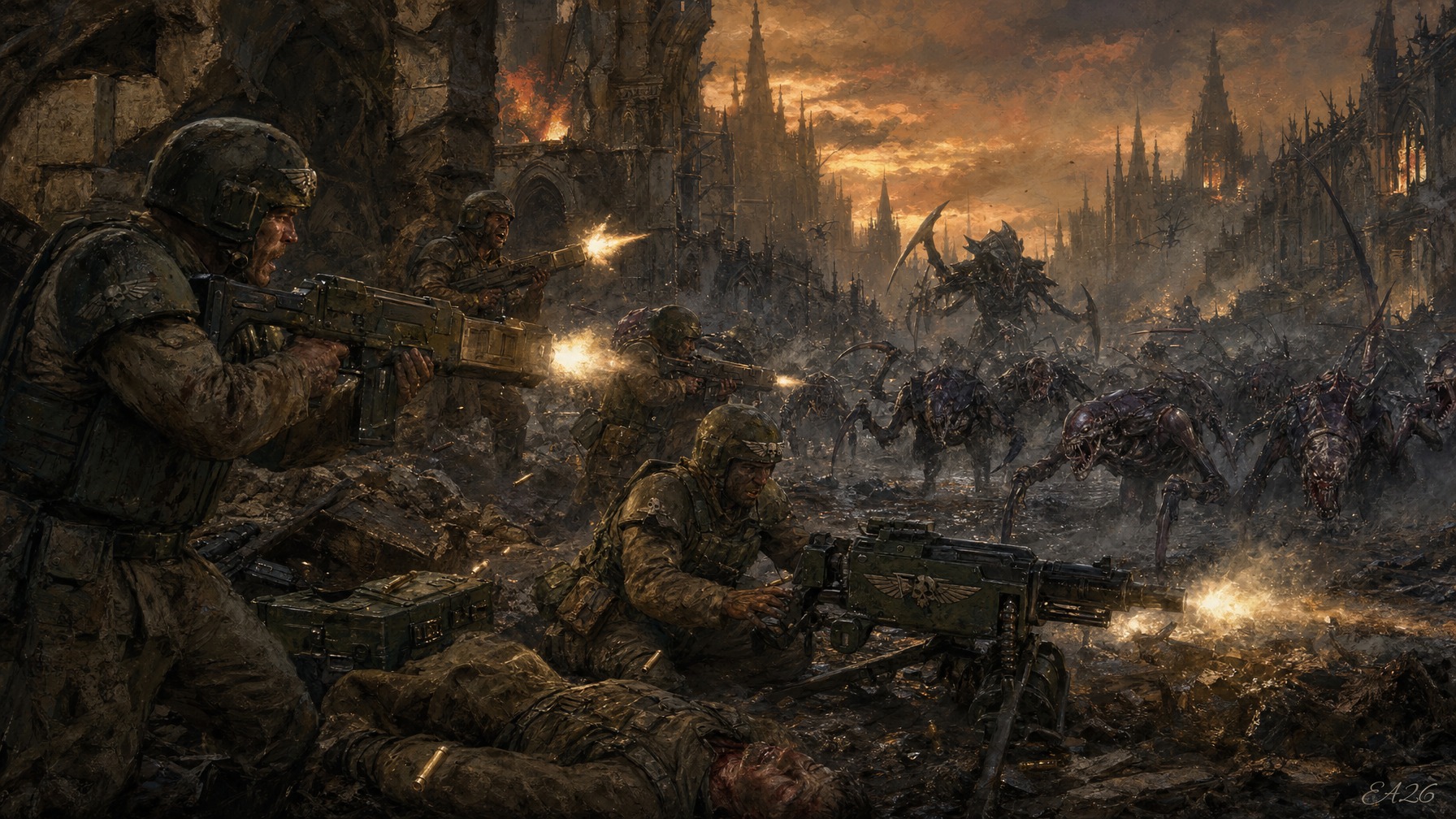
Gothic Prompts
Gothic is not a black filter: it is verticality and decay — the prompt builds height and lets it crumble.
About Gothic prompts
Generated gothic fails as a color grade: dark clothes, dark rooms, a raven somewhere. Real gothic is an argument between two forces — the upward reach of pointed arches, spires, and elongated figures, and the downward pull of moss, rust, and candle soot. Strip one away and you have either a cathedral brochure or a haunted house.
So the prompt's job is to state both forces and where they meet. Name the architecture by its bones ("pointed arches", "ribbed vaults", "flying buttresses") and the decay by its texture ("lichen on the stonework", "wax pooling on the balustrade"). Light comes from one low, warm source — a candle, a brazier, a stained-glass window at dusk — because gothic shadows are load-bearing.
The style rewards specificity about materials: iron, velvet, bone, old paper. The prompts below are tested with their real outputs — the strongest ones could be mistaken for a conservator's notes on a building that is still, barely, standing.
How to write Gothic prompts
- 1Name gothic architecture by its structural vocabulary: "pointed arches", "ribbed vault ceiling", "traceried windows". "Gothic castle" gives you a theme park; the bones give you the style.
- 2Pair every ornament with its decay: "gilded frame, tarnished", "embroidered velvet, moth-eaten at the hem". The genre lives in that comma.
- 3Use one low, warm light source: "a single candelabra", "dusk through a rose window". Overhead or ambient light flattens the vertical drama.
- 4Stretch figures and frames vertically: "elongated silhouette", "a doorway too tall for its width". Gothic proportion is aspiration made physical.
- 5Ground it in materials with history: "wrought iron", "bone", "vellum", "smoked glass". Plastic-smooth surfaces break the spell faster than any wrong color.
Frequently asked questions
Why does my AI gothic image just look like a dark photo?
Because darkness is the surface, not the structure. Add the two real ingredients: vertical architecture (pointed arches, spires, tall narrow openings) and visible decay (moss, tarnish, candle soot). Then light it from one low warm source. Gothic is height plus time, not a dimmer switch.
How do I keep gothic ornate without it becoming cluttered?
Choose one ornate element and one decayed element, and keep everything else plain: an elaborately carved arch over plain stone, a jeweled chalice on a rough wooden table. The contrast is the style; uniform ornamentation is a catalog page.
Does gothic work for AI video?
Yes — lean on slow vertical camera moves and flickering single-source light. A tilt up a candlelit stairwell or a slow rise past ribbed vaults does more than any amount of fog. Fast cuts and bright fill light are what break it.