AhaPrompt
Prompts
Featured
Models
Submit
Blog
Home
AI Prompt Library
Horror
Horror Prompts
Explore the best Horror prompts for AI image, video, and audio generation.
Browse AI Image Prompts
Browse AI Video Prompts
Browse AI Music & Voice Prompts
AI Prompt Library
All
Images
Videos
Audio
Newest
Popular
All categories
3D Render
Abstract
Advertising
Aerial
Ambient
Animals
Animation
Anime
Architecture
Avatar
Black & White
Bright
Cartoon
Character
Cinematic
Cityscape
Classical
Comic
Cyberpunk
Dark
Digital Art
Dramatic
Dynamic
Electronic
Ethereal
Fantasy
Fashion
Folk
Food
Game Assets
Gothic
Hip-Hop
Historical
Holiday
Horror
Infographic
Jazz
Landscape
Lo-Fi
Logo Design
Macro
Minimalist
Motion Graphics
Music Video
Mysterious
Mythology
Nature
Neon
Oil Painting
Peaceful
Pixel Art
Pop
Pop Art
Portrait
Poster
Product Photography
R&B
Realistic
Rock
Sci-Fi
Short Film
Sketch
Slow Motion
Sound Effects
Space
Sports
Steampunk
Sticker
Still Life
Street Photography
Surreal
Tattoo
Timelapse
Trailer
Typography
Vector
Vehicles
VFX
Vintage
Voiceover
Wallpaper
Watercolor
Whimsical
0:30
Kling 3
A colossal bat swarm blotting the sky, leathery wings in inky ebony and subtle wine-red veins.Effect: Wingbeats weave "SWARM," pulsing with ultrasonic waves.Location: A gothic belfry tower pierced by lightning during a tempest.Texture: Supple, fluttering, enveloping.Mood: Overwhelming, vampiric, eclipsing, halloween music
0
Details
0:30
Seedance 2.5
0–3s: A young Korean woman in a fitted blue crop top and white shorts walks through an underground parking garage, jokingly waving at the security guard. 3–6s: Her smile freezes, her eyes turn completely white, and dark veins appear across her face. She coughs, revealing blood around her lips. 6–9s: She tilts her head unnaturally, laughs hysterically, and suddenly slams her bloody palm against the security booth glass. 9–13s: The terrified guard runs away as she chases him between parked cars, moving with frightening speed. 13–18s: A resident exits the elevator, mistakes the situation for a prank, then screams as the zombie suddenly charges at him. 18–24s: Emergency sprinklers activate. Soaked and twitching, the zombie crawls beneath a closing metal shutter while the survivors watch in horror. 24–30s: Everyone races toward the exit. The zombie smashes against the glass door, revealing her white eyes and blood-smeared grin before the lights suddenly go out. STYLE: Photorealistic Korean horror, creepy laughter, milky-white eyes, realistic blood smears, sudden jerky movements, flickering lights, handheld camera shake, dark humor, cinematic 4K. No cartoon, anime, excessive gore, subtitles, or watermark.
0
Details
0:10
Seedance 2.5
Create a photorealistic Hollywood-style Halloween fashion comedy in one continuous 10-second shot, with no cuts. Scene 1 (0–2.5s): A man walks toward the camera on a modern city sidewalk. The camera tracks backward smoothly, maintaining full-body framing. Scene 2 (2.5–5.5s): He stops, smirks, and snaps his fingers. Aged ivory linen bandages with frayed edges and antique-gold details spiral up from his boots, gradually wrapping his entire body. The city transforms into a Halloween wonderland with glowing pumpkins, warm orange lights, spiderwebs, autumn leaves, and ground mist. Scene 3 (5.5–10s): The fully transformed mummy attempts a glamorous fashion runway walk but moves like a stiff, awkward zombie. It takes uneven shuffling steps, tries an elegant leg cross, wobbles, recovers dramatically, and strikes a ridiculous model pose with a completely serious expression. End with one final zombie step and a crooked runway pose, staring directly into the camera. Visual style: Premium live-action realism, realistic anatomy, detailed linen textures, cinematic orange lighting, wet reflective pavement, and Hollywood-quality Halloween atmosphere. Camera: One continuous shot, smooth backward tracking, full-body framing. The character always moves forward. No sliding feet or walking in place. Audio: Playful Halloween fashion music with pizzicato strings and marimba, one crisp finger snap, and delicate magical chimes. No dialogue or mechanical sounds. The key: Make the mummy look like a stiff zombie who genuinely believes it is a supermodel. Bold physical comedy, realistic movement, and perfectly timed poses.
0
Details
0:30
Seedance 2.5
FORMAT: 30 seconds | 24fps cinematic | ultra photorealistic live action | studio comedy action | practical prosthetic creature makeup | VFX time freeze | 2am fluorescent night interior. Real-time, no random slow motion. NO ON-SCREEN TEXT - CRITICAL: no captions, subtitles, titles, logos, watermarks, timecode or UI at any point. Menu board and case labels are blank coloured panels, never legible. IDENTITY LOCK: the same two leads in every shot, never changing face, skin, height, wardrobe or props. No morphing, no extra fighters. The cashier and four customers become frozen statues after 0:03 and never move, blink or react until 0:27. CHARACTERS THE ZOMBIE: 6 foot 2, gaunt, grey-green mottled skin with dry cracked patches, cloudy pale eyes, sunken sockets, lank dark hair, no wounds, no blood. Torn navy night-shift security uniform, crooked clip-on tie, one shoe untied. Moves stiff and heavy, then surprisingly quick. Voice: deep gravelly rasp, slow, every word an effort. THE ALIEN: 4 foot 10, slender, smooth pale lilac skin, large glossy black almond eyes, small nostril slits, narrow bald cranium, long four-fingered hands. Oversized yellow tourist rain poncho, small cross-body camera. Voice: light, clipped, overly correct English with a faint electronic flutter. ENVIRONMENT: a narrow 24-hour donut shop at 2am. Cream tile floor, chrome stools, a lit glass display case along the right wall, all trays empty except exactly ONE glazed donut on a paper doily, glowing under the case light. Rain streaking the front window, a red traffic light outside. 0:00-0:03 THE FREEZE Handheld medium down the counter. A customer drops a coffee cup, coffee arcing. The zombie and the alien lunge at the case from opposite ends. Sound drops out. Everything stops: coffee hangs as a glossy brown ribbon, raindrops pinned on the glass, the cashier's yawn locked open. Only the two leads keep moving. 0:03-0:08 REALIZATION Both straighten, look at the hanging coffee, then each other. Slow 30 degree orbit. ALIEN: "I have crossed four galaxies for this donut." ZOMBIE: "I... died... for this donut." ALIEN: "That is not the same thing." 0:08-0:13 FIRST EXCHANGE The zombie swings a long stiff arm, the alien ducks, slides on wet tile and kicks a stool into his shins. He topples, catches the counter, groans. Whip pan as she vaults onto the counter. 0:13-0:18 THE FLASH She snaps her camera in his face, a hard white flash. He staggers, then pulls a folded umbrella from a frozen customer with real effort, the customer staying rigid. ZOMBIE: "Rude." 0:18-0:23 COUNTER FIGHT Fast tracking shot. She leaps stool to stool over frozen shoulders, he swings the umbrella, she parries with a frozen customer's rolled newspaper. Three crisp readable exchanges. His clip-on tie pops off. Her hood flops over her eyes. 0:23-0:27 TRUCE Both stop, breathing hard, hands on knees, coffee ribbon between them. ALIEN: "Share?" ZOMBIE: "Share." They shake hands, four lilac fingers in a grey palm. Micro pause. Both eyes flick to the donut. 0:27-0:30 TIME RESUMES Both dive at the case. The world unfreezes: coffee splashes down, the cashier finishes the yawn, customers jolt, rain runs, fridge hum slams back. LAST FRAME: locked medium wide down the counter. The zombie and the alien pressed cheek to cheek at the open case, both gripping the one donut, glaze stretching between their hands, both grinning, coffee spraying through the light. Cashier and customers turn to stare. No text, captions, subtitles, signage lettering, logos or watermarks anywhere in frame. CAMERA: controlled handheld in exchanges, smooth dolly and orbit on freeze reveals, low angle for the zombie, eye level for the alien, fast whip pans. Shallow depth on dialogue, consistent screen direction. LIGHT AND COLOUR: cold overhead fluorescent key, warm amber case glow on faces and the donut, red street light through the rainy window. 70% cool tile and skin, 20% case amber, 10% red. VFX AND PHYSICS: frozen liquid holds surface tension and highlights. The resume restores gravity in one continuous frame, no morphing, no dissolve. Stools scrape and tip, his heavy fall shakes the counter, she lands light, poncho crackling and lagging, true contact shadows. Nothing floats except the deliberately frozen. ACTING: natural blinking, active brows on the zombie, the alien's eyes narrowing and widening, dry deadpan timing. Only the speaker's mouth forms words. AUDIO, DIEGETIC ONLY: fridge hum and rain before the freeze. During it near-silence: breathing, a dry groan, sneaker squeak on wet tile, poncho crackle, stool scrape, umbrella whoosh, shutter clack. At resume: splash, gasps, rain and hum return. These are the only words spoken. No music, no score, no humming, no swell, no drone. LOCKS: No blood, no gore, no wounds. No duplicated people, no extra limbs, the alien always has four fingers. No wardrobe or face changes, no cartoon physics, no excessive shake. Dry comedy, readable fight, coherent physics.
0
Details
0:20
FLUX 3
1985 horror film trailer called Frames, 35mm film grain, about a demon posssed camera that takes over the town when someone takes a photo, its a blaxploitation movie, and there should be some demon possesed zombies in it
0
Details
0:30
Seedance 2.5
Create an ultra-realistic Japanese high-school horror-action sequence featuring the female teacher . She is wearing a crop pastel green top and a jeans from the reference image during a sudden zombie outbreak. She is writing on the blackboard when a bloodied student stumbles into the classroom. Before anyone can react, an infected student lunges at a classmate, triggering absolute chaos. A zombie grabs a student by the shoulders and slams him onto a wooden classroom bench, sending books and papers flying. The teacher rushes forward, grabs a heavy chair, and smashes it against the zombie to free him. Another infected student charges from behind, but she dodges, drives the attacker into a row of desks, and shoves him away as he snaps his teeth at her. Two zombies corner a student near an open window. During the struggle, one attacker crashes through the window frame and tumbles onto the exterior rooftop below, while the other pins the student against a desk and tries to bite his shoulder. The teacher grabs the zombie from behind and pulls it away just in time. A student fights back with a desk lid while another uses a wooden bench to knock an approaching zombie off balance. The teacher gets grabbed by the throat and struggles desperately as the zombie tries to bite her face. She jams her forearm beneath its chin, breaks free, and slams it backward onto a desk. Glass rattles, chairs topple, and terrified students scramble toward the exit. The survivors barricade the classroom door with desks. The teacher catches her breath, checking whether everyone is safe. Suddenly, a student standing behind her begins twitching, his eyes turning vacant. He lunges at the nearest classmate. She spins around in horror as the camera rushes toward the sudden attack. CUT TO BLACK. VISUAL STYLE: Photorealistic live-action Japanese horror film, practical-effects zombie makeup, handheld camera shake, frantic tracking shots, tight close-ups, dramatic impact moments, realistic body weight, chaotic desk collisions, flying papers, broken glass, and natural fluorescent classroom lighting. AUDIO: Screaming students, scraping desks, crashing furniture, heavy breathing, snarling zombies, shoes pounding across the floor, glass breaking, and desperate struggling. Diegetic sound only. No background music or narration. REALISM & CONTINUITY: Maintain consistent faces, hairstyles, uniforms, and classroom layout. Every attack must have clear physical contact and believable momentum. Keep the action intense and frightening, with non-graphic bite attempts and no explicit gore. NEGATIVE: Anime, cartoon, video-game visuals, artificial CGI appearance, exaggerated superhero moves, weightless bodies, teleportation, distorted anatomy, excessive blood, graphic wounds, subtitles, logos, or watermarks.
0
Details
0:15
Seedance 2.5
STYLE: Photoreal raw flash footage, like a found Halloween night tape. Shot on a cheap early-2000s consumer camcorder with a fisheye lens: strong barrel distortion, harsh on-camera flash/light blasting whatever is close to the lens with blown-out highlights and hard shadows, everything past a few meters falls off into an underexposed, near-black background. Heavy camcorder noise, video grain, slight interlacing, smeared motion blur, auto-exposure pumping, occasional focus hunting, slightly crushed and green-tinted digital color. Chaotic documentary realism: the operator is a person running and reacting in real time, frantic handheld whip-pans, crash zooms, the camera bumping into things, subjects shoved right up into the fisheye lens. Meme energy: absurd moments played totally real. FAST pace: hard jump cuts every 0.5-1 second, no transitions. No on-screen text, no timestamp overlay, no titles, no logos, no watermark. CAST: @image (15) the devil woman. Dale the werewolf: a huge, hulking, shaggy grey-brown werewolf with glowing yellow eyes, a long snarling snout full of teeth, and matted fur. He wears a torn red varsity-style bowling jacket hanging off his massive frame, shredded at the sleeves. The skeletons: a trio of full-body human skeletons with bleached off-white bones, wearing mirrored aviator sunglasses and black tactical vests. One of them wears a bright orange baseball cap and white sneakers. The elderly witch: a frail, wrinkled old woman with wild grey hair, wearing a black feathered cape and sharp cat-eye glasses, with a pointed witch's hat and a crooked grin. The Headless Horseman: a tall rider in a burgundy velvet coat with no head, seated on a powerful black horse with a flowing mane. Shot 1 (0-2.2s): Flash-lit fisheye shot at a gas station at night, the devil woman bored against an old pickup, camera close on her face; out of the black behind her, the werewolf sprints into the flash and leaps straight at the lens; she swings up a shotgun and fires, muzzle flash whiting out the frame, camera knocked sideways. Shot 2 (2.2-2.8s): Whip-pan into a dark alley: three skeletons on a low wall lit only by the flash, one raises his rifle and they jump down at the camera. Shot 3 (2.8-3.6s): The devil woman leaps out of a black archway right past the lens, her red tulle skirt and sheer sleeves flaring and filling the frame, firing a rifle. Shot 4 (3.6-4s): Flash-blown close-up of muzzle flash and sparks, camera shaking. Shot 5 (4-5s): Running handheld through a dark farmyard toward a shed with propane tanks; the elderly witch zooms past the lens on a ride-on lawnmower, cape flapping, straight into the tanks. Shot 6 (5-6s): Massive fireball overexposes the camera; the witch is blasted up into the black sky; operator falls back. Shot 7 (6-6.6s): Pitch black cornfield, flash pops on: her broom stabs into the dirt right in front of the lens. Shot 8 (6.6-7.8s): City street at night, camera on the sidewalk; the Headless Horseman gallops inches past the fisheye lens holding a flaming jack-o'-lantern, fire flaring the image. Shot 9 (7.8-8.8s): A parked old sedan explodes, camera recoils, image clips to white then auto-exposes back. Shot 10 (8.8-12.2s): Packed barn Halloween party, flash on, crowd in witch hats and bedsheet ghosts screaming and holding up phones. Dance battle filmed from the front row: the devil woman, in her full devil costume with horns and heels, hits a sharp freeze right in the fisheye lens; the skeleton in the orange cap and white sneakers does a headspin, then collapses into a pile of loose bones. Crowd goes insane, camera shaking. Shot 11 (12.2-14s): Camera drops to the floor: harsh flash on scattered bones, the skull rolls straight into the lens and stops, distorted by the fisheye, background black. Hold. AUDIO: Raw camcorder mic audio, clipping and distorted: wind, werewolf roar, shotgun blast, people yelling 'YO!', lawnmower engine, explosions blowing out the mic, hooves, party crowd screaming, bones clattering, skull rolling. No music, no score.
0
Details
0:30
Seedance 2.5
Create an ultra-photorealistic live-action zombie-horror sequence inside a large American university library during a busy afternoon study session. The central character is a young adult Korean woman with long black hair, wearing a white fitted top, blue jeans, white sneakers, and a dark backpack. Preserve her exact face, hairstyle, outfit, and body proportions throughout the transformation. Surround her with college students, tall bookshelves, study tables, laptops, scattered books, glass windows, and fluorescent ceiling lights. Use realistic handheld camerawork, practical horror effects, believable physics, and intense continuous action. Students study quietly when the woman suddenly drops her books and begins trembling violently. Her fingers curl unnaturally, dark veins spread across her neck, and her skin turns deathly pale. Her eyes roll upward until they become completely milky white. She opens her mouth, revealing a dark-stained tongue and blood smeared around her lips. She releases a terrifying guttural growl before suddenly lunging at a nearby student and biting his shoulder. He screams and falls against a bookshelf as books rain onto the floor. The library erupts into chaos. She grabs another student by the collar, slams him onto a study table, and chokes him while he desperately struggles to escape. She suddenly throws him sideways into a stack of rolling library chairs. A third student tries to hide beneath a desk, but she crawls toward him with jerky, unnatural movements, her white eyes fixed directly on him. She grabs his ankle and drags him out, snapping her jaws inches from his face. Several students rush toward a large window overlooking the campus courtyard. The infected woman charges through the study area, overturning tables and scattering laptops and books. She grabs a fleeing student and hurls him through an already shattered, ground-level glass window onto a lower exterior awning. He disappears from view as frightened students scream and flee. Show no graphic impact. Another student attempts to fight her with a chair. She catches it, throws it aside, grabs him by the throat, and pins him against a bookshelf. Blood drips from the corner of her mouth as her blackened tongue briefly protrudes. She releases a piercing, animalistic scream and lunges toward the remaining survivors. The final survivors barricade themselves inside a glass-walled study room. Through the glass, they watch her wander between overturned tables and towering bookshelves. She suddenly stops, turns toward them, and presses both hands against the glass. Her milky-white eyes stare unblinkingly into the camera. She slowly opens her mouth into a disturbing smile, blood smeared across her teeth. She slams her face against the glass and begins pounding violently on the door. **CUT TO BLACK.** **CAMERA & STYLE:** Photorealistic live-action zombie horror, frantic handheld camerawork, sudden whip-pans, tight facial close-ups, wide shots revealing the library chaos, realistic motion blur, cold fluorescent lighting, flickering lights, deep shadows between bookshelves, and natural exposure shifts. Maintain consistent character identities and outfits across every shot. **AUDIO:** Quiet library ambience, keyboard typing, pages turning, books crashing, chairs scraping, frantic footsteps, terrified screams, wet snarls, guttural growls, heavy breathing, glass breaking, and pounding against the barricaded door. No background music or narration. **HORROR DETAILS:** Milky-white eyes, prominent dark veins, pale clammy skin, twitching fingers, unnatural head movements, blood around the mouth, an extended dark tongue, aggressive biting, choking, and feral zombie behavior. Use practical-looking makeup and restrained, non-graphic blood effects. Keep attacks intense and frightening without lingering on gore.
0
Details
0:30
Seedance 2.5
Create a 30-second, 1080p ultra-photorealistic live-action zombie-horror video aboard a luxury sleeper train traveling through a modern city during a sudden zombie outbreak. MAIN SETTING: A realistic luxury train cabin with cream-colored bedding, dark walnut panels, warm amber reading lights, and a huge panoramic window. A young adult East Asian woman with natural skin texture and slightly messy black hair sits on the bed wearing a simple cream-colored top. Beside her is an adorable, tiny, fluffy Pomeranian puppy with soft cream-and-white fur, small triangular ears, dark round eyes, and a little black nose. The puppy looks and behaves like a real young dog, with natural blinking, subtle ear movements, and gentle breathing. The woman occasionally holds the puppy close, but neither character should dominate the camera. VISUAL PRIORITY: Approximately 80–90% of the visual attention must remain on the terrifying events outside the panoramic window. The woman and puppy are secondary foreground elements that establish the train's interior perspective. 0–6 SECONDS — THE FIRST SIGNS: The train moves past a busy urban railway platform beneath a grey, overcast sky. Commuters suddenly begin running in different directions. A person stumbles near a concrete pillar while a disheveled, bloodied infected person emerges from the crowd. Other commuters flee. The woman and puppy are only partially visible at the edge of the frame. 6–12 SECONDS — ZOMBIES IN THE STREETS: Through the moving window, a group of infected people with realistic practical makeup, dirty skin, torn everyday clothing, and disturbing but believable movements chase terrified pedestrians across a street beside the railway. One infected person knocks against a parked car. People abandon bags and run toward nearby buildings. The camera stays focused on the exterior action. 12–18 SECONDS — A CITY IN PANIC: The train passes a row of shops and a stationary city bus. Panicked passengers scramble out of the bus as several zombies approach. One infected person strikes a bus window, leaving a visible blood smear. Other infected figures chase civilians between parked vehicles. Buildings and concrete pillars naturally pass across the frame, briefly obscuring and revealing the chaos. 18–24 SECONDS — RUNNING BESIDE THE TRAIN: A realistic infected person emerges from behind a concrete support and runs alongside the moving train for several seconds, reaching toward the window. Its clothes flutter in the wind, and its movements have believable human weight. More infected people pursue fleeing commuters along the railway-side walkway. The camera tracks the exterior scene naturally without cutting to reaction close-ups. 24–30 SECONDS — THE OUTBREAK SPREADS: The train crosses an elevated railway bridge overlooking a large urban intersection. Abandoned vehicles block the road, smoke rises from a damaged building, and crowds of civilians flee as a mass of infected people pours through the streets. Briefly include the tiny fluffy puppy in the lower-right foreground, sitting close to the woman and looking toward the window with alert ears. Keep the exterior disaster sharply dominant. As the train passes beneath a darker concrete structure, an infected figure suddenly appears in a gap between the supports before vanishing from view. End abruptly as the train continues through the devastated city. REALISM AND CAMERA: Professional live-action disaster-thriller cinematography, realistic 35mm lens perspective, natural overcast daylight, accurate reflections on glass, subtle train vibration, physically correct background movement, realistic motion blur, atmospheric smoke, detailed urban textures, and restrained cinematic color grading. Use a continuous viewpoint from inside the same moving train. Keep the woman, puppy, cabin layout, lighting, and train direction consistent. PUPPY REALISM: The puppy must remain a small, fluffy, anatomically correct real dog throughout the video. Preserve its cream-and-white coat, tiny body, dark eyes, and natural proportions. Use subtle, believable movements rather than exaggerated reactions. No sudden breed changes, duplicated limbs, oversized eyes, or cartoon-like expressions. ZOMBIE REALISM: Human-sized infected people with practical prosthetic wounds, pale or dirty skin, torn everyday clothing, and convincing physical movement. No glowing eyes, supernatural powers, fantasy monsters, or exaggerated CGI appearances. AUDIO: Authentic train-wheel rumble, subtle cabin vibration, distant sirens, muffled screams, footsteps, vehicle impacts, and chaotic city ambience. The puppy may give one small, natural whimper as the outside noise grows louder. No dialogue, narration, subtitles, logos, or watermarks. STRICT NEGATIVE PROMPT: No cat, no other pets, no cartoon effects, no video-game graphics, no artificial-looking CGI, no plastic skin, no exaggerated acting, no impossible camera movement, no inconsistent architecture, no teleportation, no montage, no prolonged facial close-ups, and no sudden changes in character appearance. Prioritize realistic exterior horror and a continuous, believable train journey.
0
Details
0:30
Seedance 2.5
"Cinematic live-action Korean action-comedy short, 16:9, realistic photographic look, bright natural daylight pouring through tall school-corridor windows, soft pastel sage-green and cream walls, pale blue classroom doors, polished grey floor with glossy reflections, slight film grain, smooth stabilized camera with quick punch-in cuts. Main character: A elegant Korean female teacher with a sleek black low bun, thin round gold-rimmed glasses, small pearl earrings, champagne satin sleeveless blouse, black leather pencil skirt, black sheer tights, black stiletto heels, carrying a navy hardcover book. She is always relaxed and gently smiling, never rushed, never out of breath. Attackers: A crowd of zombie-like students in navy tracksuits and dark uniforms, lurching, crawling and charging down the corridor with blank, snarling faces. 0–5s: Teacher steps out of a classroom door, one hand holding the book, the other casually pushing a charging zombie student aside as he stumbles past. Cut to a close-up profile of her calm smile, glasses catching the light, classroom blurred behind. She raises one finger to her ear with a playful, relaxed gesture while students lie collapsed behind her. 5–12s: Wide shot down the long corridor. A horde of dark-clad zombie students runs toward her while a few already crawl on the floor. She stands still, hugging the book at her side. One zombie lunges; she sidesteps and redirects him with a light palm push so he spins away. Another leans against the wall, dazed. 12–20s: Low-angle shot of her stiletto heels: she kicks one zombie into a handstand-style flip, his body toppling in slow motion. Close-up of a zombie screaming, then her open palm gently stopping his face in the frame. Quick, elegant counters: wrist twist, hip toss, heel tap, all effortless. 20–25s: Wide top-down corridor shot. The whole horde now lies sprawled across the floor in heaps, groaning. She walks back through the door, straightens her blouse, picks up her book from the desk and turns to the class with a warm smile. Subtitle-style line in her mouth: "Now, where were we?" 25–30s: Classroom interior. Students in navy blazers sit at wooden desks, stunned and wide-eyed, a girl with a short black bob in front staring at the teacher. Close-up profile of the teacher in front of the green chalkboard, glasses reflecting window light, giving a calm, gentle, slightly mischievous smile. Slow push-in on her face to end. Style notes: Comedic contrast: calm, graceful teacher vs chaotic zombie horde. Fight moves are clean and light, no heavy contact. Subtle slow-motion on flips and kicks, then snap back to real speed. Sound: running footsteps, heel clicks, soft whooshes, a playful light jazz groove, quiet classroom ambience at the end. Negative: no text overlay, no watermark, no gore, no blood, no face distortion, no extra limbs, no cartoon look."
0
Details
0:22
Seedance 2.5
generate two brothers with dead-white skin, slicked hair, white shirts and red ties in ChatGPT pick an empty alley at night with one street lamp make them copy a roller-skating girl and creep up behind her with Seedance 2.5 caption it like a horror series, "post 7"
0
Details
0:15
Seedance 2.5
[Realistic prefix] 15 seconds, vertical 9:16, 30fps. Presented in an unprocessed iPhone native camera recording style, with auto exposure, auto white balance, auto focus, no beauty filters, filters, post color grading, or cinematic effects. An off-screen bystander stands at the kitchen entrance holding the phone by hand, maintaining a two-person medium-full shot. The frame has realistic breathing movement, slight irregular wrist shake, and occasionally tilted composition. When the characters suddenly bend over or hear an abnormal sound, the camera adjusts slightly half a beat late, without gimbal gliding, orbiting, or dramatic push-ins. Use the kitchen's actual ceiling light and natural light by the window. The overall image is flat and slightly washed out, preserving skin texture, hair strands, clothing wrinkles, cabinet reflections, shadow compression noise, slight edge softness, and motion blur. Auto exposure and white balance only change slightly with actual lighting, without adding neon or flash. Focus occasionally briefly searches between the characters and the cabinet door, then recovers. The female lead opens the cabinet silently, the cabinet door stays still, and the man bends over and makes the sound. These two key verification processes must be clear and must not be obscured by blur, occlusion, or violent shaking. The whole thing should feel like a real-life moment accidentally recorded. The characters first hear, then observe, then verify, and finally understand, without hinting at the punchline to the camera in advance. [Characters and siren-like posture] Female lead: @1784453e-362e-4524-8a01-57f6d8b2fa82 adult woman, wearing decorative glasses @08d81baa-1563-44a8-b3e3-12915431a04a, wearing @7a3d2825-d0d6-45a8-b26b-6a1aa6eaefa5, holding a small white porcelain bowl. At the opening, her body is slightly turned to form a natural S curve, shoulders relaxed and lowered, neck extended, chin slightly raised, hips slightly offset, legs staggered front and back, eyelids slightly lowered, expression calm, composed, and distant. This is a natural waiting posture, not a separate runway walk. After hearing the abnormal sound, she immediately shifts to confusion and observation, without continuously posing or smiling in advance. When holding the bowl with both hands, she does not simultaneously touch her hair or neck. Male lead: adult male, black slightly fluffy medium-short hair, dark gray loose short-sleeve shirt, faded blue jeans. His movements are natural. At the beginning, he does not hold his waist or show pain, and he himself also thinks there is a problem with the cabinet door. The two people's appearances, clothes, and positions remain consistent, with no new characters added. [Space and props] A real compact family kitchen, cream-white upper and lower cabinets, slender gold handles, light-colored tile walls and floor, white countertop, black range hood and gas stove. On the stove are two pink pots with lids, and by the wall is a pink long-handled spoon. The cookware does not move and does not emit exaggerated smoke. The female lead is by the stove on the left side of the frame, and the male lead approaches the lower cabinet from the right. Throughout, only the same lower cabinet door is operated, with a fixed hinge direction, opening outward, and when closed, flush with the cabinet body. It cannot become a drawer or switch to another door. When the female lead checks the cabinet door, she holds the bowl with her left hand and operates with her right hand. The bowl does not disappear or teleport to the other hand. [Sound reversal: highest priority] The "creak—squeak" is an absurd bodily sound produced when the male lead bends over, dry in timbre and slightly drawn out, similar to old cabinet hinge friction. The first time, bending over and opening the door happen simultaneously, creating the illusion that the cabinet door is making the sound. When the female lead opens and closes the cabinet door alone, this creak must never appear. Later, the cabinet door does not move at all, and the male lead bends over empty-handed, and the same creak appears again, proving the sound comes from him. Finally, use one more small bend to confirm. Each creak is synchronized with the torso bending; when the movement stops, the sound ends immediately; do not have the character stop while the sound continues. Use the same timbre each time, and do not turn it into a fart, scream, bone fracture, shoe sole, or pot lid sound. The first time, do not emphasize the waist as the sound source; at the reveal, make the sound clearly correspond to the man's position. [0.00—0.70 sec | Everyday opening] Two-person medium-full shot, simultaneously seeing the characters' expressions, the man's lower back, and the lower cabinet door. The female lead holds the bowl in front of her abdomen with both hands, slightly turned, shoulders and neck relaxed, presenting a restrained siren-like standing pose. The male lead approaches the cabinet from the right. Neither person anticipates the abnormal sound. [0.70—2.50 sec | Opening the cabinet, bending over, first creak] The male lead pulls the cabinet door handle with his right hand, and while opening the door, naturally bends over to look inside. When the obvious folding of the torso overlaps with the cabinet door's movement, a dry "creak—squeak" sounds for about 0.6 seconds. The camera remains in full shot, without cutting to a waist close-up, and without expressions prematurely revealing the source. Only after hearing it does the female lead look down at the cabinet door, frowning slightly. The male lead also pauses for a moment, then straightens up and gently closes the door. Standing up and closing the door do not repeat the creak. [2.50—4.40 sec | Mistaking it for an aging cabinet door] The female lead first looks at the cabinet door, then raises her eyes and asks: Female lead: "What was that sound?" The male lead glances at the handle and answers casually: Male lead: "The cabinet door's probably just old." The tone is ordinary, and both genuinely believe this explanation. The male lead steps half a step to the right, remaining upright. [4.40—6.80 sec | Female lead verifies, opening and closing the cabinet door has no creak] The female lead steadies the bowl with her left hand, grabs the same handle with her right hand, slightly bends her knees and leans forward, pulls the cabinet door open, then gently closes it. This complete opening and closing must be visible and cannot be omitted by a cut. Here there is only the hand touching the handle, clothing friction, and a slight door-closing sound, with no creak. The male lead stands upright on the right without moving, and does not bend over at the same time. The female lead looks at the door gap, then at the male lead, and says in confusion: Female lead: "There's nothing." She stands straight, and her right hand leaves the handle. The door is already completely closed. [6.80—9.30 sec | Cabinet door does not move, but the man bends and it sounds] The male lead does not believe it and leans forward to check. Both hands hang naturally, clearly not touching the door, handle, countertop, or other objects. The same frame clearly preserves three pieces of evidence: The cabinet door is already closed; The door and handle are completely still; Only the male lead's torso is bending. When he bends to an angle close to the first time, the same "creak—squeak" sounds again, about 0.6 seconds. The male lead immediately stops in the half-bent state, and the sound stops with the movement. The female lead's gaze first goes to the motionless cabinet door, then shifts to his lower back, and finally to his face. Her frown gradually relaxes from confusion, and her eyes widen slightly, but she should not laugh yet. The male lead also realizes something is wrong and slowly straightens up. Keep a brief silence to let the audience discover it themselves. [9.30—12.00 sec | Bend once more, complete confirmation] The two exchange a half-beat look. The male lead looks down at himself, with an expression of disbelief, and empty-handed does one more smaller bend. The cabinet door is still completely closed and motionless. Just as his body folds down, the same timbre of short "creak" sounds again, about 0.35 seconds. He immediately stops, and the sound ends in sync. The male lead stands straight, the corner of his mouth twitches awkwardly, and he says softly: Male lead: "Oh man." The female lead first presses her lips together, then the corners of her mouth cannot help but rise, and her shoulders tremble slightly. Only now does she show the smile of truly understanding. [12.00—15.00 sec | Holding back laughter and awkward ending] The male lead looks at the cabinet door, then at the female lead, as if finally admitting "the sound was me." Only then does one hand naturally support his lower back for a moment, restrained, without showing injury or severe pain, and without falling. The female lead continues to hold the bowl with her left hand, and with her right hand tucks a strand of hair by her ear back, trying to regain composure, yet still unable to help but chuckle softly. Her body is slightly turned, shoulders and neck relaxed again, with a faint siren-like smile, but not deliberately flirtatious or mocking. The camera always keeps both people and the closed cabinet door in frame. The 15 seconds end on their awkward eye contact and slice-of-life reaction, without additional explanation, freeze frame, or fade-out. [Live sound capture] Built-in phone microphone texture, preserving room noise floor, footsteps, clothing friction, hand touching the handle, and slight door-closing sound. Dialogue is natural, with a real sense of space, not clean studio dubbing. No BGM, narration, canned laughter, or reveal cue sound. The creak is the only prominent comedic sound and does not drown out the dialogue. During the female lead's cabinet-opening verification, the "no creak" must leave an audible silence, not filled with music or other sounds. At the end, only the female lead's slight natural laughter is allowed. [Realistic suffix and hard constraints] First mistake it for the cabinet door, then use the silent opening and closing to rule out the cabinet door, and finally use an independent bend to prove the source. The causal order cannot be changed. It is forbidden for both the cabinet door and the male lead to make the same creak; it is forbidden for the cabinet door to shake during the reveal; it is forbidden for the male lead to bend over at the same time the female lead opens the cabinet. Before the first abnormal sound, it is forbidden to hold the waist, grimace, or laugh in advance; it is forbidden for subtitles to directly write out the answer. "What was that sound?" and "There's nothing." are said by the female lead; "The cabinet door's probably just old." and "Oh man." are said by the male lead, and lip sync and speaker must match. No extra punchlines, falling objects, drawers, falls, object teleportation, extra arms, exaggerated body deformation, cinematic camera movement, slow motion, titles, subtitles, or watermarks.
0
Details
GPT Image 2.5
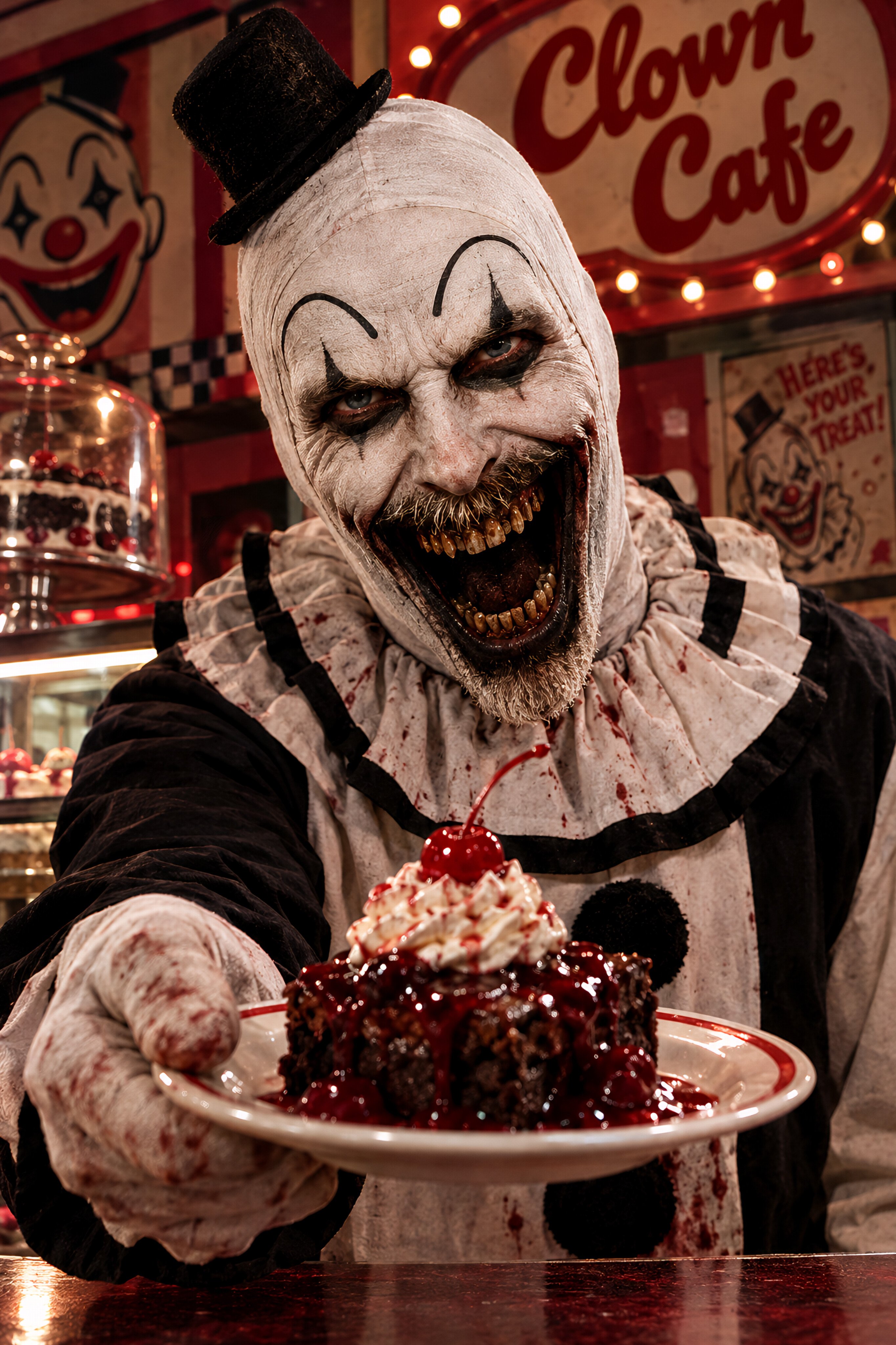
Using my uploaded photo, turn me into a creepy Art The Clown-inspired version of myself. Keep my face and features recognizable. Dress me in a Art The Clown-inspired outfit, full skull cap covering my head and ears, with Art The Clown-inspired accessories and an creepy, Art The Clown vibe. Put me in The Clown Cafe serving a Cherry Brownie with a a grotesque, unnervingly wide, maniacal grin stretched across the face, with the mouth opened excessively wide in a deranged, silent cackle. The lips are pulled taut toward the cheeks, exposing uneven, crooked, heavily stained yellow-brown teeth in a sinister, decaying smile. The mouth forms a deep, exaggerated black cavity, creating a stark, hollow contrast against the pale face. The cheeks are pulled upward and backward, creating deep creases, pronounced nasolabial folds, and harsh wrinkles around the nose and mouth. The upper lip curls slightly, while the lower jaw hangs open in an exaggerated, unnatural laughing expression. The eyes are narrowed beneath sharply arched, sinister brows, with dark, hollow eye sockets and an intense, unhinged stare. The overall expression conveys psychotic amusement, sadistic delight, and terrifying, uncontrollable laughter — grotesque, predatory, deeply unsettling, and disturbingly inhuman. Photorealistic facial anatomy, extreme skin texture, harsh shadows, high-contrast cinematic horror lighting. in the infamous and surreal "Clown Cafe" dream sequence from Terrifier 2, Art is seen serving up treats directly to the camera/viewer at a bizarre, retro-style counter scenery. Make it realistic, creepy AF, and high quality. 8k resolution, 2:3 format, octane render.
0
Details
GPT Image 2.5
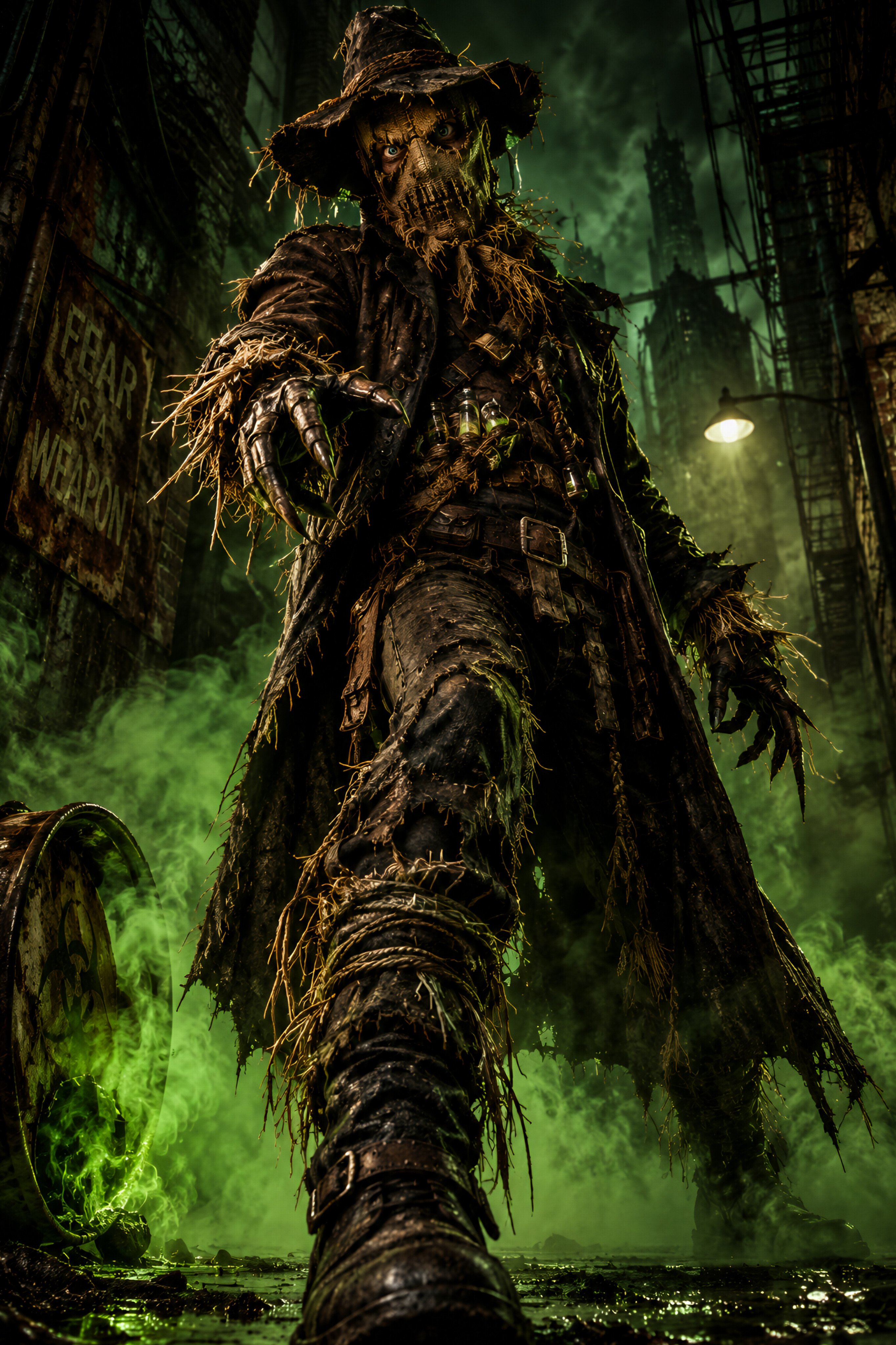
Using my uploaded photo, turn me into an intense (DC Comics) Scarecrow-inspired version of myself. Keep my face and features recognizable. Dress me in a (DC Comics) Scarecrow-inspired outfit with (DC Comics) Scarecrow-inspired accessories (burlap hood/mask/hat), with a burlap bag over my face and an creepy, wide eyed, lunatic, Hallucinogenic, Fear Toxin, Psychology vibe. Put me in a dimly lit abandoned city alleyway setting with rusted creepy, green airborne toxin, green foggy, dark scenery, full body in frame in a dramatic low angle hero pose. Make it realistic, creepy AF, and high quality. 8k resolution, 2:3 format, octane render.
0
Details
0:30
Seedance 2.5
MIDNIGHT HARVEST: THE LAST LANTERN OF HOLLOW CREEK ENGINE DIRECTIVE Genre: Supernatural Halloween horror-action. Duration: Exactly 30 seconds. Format: 16:9, 60 fps where supported. Photorealistic Hollywood cinema, realistic textures, volumetric fog, cinematic lighting, natural motion blur. HERO LOCK: Use @image1 as the only hero reference. Preserve his exact face, skin tone, hairstyle, beard, age, body proportions, black outfit and weapon. No identity drift, clones or costume changes. He carries an old iron oil lantern in his off hand. If no weapon is visible in @image1, he takes an iron hay hook from the fence at 00:08. LOCATION: Hollow Creek pumpkin farm at midnight. Full moon, foggy pumpkin fields, farmhouse on the left hill, crooked barn on the right, and a tall scarecrow pole in the center. Maintain consistent geography and continuity. ENEMIES: Four possessed scarecrows with glowing jack-o'-lantern heads, a small witch-shaped pumpkin lure, and the 30-foot Harvest Titan made of timber, straw and vines, with a furnace-lit pumpkin head and glowing candle-heart. AUDIO: Original music-box melody, dark cello, escalating war drums, eerie giggles, wood splinters, pumpkin bursts, roaring fire and cinematic orchestral impacts. No dialogue, text, logos or subtitles. TIMELINE 00:00–00:05 | THE FIELD AWAKENS Aerial descent over the moonlit farm. Track behind the hero walking between pumpkin rows with his lantern. One pumpkin ignites, triggering a ripple of glowing faces across the field. A distant bell tolls. 00:05–00:10 | THE ATTACK Four scarecrows awaken, tear free from the fence and attack. The hero dodges, blocks and strikes with his weapon. One scarecrow collapses; another's pumpkin head explodes into glowing pulp, sparks and straw. Dynamic handheld tracking and clear choreography. 00:10–00:15 | THE HARVEST CUT Orbit around the hero as he fights the remaining scarecrows. An overhead slow-motion shot captures his leap, swirling embers and flying straw. He lands and defeats the final attacker. Sudden silence. 00:15–00:20 | THE WITCH'S TRAP A child's giggle draws the hero toward a small witch beside the barn. She turns, revealing a glowing carved pumpkin face. Vines erupt from the ground, seize his ankle and drag him backward. In the distance, the giant scarecrow begins to rise. 00:20–00:25 | THE TITAN RISES The 30-foot Harvest Titan tears free from its pole. The witch dissolves into smoke and enters its chest, igniting its candle-heart. The hero escapes the vines and runs toward the barn. The Titan smashes through its lower wall, leaving visible destruction. 00:25–00:30 | THE LAST LANTERN The hero races up the barn roof and leaps toward the Titan, throwing his lantern into its chest. At 00:26.5, it shatters against the candle-heart, igniting the Titan from within. The monster collapses in flames, timber and embers. The hero lands, rises and walks away. Final shot: a small pumpkin near his boots suddenly lights up with a sinister grin. A final bell tolls. Cut to black at exactly 00:30. CONTINUITY RULES: Preserve hero identity, outfit, weapon and lantern until used. Destroyed enemies remain destroyed. Keep lighting, geography and damage consistent. Use realistic physics, readable action and seamless cinematic transitions.
0
Details
0:30
Seedance 2.5
HALLOWEEN NIGHT — “TRICK OR TREAT” 30 seconds | 16:9 | Photorealistic Hollywood cinematic, 24 fps, natural film grain, realistic motion and lighting. REFERENCE LOCK: @image1 is the hero’s identity and wardrobe reference. Preserve his exact face, skin tone, hairstyle, facial hair, and body proportions. No morphing or costume changes. He carries a silver-edged machete in his right hand. WORLD & CONTINUITY: Foggy American suburban street at Halloween, glowing jack-o’-lanterns, cobwebs, bare trees, brick wall, hedge, and flickering streetlight. Deep teal shadows, warm orange firelight. Maintain the 180-degree rule. Hero starts screen-left and faces screen-right until Shot 9. TIMELINE 00:00–00:03 | SHOT 1: Wide, low-angle establishing shot. Fog rolls across the street as pumpkins flicker. The hero walks three steps toward a child-sized ghost-sheet figure holding a candy bucket beneath the streetlight. 00:03–00:06 | SHOT 2: Lateral tracking shot. Hero approaches and stops three meters behind the figure, machete lowered, breath visible in cold air. 00:06–00:09 | SHOT 3: Medium shot. The ghost slowly turns toward the hero, revealing pitch-black eye holes. Its bucket drops, spilling glowing orange embers. 00:09–00:11.5 | SHOT 4: Low-angle reveal. The sheet flies away, exposing a 2.5-meter pumpkin-headed scarecrow demon with a glowing carved head, straw body, tattered black coat, and rusty scythe. Embers burst outward. The hero raises his machete. 00:11.5–00:15.5 | SHOT 5: Side-view fight. The demon swings horizontally; the hero ducks and slashes its straw abdomen. Contact ignites orange embers as the demon staggers backward. 00:15.5–00:19.5 | SHOT 6: The demon attacks overhead. The hero blocks with both hands, producing sparks and a metal clang, pushes the scythe aside, and kicks the demon into pumpkins on the right curb. 00:19.5–00:22 | SHOT 7: Slow motion only during the hero’s leap and finishing diagonal machete strike through the demon’s neck. Its pumpkin head explodes in orange fire and sparks. Normal speed resumes upon landing. 00:22–00:25 | SHOT 8: The headless body collapses into burning straw. Pumpkins ignite. The sweaty, slightly dirty hero stands breathing heavily, machete lowered, embers floating through fog. 00:25–00:27.5 | SHOT 9: A real child in a plain white ghost costume emerges from behind the left hedge. The hero turns left, kneels, accepts candy gently, and gives a tired half-smile. 00:27.5–00:30 | SHOT 10: Wide shot. Hero and child face the fire. Their shadows fall on the brick wall; the child’s shadow transforms into a towering pumpkin-headed figure with glowing orange eyes. Eyes flare, then hard cut to black. SOUND: Church bell, wind, footsteps, breathing, fire, metal impacts, cello drone, dramatic brass during combat, sustained aftermath note, and eerie music-box lullaby ending with a dissonant sting. No dialogue. QUALITY RULES: Realistic physics, clear contact before reactions, readable choreography, stable camera, consistent lighting, no teleporting, gliding, extra characters, limb merging, text, logos, or watermark.
0
Details
0:15
Grok Imagine 2
Cinematic realistic video prompt (horror cyberpunk Transformers evolution): Nighttime cyberpunk megacity rooftop, rain-slicked concrete and neon reflections. A exhausted, rain-soaked man in a worn dark trench coat stands at the edge of a towering building. He hurls a heavy metallic suitcase off the roof with desperate force. The suitcase tumbles through the rainy night sky. Mid-fall, the suitcase violently transforms with mechanical horror: panels rip open, hydraulic limbs explode outward, gears and cables tear through metal skin with wet, grinding, flesh-like sounds. It rapidly unfolds and mutates into a massive biomechanical dragon — half machine, half nightmare. Segmented metal scales shift like living armor, glowing red cybernetic eyes snap open, wings of jagged steel and translucent membrane unfurl with bone-cracking force, and a long neck snaps forward with a maw full of interlocking blades. Sparks, black fluid, and neon-lit steam erupt during the transformation. The dragon fully forms mid-air, lets out a distorted, mechanical roar that mixes with distorted city alarms, then dives or circles with predatory menace. Dark, wet, industrial atmosphere. Extreme detail on metal textures, rain, reflections, and the grotesque beauty of the transformation. Shot with cinematic anamorphic lens, slow-motion emphasis on the transformation, dynamic tracking camera that follows the suitcase as it falls and becomes the dragon. High-contrast neon lighting (cyan, magenta, deep red), volumetric rain, volumetric god rays from neon signs, realistic physics, 8K, photorealistic, horror-sci-fi tone, next-level Transformers-style evolution with terrifying organic-mechanical fusion.
0
Details
0:08
Seedance 2.5
Scene & Style: Use Image 1 as the scene reference. A quiet suburban house entrance at night, viewed through a fixed doorbell camera with a circular fisheye effect. Use realistic low-resolution monochrome CCTV footage with cool tones, digital noise, compression artifacts, and weak streetlight illumination. Keep all characters monochrome. Music: Quiet, eerie Halloween instrumental music with deep ambience, ethereal synthesizers, and a slow, unsettling melody. 0–2 seconds: Image 3 stands close to the camera, knocks, and cheerfully says, “Trick or treat!” Her voice sounds distant, muffled, compressed, and slightly distorted, like real doorbell audio. 2–5 seconds: Image 3 steps back slightly. Image 2 is revealed standing directly behind her, expressionless, with his head tilted. She turns, sees him, panics, faces the camera, and desperately shouts, “Let me in!” 5–8 seconds: Image 2 slowly approaches while remaining behind her. She presses her face against the lens and frantically pounds below it. He places one hand on her shoulder. End the video at this unsettling moment. Camera & Audio: One continuous, fixed doorbell-camera shot. No cuts, zooms, camera movement, teleportation, or sudden position changes. Maintain realistic spacing, muffled surveillance audio, and a low-resolution monochrome horror aesthetic throughout.
0
Details
0:15
Wan 3.0
Create a 15-second ultra-realistic, visually spectacular Halloween fantasy-horror video designed to capture attention instantly and maximize replays on X, TikTok, and Reels. Scene 1 — The Hook (0–3 seconds): A gigantic blood-red moon hangs above an abandoned gothic mansion. The camera rushes toward its enormous iron gates as hundreds of glowing jack-o’-lanterns suddenly ignite in sequence. The mansion doors violently swing open, revealing a mysterious woman standing in a cloud of black smoke. An eerie whisper says, “You shouldn't have come tonight…” Scene 2 — The Transformation (3–7 seconds): She slowly raises her head, revealing glowing orange eyes and an enchanting, sinister smile. Her elegant black gothic gown transforms into a spectacular feathered dress with molten-orange magical patterns. Her hair floats unnaturally as black ravens explode into a swirling vortex around her. The camera performs a dramatic 360-degree orbit while purple lightning illuminates the sky. Scene 3 — The Viral Visual Explosion (7–11 seconds): She snaps her fingers. Thousands of pumpkins levitate into the air, forming a gigantic flaming skull above the mansion. Ghostly dancers emerge from the mist, skeletons rise from the ground, and enormous shadow creatures crawl across the walls. Orange flames and violet magical energy collide in a breathtaking cinematic explosion synchronized perfectly with a heavy phonk bass drop. Scene 4 — The Jaw-Dropping Finale (11–15 seconds): The Halloween queen walks directly toward the camera as everything freezes around her. She smiles, revealing supernatural glowing teeth. Suddenly, her face transforms into an exquisitely detailed jack-o’-lantern mask for a split second before returning to normal. She whispers, “Happy Halloween…” The screen flashes orange, revealing a gigantic glowing eye in the darkness, then cuts seamlessly back to the opening shot for a perfect loop. Visual direction: Photorealistic Hollywood fantasy horror, 4K detail, vertical 9:16 composition, dramatic low-angle shots, realistic skin and fabric textures, volumetric fog, cinematic camera movements, intricate gothic architecture, supernatural transformations, deep shadows, blood-red moonlight, neon orange flames, violet lightning, and premium blockbuster color grading. Sound design: Eerie whispers, distant thunder, creaking gates, raven wings, rising orchestral tension, a hard-hitting dark phonk bass drop at 7 seconds, and a chilling final whisper. Must-have requirements: * First-second visual hook — absolutely no slow introduction. * A new spectacular visual event every 2–3 seconds. * Seamless, physically convincing transformations. * Strong contrast between beautiful gothic fantasy and terrifying horror. * A shocking final reveal that encourages viewers to replay. * Perfect synchronization between music, camera movement, and visual effects. * No cartoon visuals, no cheap CGI appearance, no text, no logos, no watermark. Creative goal: Make it feel like a billion-dollar Halloween movie compressed into 15 seconds — beautiful, creepy, magical, unexpected, and impossible to scroll past. 🎃🔥
0
Details
0:30
Seedance 2.5
Create an ultra-realistic, cinematic zombie outbreak sequence in a crowded hospital ER during a mass-casualty night. Character A must match the reference image exactly in face and outfit. Fluorescent trauma lighting, handheld camera movement, realistic acting, intense sound design, escalating panic, and visceral horror. 0–5s: Character A frantically treats injured patients as doctors shout vitals and stretchers rush through the chaotic ER. A severely wounded man arrives, seemingly just another casualty. While checking his vitals, she notices his abnormal pallor and darkening veins. 5–10s: The patient’s eyes snap open, clouded white, and he suddenly bites a nearby paramedic. The paramedic screams and crashes into a medical cart. Dark veins spread rapidly from the bite as horrified staff realize something is terribly wrong. 10–15s: Character A calls for the trauma bay to be sealed, but the bitten paramedic convulses and transforms within seconds. He attacks a nurse, triggering a chain reaction as the ER erupts into screaming chaos. 15–20s: Another nurse turns and attacks a helpless patient. Forced to defend herself, Character A grabs a scalpel and strikes the infected nurse in desperation. Meanwhile, doctors struggle to decide which critically injured patients can be evacuated first. 20–25s: Character A prioritizes a wheelchair-bound patient as staff drag wheelchairs and gurneys toward the exit. A doctor slams the trauma bay doors shut, abandoning those trapped inside. Infected faces and hands pound against the small glass window. 25–30s: In the corridor, exhausted survivors regroup around the patients they managed to save. Character A sets down her bloodied scalpel with trembling hands. A junior nurse quietly asks whether they did the right thing. She cannot answer. Flickering lights illuminate the sealed, shuddering doors as the camera closes in on her hollow, resolute face. Style: Photorealistic live-action horror, believable zombie transformations, practical-looking VFX, realistic hospital environments, frantic handheld cinematography, continuous escalation, visceral but grounded violence, emotionally devastating triage decisions, and a bleak unresolved ending.
0
Details
0:30
Seedance 2.5
[ENGINE DIRECTIVE] Generate a continuous 30-second hyper-realistic live-action horror-action sequence at 60fps ultra-realism in 16:9 widescreen format. Maintain 100% strict visual consistency with provided asset sheets: "Maya" (Survivalist in leather jacket, chest harness, titanium crowbar) and "The Infected Swarm" (Pale, veined hyper-fast infected). Setting strictly follows "Flooded Subterranean Subway Terminal". Style: Gritty neo-noir horror-action, rapid 2-to-3 second beats, visceral CQC leverage, red emergency strobe lighting, water splash physics. [AUDIO DIRECTIVE] • MUSIC: Driving industrial pulse synth blended with heavy taiko-style impact thuds and rising distorted electronic tension. • SOUND DESIGN: Rain dripping, glass shattering, shrieking infected roars, crowbar metal impacts, water splash blasts, and flare ignition hiss. [TIMELINE BREAKDOWN] 00:00 - 00:03 | PLATFORM AMBUSH & GLASS BREAK BURST • VISUAL: Low-angle tracking shot along flooded concrete as flashlight beam cuts through mist. • ACTION: Maya stands alone on the dark subway platform. Suddenly, glass on a crashed subway car shatters as five hyper-fast infected burst through, sprinting through water toward her. • SOUND: Dripping water mist, explosive glass SHATTER, shrieking infected roars, heavy water splash running. 00:03 - 00:06 | SIDESTEP HOOK & PILLAR FACE-SMASH • VISUAL: Dynamic close-quarters camera tracking Maya's leverage counter. • ACTION: Lead infected lunges; Maya sidesteps sharply, hooks its ankle with her titanium crowbar, and drives its momentum face-first into a steel support pillar, sending water and glass spraying. • SOUND: Crowbar ankle HOOK, steel pillar face-impact CRUNCH, water splash explosion. 00:06 - 00:09 | WATER DROP ELBOW & KNEE JOINT DISRUPT • VISUAL: Low-angle impact camera tracking the ground CQC. • ACTION: Two infected tackle her simultaneously. Maya drops low into standing water, delivers a tactical elbow strike to break the first infected's jaw, and jams her crowbar into the second infected's knee joint to collapse its balance. • SOUND: Heavy water plunge CRASH, jaw-breaking elbow THUD, knee joint crunch. 00:09 - 00:12 | HYPER-SLOW FLARE SPARK & BLINDING THRUST • VISUAL: 0.8-second time-dilation orbital camera close on the flare ignition. • ACTION: In hyper-slow motion, Maya unclips a red road flare from her vest, sparks it to life, and thrusts the intense red chemical flame directly into a lunging infected's face, blinding it instantly. • SOUND: Time-dilation sub-bass DROP, flare striker IGNITION HISS, intense burning sizzle, screeching roar. 00:12 - 00:15 | TURNSTILE VAULT & ESCALATOR SWARM REVEAL • VISUAL: Upward tilting hero tracking shot as Maya vaults onto elevated ground. • ACTION: Using the flare's red glare, Maya vaults onto an overturned metal turnstile, looking down as dozens of infected pour out from dark escalators behind her, setting up Phase 2. • SOUND: Boot turnstile CLANG, red flare crackle, roaring swarm echo, swelling action riser. 00:15 - 00:18 | HANDRAIL SWING & FLOODED TRACK KNOCKDOWN VISUAL: Dynamic high-angle tracking camera following the aerial swing. ACTION: Maya leaps from the turnstile onto an overhead hanging handrail, swinging her legs forward in mid-air to kick three infected into the flooded track bed below. SOUND: Handrail metal friction, double boot impact THUD, heavy track bed water plunge CRASH. 00:18 - 00:21 | ALPHA TACKLE & VENDING MACHINE GLASS CRASH VISUAL: Fast pursuit camera crash-zooming into the impact. ACTION: Landing near the emergency exit, an alpha-style infected tackles her sideways into a flickering neon vending machine, shattering the glass panel in a shower of electrical sparks. SOUND: Body metal slam IMPACT, glass shattering CRUNCH, electric spark crackle. 00:21 - 00:24 | FRAME TRAP & HORDE LEVERAGE THROW VISUAL: Tight profile camera tracking the fast CQC combination. ACTION: Maya traps the alpha's arm against the steel frame, strikes its torso with three rapid palm-and-knee thrusts, and executes a leverage throw that hurls it back into the advancing swarm. SOUND: Frame binding CLACK, rapid torso strikes THUD-THUD-THUD, heavy horde crash collision. 00:24 - 00:27 | STEEL DOOR BOOT & CROWBAR DOOR-JAM VISUAL: Medium wide tracking shot capturing the barricade action. ACTION: Maya kicks open the heavy steel emergency door, ducks through, slams it shut, and jams her titanium crowbar tightly through the handles—sealing the swarm inside as bloodied hands beat against reinforced glass. SOUND: Heavy boot door KICK, steel door SLAM, crowbar handle JAM CLICK, violent glass banging. 00:27 - 00:30 | BLOOD WIPE & DARK TUNNEL ESCAPE VISUAL: Hero close-up tracking shot settling in dim red emergency light. ACTION: Maya leans against the door frame panting, wipes a streak of dark blood from her cheek, clicks her chest flashlight back on, and turns toward the dark escape tunnel ahead. CUT TO BLACK. SOUND: Heavy breathing exhale, leather glove face wipe, flashlight click SNAP, tunnel wind howl, total silence.
0
Details
0:15
Seedance 2.5
[Video Specifications and Overall Style] 9:16 vertical screen, 15 seconds, one continuous shot. Inside a Chinese wildlife park, a thrilling scene accidentally captured by a tourist using an ordinary phone. It starts calm; after the giant crocodile strikes, the videographer reacts half a beat late in shock—the camera shakes, aims off-target, then hurriedly finds the subject again. Preserve the realistic feel of amateur phone footage. [Characters and Reference Lock] The female lead uses preset adult Chinese female character #1@598c0e35-7c27-4b7c-8bac-19bb206ff1c3, wearing preset outfit #2@d57ec59a-c0a5-4eae-84f4-4f02ef21a92d, strictly maintaining the facial features, long hair, clothing style, color, and material from the reference. #1 is the character, #2 is the outfit; the numbers do not appear in the frame. The administrator is a Chinese man around forty years old, with short black hair, wearing a khaki short-sleeved work uniform and dark trousers, with a work badge on his chest, standing behind and to the side of the female lead. Behind them are a small number of adult Chinese tourists in summer casual clothes, standing naturally scattered along the boardwalk. [Scene and Camera Position] Tropical crocodile viewing area, an old wooden boardwalk extending along a dark green pool, with bamboo, palms, and shrubs on the opposite bank. A thick wooden railing extends diagonally from the lower right of the frame toward the background. The external videographer stands about one meter behind and to the side of the female lead, slightly above the position of the phone in her hands, shooting vertically downward. On the right side of the frame are the female lead, the administrator, and the boardwalk; on the left and below is the pool. Humid daytime, natural daylight passing through vegetation, the water surface reflecting a slight green. Ordinary phone 1x main camera, slight hand shake, tilt, compression smearing, noise in dark areas, brief blur during rapid turns. No cinematic color grading, drone camera position, or portrait bokeh. [Female Lead's Phone Orientation—Must Be Accurate] The female lead is using the phone's rear camera to film the crocodile in the water—not a selfie, and not showing the phone to the external videographer. The female lead holds the phone horizontally with both hands at each end, fingers avoiding the rear camera. The phone is below her chest, near the outer edge of the railing, the body clearly tilted downward, with the rear lens's shooting direction accurately landing on the huge dark shadow underwater in the lower left. The phone screen faces upward and slightly toward the female lead's face; the back of the phone and the rear lens face downward toward the water. The female lead looks down at the screen, observing the target in the water through the screen. From the external videographer's slightly higher rear-side angle, the phone screen and the side edge of the body should mainly be visible; the entire back of the phone and the camera module should not be clearly visible facing the external videographer. The screen's viewfinder content matches the real water surface: the same patch of water and the same blurry dark shadow can be seen; no female lead selfie face, unrelated scenery, or wrong-direction image appears. As the female lead slightly adjusts her wrist, the phone's rear lens always follows the underwater dark shadow. Only when the giant crocodile strikes does she retract the phone in shock, disrupting its orientation. [Giant Crocodile and First-Frame State] Only one abnormally massive dark gray-black crocodile. When it leaps up, its head is close to the size of an adult's upper body, and its open mouth occupies nearly half the left side of the frame; scale references the original video—do not generate an ordinary small crocodile. In the first frame, the giant crocodile is completely submerged underwater, presenting only a huge, blurry elongated dark shadow, like sunken wood. Water reflections and turbidity obscure details; the head, eyes, nostrils, scales, or teeth cannot be clearly identified, and no part breaks the water surface. The giant crocodile maintains the same volume throughout and does not suddenly expand at the moment of leaping. [0–2 seconds: Aiming at the underwater shadow] The female lead stands inside the railing, body slightly leaning forward, holding the phone horizontally with both hands, pointing the rear camera downward at the huge dark shadow in the water to the lower left. She looks down at the screen facing her; the shadow on the screen corresponds in position to the shadow in the pool. The external videographer captures the phone screen, the female lead's side profile, and the water below from behind and to her side. The administrator warns seriously: "Miss, step back a bit, don't lean on the railing!" The water surface has only slight ripples; the crocodile still has not surfaced. [2–4 seconds: Target approaches, phone follows] The huge underwater outline slowly approaches the female lead's position. The female lead slightly rotates her wrist so the phone's rear camera continues aiming at the moving shadow, screen facing herself, not turning the back of the phone toward the external videographer. The administrator steps closer, reaching out to steady her, tone turning urgent: "That's not wood, it's alive! Don't lean over!" The female lead begins to pull her body back, but the phone is still filming the water. At the end of this segment, the crocodile's snout tip and eyes just break the water surface. [4–6 seconds: Giant crocodile strikes] The giant crocodile suddenly bursts through the water surface, its massive head rising along the outer side of the railing, open mouth instantly occupying nearly half the left side of the frame, throwing up a large splash. The female lead screams, hurriedly retracting the phone and her arm. The phone's orientation loses stability from the fright; previously it must have been consistently aimed correctly at the crocodile. The giant crocodile briefly bites her forearm extended outside the railing on one side and nearby clothing fabric. The administrator immediately supports her upper arm and shoulder/back, steadying her center of gravity inside the railing. The external videographer recoils half a step in shock, the camera briefly jerks upward; no cut or wound close-up. [6–9 seconds: Breaking free and falling into water] The giant crocodile briefly releases its bite, head falling back; the female lead takes the opportunity to retract her injured forearm, and the administrator pulls her to the inner side of the boardwalk. The action must include a clear release—the arm must not pass through closed teeth. The phone slips from the female lead's hand, flips, and falls into the pool, dropping only once. The giant crocodile crashes back onto the water surface, splashing white water. The female lead clutches her forearm; a small amount of red liquid seeps from the injury, forming short, thin streaks, staining the clothing fabric at the contact point, with one or two drops falling toward the wooden boardwalk. No deep wound display, no spurting, no heavy bleeding. The administrator shouts: "Back up! Don't reach out! Don't pick up the phone!" [9–11 seconds: Tourists panic] The female lead retreats to the middle of the boardwalk, guarding her injured forearm, shoulders tense, breathing rapid. Nearby tourists first hunch their shoulders and back away, pulling at companions; tourists farther back only turn around upon hearing the scream—some put away phones, some turn sideways to make way, exclaiming in succession: "Get back!" "Don't lean on the railing!" The crowd reactions have time delays, are not uniformly synchronized, no clipping, no one falls into the pool. The giant crocodile remains underwater and does not launch a second attack. [11–13 seconds: Administrator evacuates] The administrator stands between the female lead and the railing, shielding her as they continue retreating, gesturing for tourists to make way: "Back up! Everyone don't crowd!" A nearby tourist hands over a tissue; the female lead takes it and presses it on the same injury; the tissue contact area gradually stains with a small amount of red. The videographer backs up slightly and corrects the framing, capturing the female lead, the administrator, and the panicking tourists retreating. [13–15 seconds: Aftermath] The female lead clutches her forearm, panting, voice trembling as she says: "I'm scared to death... it really bites!" The administrator still shields her, warily watching the pool. Background tourists remind in low voices: "Stay away, stop filming!" End on the scene with the female lead still shaken, the crowd retreating, and the water's aftermath not yet settled. [On-Site Sound] All phone on-site audio recording, Chinese dialogue, no music, narration, or subtitles. At the beginning there are tourists talking in low voices, bamboo leaves rustling, and slight water sounds. The administrator's voice is close and clear, changing from a serious warning to urgent restraint as danger occurs. When the giant crocodile surfaces there is heavy water sound, the female lead's scream, nearby gasps; then the phone falling into water, splashing, rapid panting, and chaotic footsteps. The largest splash and scream briefly clip the microphone, then automatic gain recovers. Distant tourist voices are more scattered and softer; no monster roars added. [Continuity and Key Constraints] At the beginning, the female lead's phone must correctly film the underwater target: screen facing up and toward the female lead, rear camera facing down aimed at the crocodile's position; the external videographer mainly sees the screen and side edge. It is forbidden for the phone's rear camera to face the external videographer while appearing to film the underwater target. The first frame has only a blurry giant shadow underwater; no clear crocodile head, eyes, scales, or teeth appear. Red liquid appears only after the bite. Maintain continuity of character #1, outfit #2, the administrator, the giant crocodile, and the boardwalk. The injury is always on the same forearm; the red streaks, clothing damage, and tissue-pressing position correspond. Only one phone; after falling into the water it does not return to hand. The female lead and administrator remain inside the railing; the crocodile @d57ec59a-c0a5-4eae-84f4-4f02ef21a92d remains in the pool at all times. Maintain causal relationships of contact, weight, bite, release, and retreat throughout. No wound close-ups, no severed limbs, no deep tissue display. Entire film one continuous shot, no slow motion, replay, studio reveal, interface overlays, or watermarks.
0
Details
0:28
Seedance 2.5
Create an ultra-realistic, cinematic VFX sequence on a busy modern city street. A young woman wearing a grey hoodie lies on the pavement, desperately reaching toward a smartphone just beyond her fingertips. As she touches the phone, her hand begins transforming into a grotesque, liquid-metal creature made of reflective bronze and copper, with intricate branching tendrils spreading across her fingers, palm, and face. The transformation progresses organically, with metallic fluid crawling over her skin, forming intricate vein-like structures and glossy, liquid textures. Her expression shifts from curiosity to intense fear and pain as the transformation spreads. Use extreme low-angle ground-level shots, macro close-ups of the metallic transformation, realistic skin pores, natural daylight, physically accurate reflections, shallow depth of field, and softly blurred pedestrians in the background. Gradually push the camera closer to her terrified face as the metallic substance engulfs more of her features. Premium Hollywood sci-fi horror cinematography, photorealistic CGI integration, detailed material simulation, realistic human anatomy, natural motion, dramatic facial expressions, 35mm cinema lens, HDR, 4K quality, seamless visual effects, and smooth cinematic camera movement. Negative prompt: Cartoon, anime, illustration, artificial-looking CGI, plastic skin, low resolution, blurry subject, distorted anatomy, extra fingers, deformed hands, unnatural facial movements, flickering, abrupt transitions, inconsistent lighting, unrealistic reflections, excessive motion blur, text, subtitles, logos, background music.
0
Details
0:15
Seedance 2.5
HER LAST LOOK — THE MIRROR Duration: 15s | Vertical 9:16 | Photorealistic supernatural horror. REFERENCE LOCK Image 1 = Human Ana. Preserve exact face, facial proportions, dark-brown shoulder-length hair, body proportions, brown-beige plaid romper and white sneakers. Image 2 = Ghost Ana. Match the pale face, long tangled black hair, distressed ivory long-sleeved dress, muddy stains and pale hands. No identity drift. SCENE 1 — HER REFLECTION (0–3s) Night, Ana's bedroom. Ana stands directly before a large mirror, gently fixing her hair with both hands. She tilts her head and smiles at her reflection. The reflection perfectly mirrors every movement. Medium shot, slow cinematic push-in, realistic bedroom lighting. SCENE 2 — SOMETHING IS WRONG (3–5s) Ana leans closer and adjusts her hair. Suddenly, her reflection lags slightly behind her real movements. Ana freezes as her smile fades. Disturbed, she raises both hands and completely covers her face. An unnatural breeze moves her hair despite the closed room. The reflection remains visible in the mirror. SCENE 3 — THE TRANSFORMATION (5–8s) While Ana's face is hidden behind her hands and sweeping hair, her reflection transforms first: shoulder-length hair becomes long, tangled black hair; the plaid romper becomes a dirty ivory gown; her face turns deathly pale and her hands become ghostly. Ana slowly lowers her hands. The supernatural change spreads from the reflection to her real body, completing as her hands reach her sides. Reveal both Ana and her reflection as the same terrifying ghost, accurately matching Image 2. Preserve their alignment and physical continuity. SCENE 4 — THE LAST LOOK (8–11s) Ghost Ana stands motionless before the mirror, head lowered. She slowly raises her pale face as tangled hair parts naturally. Her reflection maintains perfect synchronization. She locks eyes with herself, then slowly shifts her gaze directly toward the camera, as if sensing someone behind her. Slow push-in, cold muted lighting, oppressive silence. SCENE 5 — FINAL SCARE (11–15s) Ghost Ana turns away from the mirror and slowly approaches the camera. Her long gown drags across the floor and her tangled hair sways naturally. She tilts her head, then suddenly lunges close. Her black hair swings forward, physically covering the entire lens until the frame becomes completely black. End immediately; no additional shot. CONTINUITY & NEGATIVE CONSTRAINTS Maintain consistent bedroom layout, mirror geometry, camera direction and reflection alignment. The reflection changes first; real Ana transforms only after her face is concealed. No duplicated characters, random reflection behavior, premature wardrobe changes, face morphing, anatomy errors, teleportation, unexplained cuts, cartoon effects, gore, text, logos or watermarks. Ultra-realistic skin, hair and fabric physics. Audio: quiet room tone, hair rustle, faint wind, one restrained supernatural hit, then silence. No dialogue or music.
0
Details
0:15
Seedance 2.5
The opening frame is Image 1 and the snack the girl is eating is Image 2. From 0–0.5 seconds, use a medium shot to establish the setting: the girl is sitting alone on the sofa in a dimly lit living room. The only light comes from the television, which is playing a Resident Evil zombie movie. The camera moves closer, showing her clutching a large bag of snacks. She watches nervously while mechanically stuffing snacks into her mouth. Image 3: Cut to a close-up of the girl. A pale, blood-stained hand quietly rests on her shoulder, slowly reaching from behind her directly into the snack bag in her arms. Her entire body freezes. She slowly turns her head. Reverse angle: A zombie is standing behind her. Once the girl comes to her senses, she immediately hugs the snack bag tightly. The monster refuses to give in and reaches over to snatch it away. The tug-of-war over the snacks lasts for a while and becomes increasingly funny, with exaggerated expressions and perfectly timed comedic movements. Suddenly cut to a medium shot. Image 4: The girl and the zombie are now sitting side by side on the sofa, watching television and eating snacks together. End with a cinematic close-up of the product, making the packaging clearly visible and appealing. Style: Cinematic horror-comedy, realistic lighting, smooth camera movements, expressive characters, accurate product details, seamless transitions, and humorous storytelling.
0
Details
0:24
Seedance 2.5
A cinematic and emotional storytelling video. First scene: a close-up of a distressed crying young woman with scratches on her face holding a handgun inside a dark, ruined abandoned building, confronting a terrifying zombie-like man with white milky eyes. Second scene: she drops her weapon, wearing a brown poncho over a white dress. Third scene: a magical cinematic transition into a bright, golden-hour sunlit mountain landscape with vast tall grass fields. The man and woman joyfully embrace, laugh together in the grass, run hand-in-hand through the field, and finally sit peacefully on a hill overlooking majestic snow-capped mountains at sunset as he kisses her head. Negative Prompt: low quality, blurry, distorted faces, bad anatomy, deformed hands, unnatural movements, grainy, flickering, poorly rendered
0
Details
0:30
Seedance 2.0
Ultra-realistic cinematic sci-fi horror scene inside a futuristic high-security research laboratory. A young female scientist wearing a white lab coat carefully conducts a mysterious experiment in a sterile laboratory filled with glass chambers, advanced scientific equipment, glowing blue monitors, and reflective metallic surfaces. She examines a strange biological specimen, then suddenly notices something terrifying. A pale, mysterious humanoid entity with sunken dark eyes and an unsettling expression appears inside the laboratory. Its appearance is disturbing yet realistic, with subtle facial movements and lifelike skin texture. The laboratory lights begin flickering as a red emergency alarm activates. Scientists rush through a glass corridor while white vapor bursts from a containment chamber. The female scientist turns in shock as the facility enters lockdown. Red warning lights illuminate the dark hallway, creating dramatic reflections on the glass walls. The mysterious entity remains visible behind reinforced glass at the end of the corridor. Visual style: Photorealistic science-fiction thriller, cinematic horror atmosphere, futuristic biotechnology laboratory, volumetric lighting, realistic facial expressions, atmospheric fog, dramatic red and cyan lighting, detailed textures, shallow depth of field, slow cinematic camera movements, suspenseful pacing, professional Hollywood film quality, 4K detail, vertical 9:16 composition. Negative prompt: Cartoon, anime, low resolution, blurry faces, distorted anatomy, extra limbs, unrealistic movement, oversaturated colors, text overlays, watermarks, inconsistent characters, flickering visual artifacts.
0
Details
0:22
Seedance 2.5
Photorealistic Hollywood-style horror-action short film, styled as a cropped clip pulled from a larger feature film, opens with an instant attack, no slow build, grounded realistic style, maximum dynamic camera work. Setting: a wide open sunlit field, tall grass swaying, bright clear daylight. Ten infected emerge across the field toward a small group of people. Two men armed with swords stand ready to defend the group. Muted natural color grading with bright sunlight contrast, natural diegetic sound throughout, cinematic score entering immediately. > > **[0-1s]** Hard cut: the infected burst from the tall grass on all sides, lunging at the nearest people instantly. > > **[1-2s]** Two people are caught off guard, pulled down hard before they can react. > > **[2-3s]** Screaming erupts across the field, the group scattering in different directions. > > **[3-4s]** The two swordsmen step forward, positioning themselves between the group and the advancing infected. > > **[4-5s]** Wide shot: the infected close in from multiple directions, moving fast through the grass. > > **[5-6s]** The first swordsman meets the nearest infected head-on, a clean strike dropping it instantly. > > **[6-7s]** The second swordsman pivots, cutting down another as it lunges from the side. > > **[7-8s]** Low-angle shot: sunlight glints off the blades as they move through the chaos. > > **[8-9s]** A third infected charges the first swordsman; he sidesteps and strikes in one fluid motion. > > **[9-10s]** Wide tracking shot: both men moving back-to-back, cutting down infected as they close in from all sides. > > **[10-11s]** A fourth infected lunges at the second swordsman; he blocks and counters sharply. > > **[11-12s]** The remaining group members huddle together behind the two men, watching in fear. > > **[12-13s]** A fifth and sixth infected charge together from the left flank. > > **[13-14s]** The first swordsman meets both, striking in a rapid two-part motion. > > **[14-15s]** Both infected fall, the swordsman barely breaking stride. > > **[15-16s]** The second swordsman faces two more infected charging from the right. > > **[16-17s]** He cuts down the first, spins, and strikes the second in the same motion. > > **[17-18s]** Wide shot: eight infected now down across the sunlit field, two remaining. > > **[18-19s]** The final two infected charge together directly at both swordsmen simultaneously. > > **[19-20s]** The two men exchange a brief glance, positioning side by side. > > **[20-22s]** SLOW MOTION: both swordsmen strike in perfect unison, blades arcing through the sunlight. > > **[22-24s]** SLOW MOTION continues: the final two infected collapse together in the tall grass. > > **[24-26s]** Wide shot: the field falls silent, dust and disturbed grass settling in the bright sunlight. > > **[26-28s]** The two swordsmen lower their blades, breathing hard, scanning the field one final time. > > **[28-30s]** Final shot: they turn back to the group, nodding reassurance, bright sunlight washing over the now-quiet field. Cut to black. > > Natural diegetic sound throughout — screaming, sword strikes, footsteps through grass, heavy breathing — layered with a sweeping cinematic score building through the fight and resolving fully only in the final slow-motion sequence. No text overlay, no watermark. Maximum dynamic camera variety — low angles, wide shots, tracking shots, with slow motion reserved exclusively for the final two kills. Realistic shake only during physical impacts, bright natural sunlight color grading throughout.
0
Details
0:30
Seedance 2.5
Photorealistic Hollywood-style creature-horror action short film, opens with an instant attack, no slow build, grounded realistic style, maximum dynamic camera work. Setting: a military encampment at dusk, tents and barricades, armed personnel in black tactical uniforms with gear, a watchtower bunker position nearby. Creature: a massive winged bat-like creature, dark leathery wings, sharp claws, moving with sudden bursts of aerial speed. Muted tactical color grading, natural diegetic sound throughout, tension score entering immediately. > > **[0-1s]** Hard cut: the creature swoops down fast from above, slamming into a soldier near the perimeter. > > **[1-2s]** He's knocked flat to the ground, body convulsing from the impact. > > **[2-3s]** Nearby soldiers turn in alarm, shouting warnings across the camp. > > **[3-4s]** The creature banks sharply and dives again, striking a second soldier near the supply tents. > > **[4-5s]** He collapses hard, the camp erupting into chaos as alarms sound. > > **[5-6s]** Soldiers scramble for weapons, forming defensive positions across the camp. > > **[6-7s]** The creature circles high above, then dives fast toward a cluster of soldiers near the fence line. > > **[7-8s]** They open fire upward, tracers cutting through the dusk sky, but it banks away unharmed. > > **[8-9s]** It strikes another soldier from the side, talons catching his shoulder as it passes. > > **[9-10s]** Wide shot: soldiers firing in multiple directions, the creature weaving between tents too fast to track. > > **[10-11s]** It dives again, striking down a soldier near the command tent. > > **[11-12s]** More soldiers rush in, firing upward as it climbs back into the sky. > > **[12-13s]** It banks hard and dives once more, taking down another soldier near the barricades. > > **[13-14s]** The camp is in full chaos now, soldiers regrouping and firing in coordinated bursts. > > **[14-15s]** It strikes two more soldiers in quick succession near the perimeter fence. > > **[15-16s]** Wide shot: nearly a dozen soldiers down or scrambling, the creature circling high above the camp. > > **[16-17s]** On the watchtower bunker, a soldier manning a mounted machine gun tracks its movement carefully. > > **[17-18s]** He braces the weapon, following the creature's erratic flight path through the sight. > > **[18-19s]** The creature banks and dives directly toward the watchtower. > > **[19-20s]** SLOW MOTION insert: he opens fire as it closes the distance, rounds streaking through the air. > > **[20-21s]** SLOW MOTION continues: a burst connects directly as the creature's mouth opens mid-dive. > > **[21-22s]** Its wings buckle instantly, momentum carrying it into a hard crash near the tower base. > > **[22-24s]** Wide shot: the creature lies motionless at the base of the watchtower, wings splayed across the dirt. > > **[24-26s]** Soldiers cautiously approach, weapons still raised, confirming it's down for good. > > **[26-28s]** The gunner climbs down from the tower, scanning the camp for any further threats. > > **[28-30s]** Final shot: soldiers regroup across the camp, checking on the fallen, dusk settling over the now-quiet encampment. Cut to black. > > Natural diegetic sound throughout — wing beats, impacts, gunfire, shouting, radio chatter, heavy breathing — layered with a tense instrumental score building through the chaos and easing into calm at the end. No text overlay, no watermark. Maximum dynamic camera variety — low angles, aerial tracking shots, wide shots, close-ups, slow motion reserved for the final takedown. Realistic shake only during physical impacts, dusk tactical color grading.
0
Details
0:10
Kling 4.0
DURATION: EXACTLY 10 SECONDS ASPECT RATIO: 16:9 STYLE: Premium Hollywood live-action psychological horror, ultra-photorealistic humans, grounded CGI, realistic physics, elegant Japanese dark fantasy, desaturated cinematic photography. No anime rendering. ENVIRONMENT Vast abandoned underground Japanese temple. Aged wooden pillars, black stone flooring, shallow reflective water, old oil lanterns, faint moonlight and floor-level mist. Deep architectural layers create oppressive atmosphere and strong spatial depth. LIGHTING / COLOR Cold blue-gray moonlight, restrained amber lanterns, detailed shadows, subtle haze, realistic reflections, natural skin tones. Desaturated charcoal, black, gray, and weathered wood. No neon. ACEN Calm, composed, elegant, intimidating. Natural human performance. Zanpakutō remains physically consistent. CORE CONCEPT Kyōka Suigetsu manifests gradually: EMPTY SPACE → SUBTLE DISTORTION → TRANSPARENT ACEN → INCREASING DENSITY → FULLY REALISTIC ACEN. Approximately 12–14 manifestations emerge asynchronously across different depths and positions, never in formations. No instant appearance, teleportation, holograms or pop-in. Each has subtle, independent human movements. ACTION / CAMERA 0.0–1.5s — ACTIVATION Medium-wide shot. Camera slowly arcs around Acen as he draws his Zanpakutō. Cold light catches the blade. He quietly says “Kudakero, Kyōka Suigetsu.” Metallic blade sound and distant ambience only. No aura or explosion. 1.5–3.0s — FIRST MANIFESTATIONS Camera continues moving. Empty space behind a pillar subtly distorts, gradually forming a transparent Acen. Three more emerge independently near a wall pillar, and water. Background remains visible through them. Subtle blinking and head movements. 3.0–5.0s — THE ROOM BEGINS TO FILL Lateral tracking reveals additional Acens behind pillars and near the water. Some are faint, others 50–70% opaque and one nearly solid. Natural breathing, posture adjustments, and subtle sword-grip movements. No synchronization. 5.0–7.0s — COMPLETE HYPNOSIS ESCALATES Camera passes foreground architecture, revealing 9–11 scattered manifestations across different depths. Some are partially hidden or visible through reflections. Skin, fabric, shadows, reflections and mist gradually respond like real physical bodies. 7.0–8.8s — REALITY BECOMES UNTRUSTWORTHY Passing another pillar reveals 12–14 Acens throughout the sanctuary.Some are solid, some translucent others obscured. Every manifestation develops gradually from empty space. No attacks or theatrical reactions. 8.8–10.0s — FINAL REVEAL Camera passes a final pillar, revealing a fully solid Acen close to the lens. No glow or distortion.He calmly looks toward the camera with a faint smile. Numerous manifestations remain scattered behind him in different states of solidity.The original is indistinguishable.CUT TO BLACK. CAMERA LANGUAGE Continuous lateral tracking with a subtle orbital arc. Use pillars darkness, and parallax to reveal manifestations naturally. Maintain spatial depth. No frantic handheld random shake, or unnecessary cuts. VFX / PHYSICS:Grounded CGI, realistic human integration, progressive solidity, consistent shadows and reflections natural fabric movement, mist displacement and water interaction. No holograms, glowing edges particles, dissolves or teleportation. PERFORMANCEAcen remains unnervingly calm. No screaming, exaggerated expressions, attacks, or unnecessary sword choreography. Horror comes from numerous realistic versions occupying the sanctuary. NEGATIVE: Anime, cartoon, videogame render plastic skin, holograms, clone formations synchronized movements, static mannequins, instant materialization teleportation, magical explosions, neon, distorted anatomy duplicated limbs, floating sword inconsistent reflections or shadows rubber physics excessive camera shake chaotic editing cheap horror oversaturated colors.
0
Details