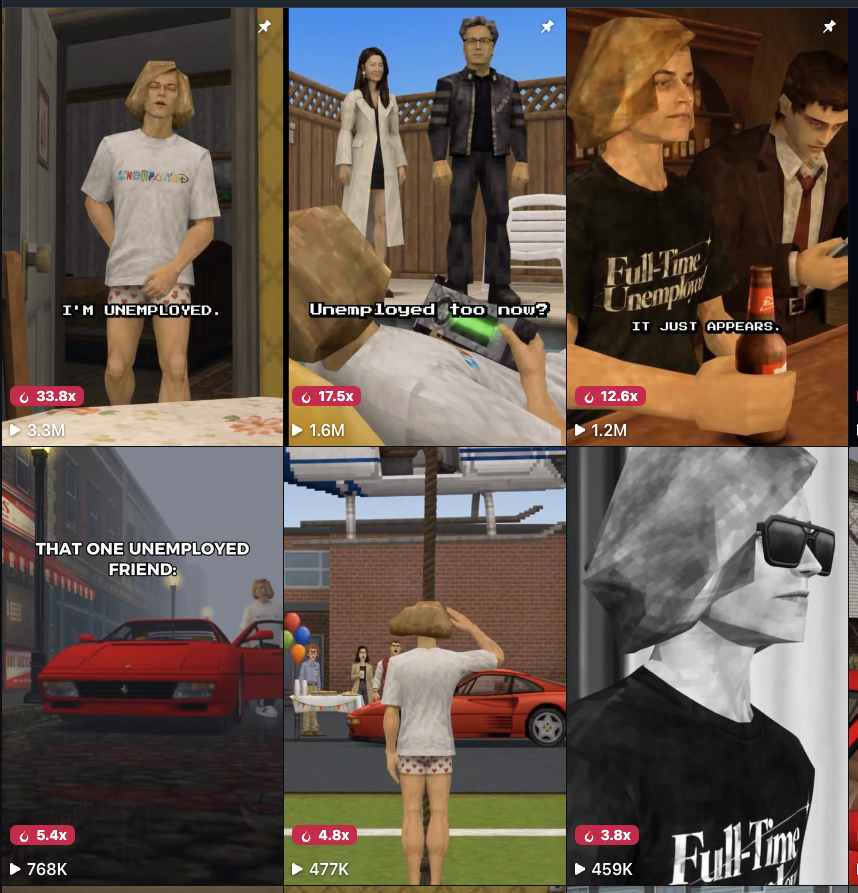
PS2 Low-Poly Cutscene Frame
 GPT Image 2.6OpenAIimage
STYLE: a cutscene frame from a mid-2000s console game (PlayStation 2 / original Xbox era), captured from an emulator at high internal resolution so the image is crisp while every 3D asset is low-poly. Characters are clearly video-game 3D models, never real people: low-polygon meshes with visibly faceted silhouettes, angular jawlines, flat-planed cheeks and nose, simple blocky hands, stiff mannequin posture. Faces use hand-painted low-resolution game textures (not photographs), slightly smeared, with glassy painted eyes and simplified features. Hair is one solid sculpted mesh with a low-res painted hair texture and hard chunky planes, no individual strands. Clothing is flat-textured with baked-in folds; logos and printed graphics are slightly pixelated. The set is a simple game level: repeating low-res textures, box-like furniture, low-poly props. Fake ambient occlusion in corners, faint blob shadows, no realistic specular highlights, no depth of field. Static cutscene camera. No UI, no HUD, no captions, no subtitles, no watermark, no readable text or signs anywhere. COLOR AND LIGHT: high-saturation, high-key palette built from the set palette named in the scene; those bold colors appear on walls, furniture, clothing and props; clean neutral white light; whites stay white and skin tones stay natural; no sepia, no yellow cast, no brown haze.
Details
- Type
- AI Image Prompts
- Aspect Ratio
- 858:893
- Updated
- Nov 21, 2026
Category
How to use this prompt
- 1Copy the full prompt with the copy button above.
- 2Open GPT Image 2.6 by OpenAI, or any image generator with a similar style range.
- 3Paste the prompt, then swap the subject and style keywords to match your idea.
- 4Match the example's settings (858:893 · Game Assets · 3D Render · Vintage), then iterate — small wording changes shift the output a lot.
Frequently asked questions
Which AI model generated this image?
This image was generated with GPT Image 2.6 by OpenAI. The prompt on this page is the exact text used to create it.
What settings does this prompt use?
The example was generated with GPT Image 2.6 using: 858:893 · Game Assets · 3D Render · Vintage. Reusing these settings gives the closest match.
How do I get similar results?
Copy the prompt as-is first, then replace only the subject while keeping the style, lighting, and composition keywords. Generate a few variations — outputs differ between runs.
Can I modify this prompt?
Yes. Prompts work best as starting points — adjust descriptors, aspect ratio, or style tags to make the output your own.