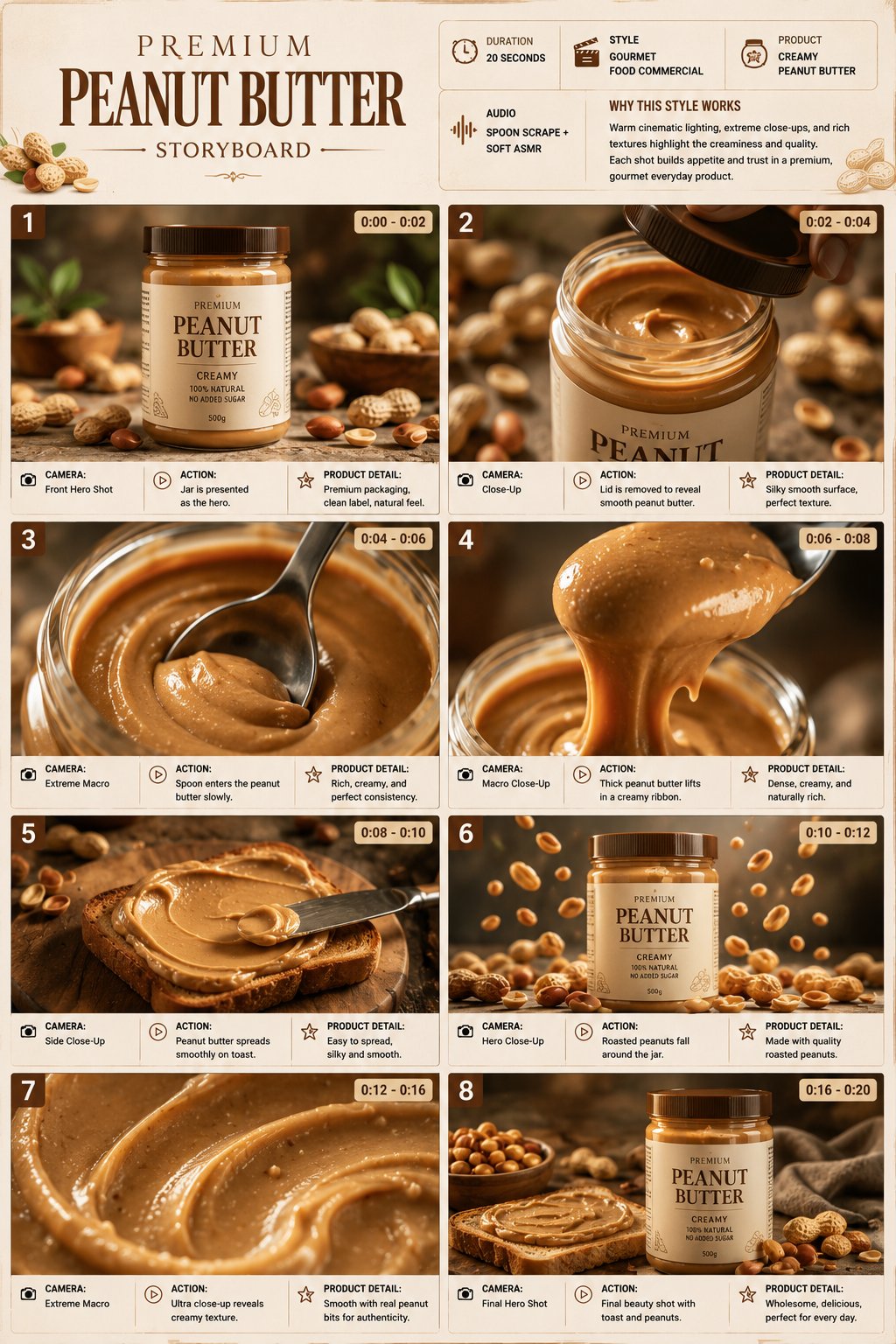
Premium Peanut Butter Commercial Storyboard
 Nano BananaGoogleimage
Nano Banana 2 × Gemini Omni flash 1.1 Prompt - TITLE: Premium Peanut Butter Product Commercial Storyboard FORMAT: • Single-page premium storyboard • 3:4 Portrait ratio • Gourmet breakfast product campaign • 8 cinematic product-focused scenes • Product remains the main hero • Luxury advertising presentation HEADER: • Elegant serif typography • Information cards: - Duration: 20 Seconds - Style: Gourmet Food Commercial - Product: Creamy Peanut Butter - Audio: Spoon Scrape + Soft ASMR • Why This Style Works section • Warm beige, caramel and brown aesthetic • Minimal peanut-inspired decorative elements STORYBOARD: 1. Peanut butter jar positioned on a premium stone surface with whole peanuts around it 2. Jar lid being removed, revealing perfectly smooth peanut butter 3. Spoon entering the jar in an extreme macro shot 4. Thick peanut butter slowly lifting from the spoon in a long creamy ribbon 5. Peanut butter spreading smoothly across warm toasted bread 6. Roasted peanuts falling around the jar in slow motion 7. Extreme macro showing creamy texture with tiny peanut particles 8. Final hero jar beside toast and scattered roasted peanuts EVERY PANEL: • Scene number • Duration badge • Camera direction • Visual • Action • Product detail CAMERA: Extreme macro, slow-motion spread, overhead composition, creamy texture close-up, controlled ingredient drop, smooth product push-in. STYLE: Ultra-realistic food photography, rich creamy texture, realistic viscosity, roasted peanut details, warm natural lighting, premium glass packaging, sophisticated breakfast advertising, 8K.
Details
- Type
- AI Image Prompts
- Aspect Ratio
- 2:3
- Updated
- Sep 4, 2026
How to use this prompt
- 1Copy the full prompt with the copy button above.
- 2Open Nano Banana by Google, or any image generator with a similar style range.
- 3Paste the prompt, then swap the subject and style keywords to match your idea.
- 4Match the example's settings (2:3 · Product Photography · Advertising · Food), then iterate — small wording changes shift the output a lot.
Frequently asked questions
Which AI model generated this image?
This image was generated with Nano Banana by Google. The prompt on this page is the exact text used to create it.
What settings does this prompt use?
The example was generated with Nano Banana using: 2:3 · Product Photography · Advertising · Food. Reusing these settings gives the closest match.
How do I get similar results?
Copy the prompt as-is first, then replace only the subject while keeping the style, lighting, and composition keywords. Generate a few variations — outputs differ between runs.
Can I modify this prompt?
Yes. Prompts work best as starting points — adjust descriptors, aspect ratio, or style tags to make the output your own.
![Make me a 6-slide TikTok photo carousel for [app]: slide 1 is a wide, candid, realistic photo with t — AI image prompt — Nano Banana](https://cdn.ahaprompt.app/harvest-media/import-1791518772826-8d3z30.jpg)