LogoAhaPrompt
  • Prompts
  • Featured
  • Models
  • Submit
  • Blog
AhaPromptAhaPrompt

AI Prompts for Images, Video & Audio — Every Model, One Library

Built withLogoNEXTY.DEV
Explore
  • All Prompts
  • Featured Prompts
  • Image Prompts
  • Video Prompts
  • Audio Prompts
  • AI Models
  • Submit a Prompt
  • Blog
Languages
  • English
  • 中文
  • 日本語
  • 한국어

Copyright © 2026 AhaPrompt All rights reserved.

Privacy PolicyTerms of Service
HomeAI Prompt LibraryAI Image PromptsHand-drawn watercolor owl on branch
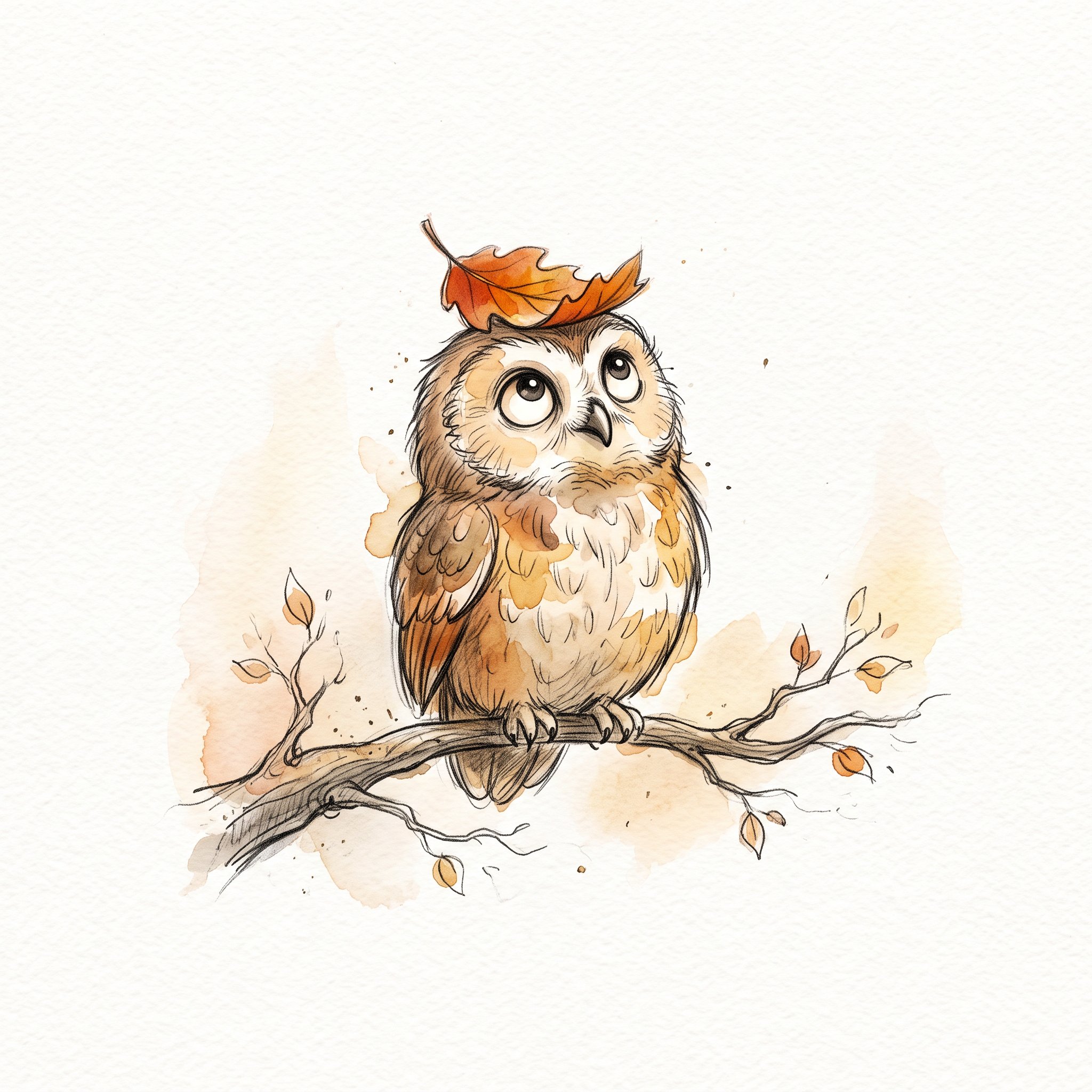
Hand-drawn watercolor owl on branch — AI image prompt — Nano Banana 2.1 — Whimsical, Watercolor, Sketch

Hand-drawn watercolor owl on branch
GoogleNano Banana 2.1Googleimage

A charming hand-drawn owl perched on a delicate branch, gazing upward as a single autumn leaf rests atop its head. Rendered in expressive dark pencil lines with a few translucent watercolor washes, subtle paper texture, warm fall tones, gentle natural light, and a whimsical, storybook mood; centered composition with clean, softly textured background.

Details
Type
AI Image Prompts
Aspect Ratio
1:1
Updated
Oct 29, 2026
Category
WhimsicalWatercolorSketch
Source

How to use this prompt

  1. 1Copy the full prompt with the copy button above.
  2. 2Open Nano Banana 2.1 by Google, or any image generator with a similar style range.
  3. 3Paste the prompt, then swap the subject and style keywords to match your idea.
  4. 4Match the example's settings (1:1 · Whimsical · Watercolor · Sketch), then iterate — small wording changes shift the output a lot.

Frequently asked questions

Which AI model generated this image?

This image was generated with Nano Banana 2.1 by Google. The prompt on this page is the exact text used to create it.

What settings does this prompt use?

The example was generated with Nano Banana 2.1 using: 1:1 · Whimsical · Watercolor · Sketch. Reusing these settings gives the closest match.

How do I get similar results?

Copy the prompt as-is first, then replace only the subject while keeping the style, lighting, and composition keywords. Generate a few variations — outputs differ between runs.

Can I modify this prompt?

Yes. Prompts work best as starting points — adjust descriptors, aspect ratio, or style tags to make the output your own.
More Nano Banana 2.1 prompts

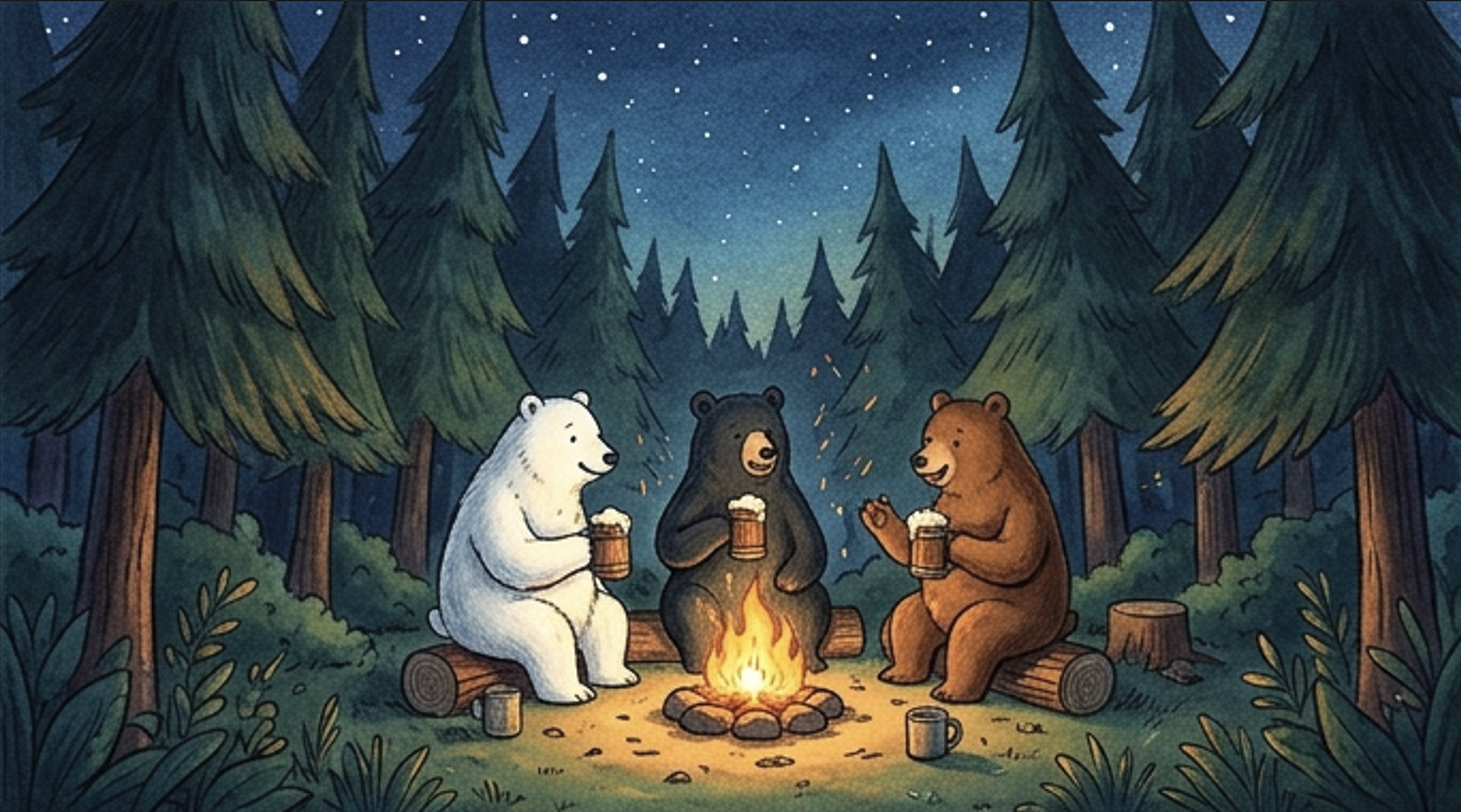
Children's book illustration style, create a 2x2 image grid showing different angles of this scene:
 — AI image prompt — Nano Banana 2.1
GoogleNano Banana 2.1
Children's book illustration style, create a 2x2 image grid showing different angles of this scene: a polar bear, a black bear, and a brown bear all drinking beer in the woods sitting around a campfire at night
Details
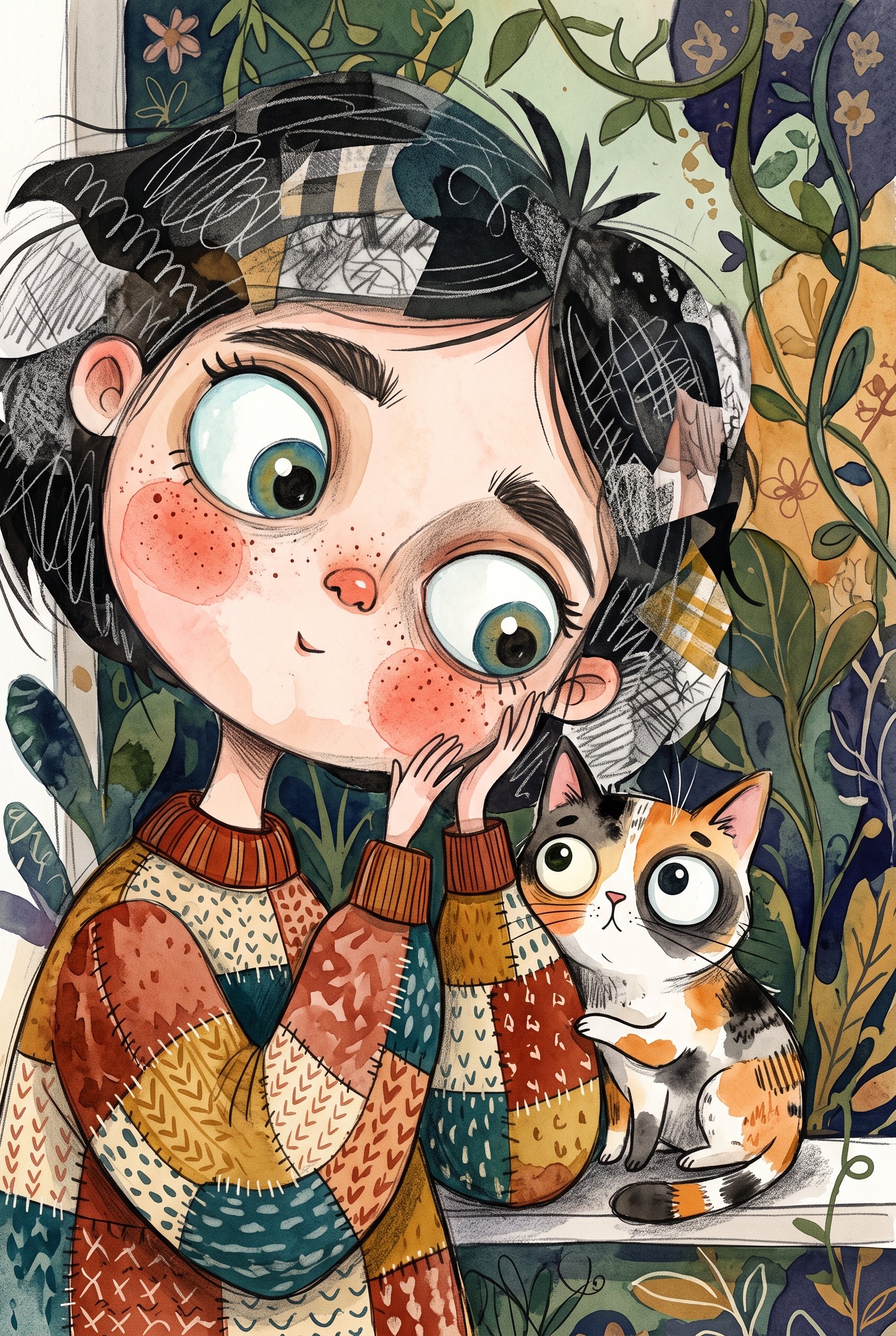
Extreme close-up mixed-media storybook illustration of [HUMAN] with [ANIMAL] beside them in [SETTING — AI image prompt — Nano Banana 2.1
GoogleNano Banana 2.1
Extreme close-up mixed-media storybook illustration of [HUMAN] with [ANIMAL] beside them in [SETTING]. Oversized tilted head, gigantic uneven blue-green eyes, thick eyebrows, tiny nose, coral-pink freckled cheeks, thin neck, and miniature hands. Irregular color planes, translucent watercolor, cut-paper layers, ink washes, chalk-pastel grain, and delicate pencil outlines. Sweeping graphic hair with white scribbles. Wearing [CLOTHING], in [COLORS]. Abstract organic background, smaller wide-eyed matching animal, playful asymmetry, intimate composition, and tactile painterly texture.
Details
Create an ultra-realistic black-and-white luxury fine-art portrait, vertical 9:16, using the uploade — AI image prompt — Nano Banana 2.1
GoogleNano Banana 2.1
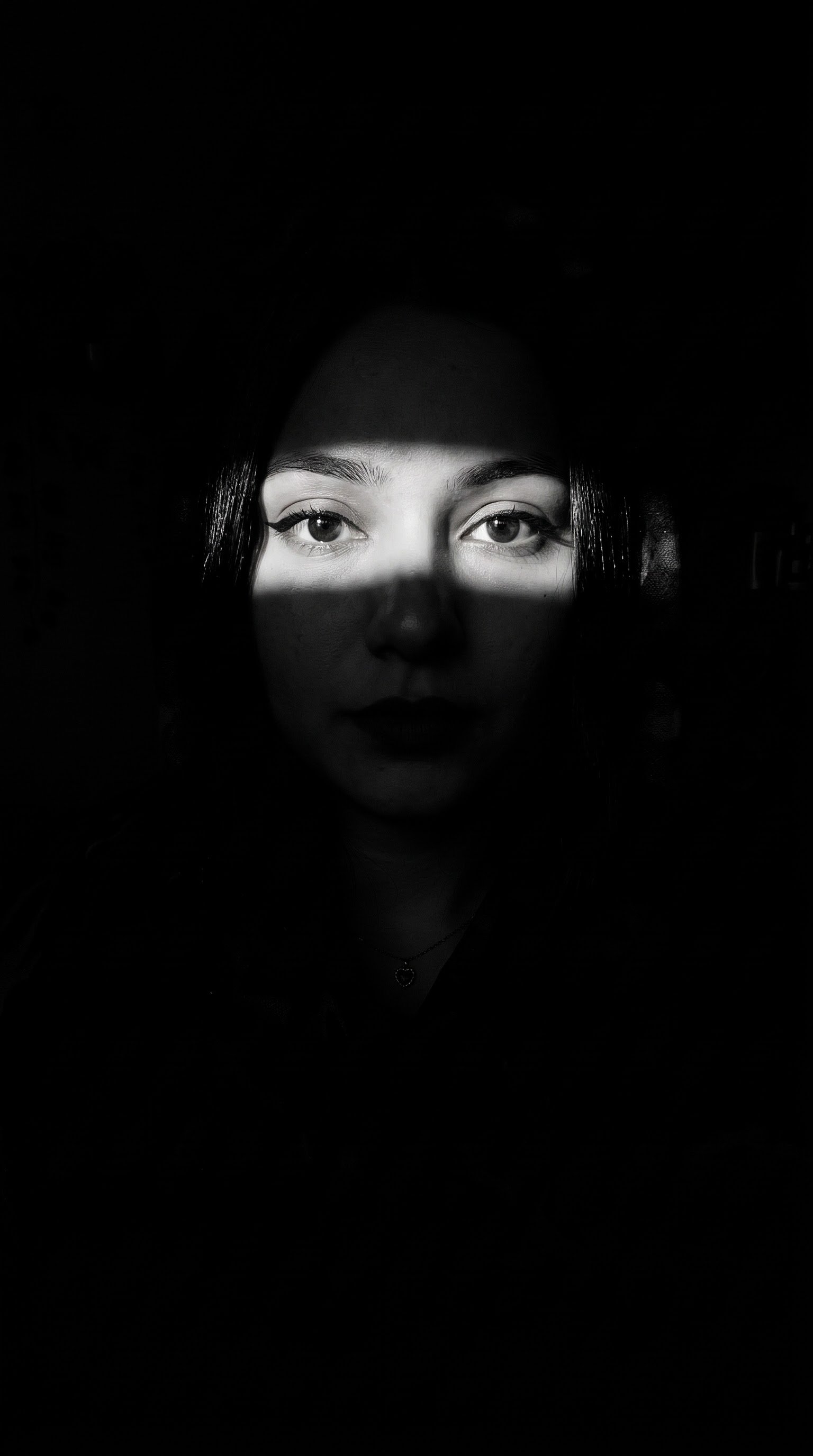
Create an ultra-realistic black-and-white luxury fine-art portrait, vertical 9:16, using the uploaded reference image as the absolute source of truth. STRICT IDENTITY LOCK: Preserve the exact facial identity, eyes, eyebrows, eyelashes, natural skin details, hairstyle, clothing, and accessories from the reference image without alterations. LIGHTING & COMPOSITION: Immerse the entire scene in near-total darkness. Reveal only a thin, sharply defined horizontal beam of light crossing the face, selectively illuminating the eyes, eyebrows, and eyelashes while keeping the rest of the face and background completely hidden in deep black shadows. FOCUS: Extreme close-up emphasizing the natural beauty of the eyes, intricate iris details, sharp eyelashes, and expressive gaze. Dramatic high-contrast chiaroscuro, deep blacks, cinematic mystery, and sophisticated fine-art photography.
Details
2x2 grid, 16:9, do this for 4 under rated sci-fi movies: Style = {
  
  MEDIUM: Hand-drawn sketchboo — AI image prompt — Nano Banana 2.1
GoogleNano Banana 2.1
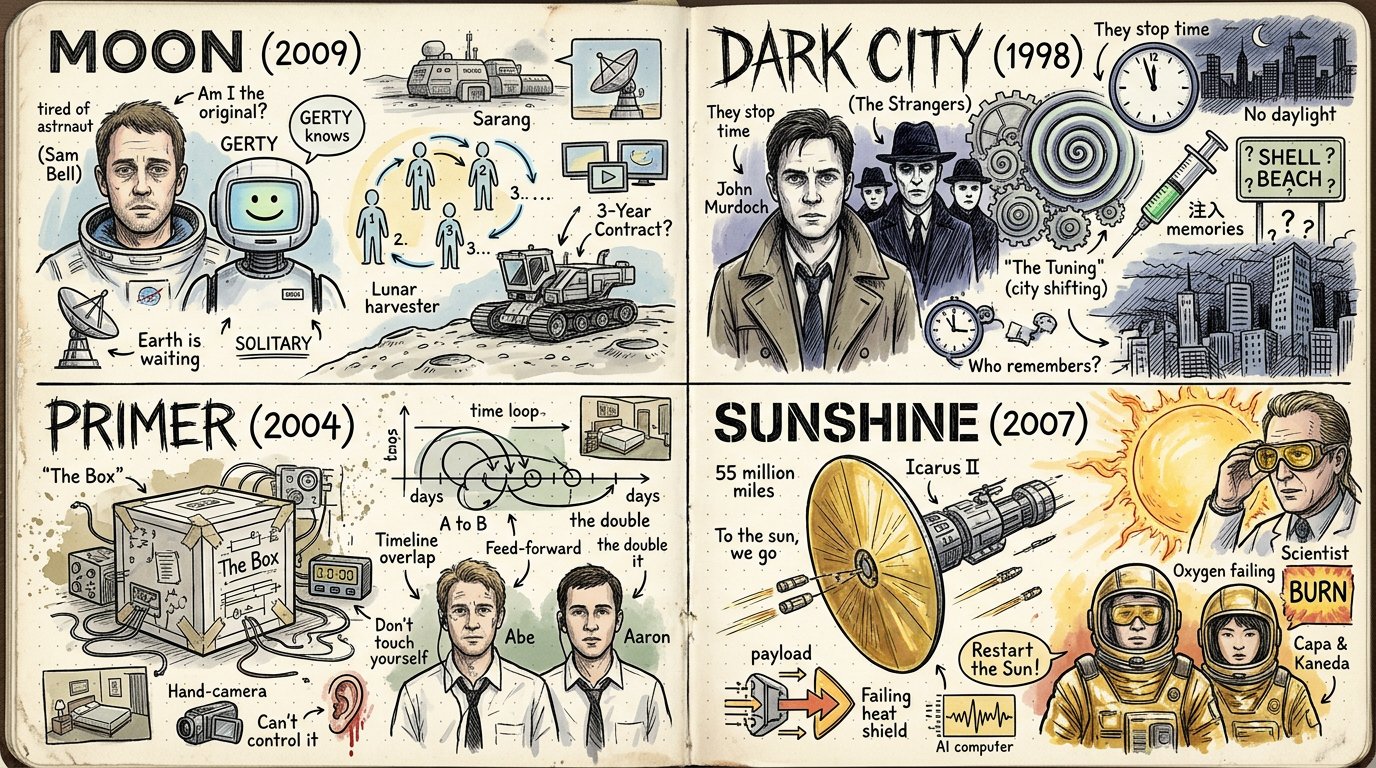
2x2 grid, 16:9, do this for 4 under rated sci-fi movies: Style = { MEDIUM: Hand-drawn sketchbook spread, visual biography map, notebook doodle infographic, scrapbook-style idea journal. SURFACE: Open cream notebook pages, dotted-grid paper, worn page edges, slight paper grain, soft archival texture. LINEWORK: Black ink pen drawing, loose crosshatching, hand-lettered labels, imperfect doodle outlines, energetic sketch marks. COLOR: Mostly monochrome ink with sparse watercolor or marker accents in muted peach, pale blue, soft yellow, faded red, dusty green, and warm beige. COMPOSITION: Dense two-page spread filled with portraits, icons, inventions, arrows, symbols, timelines, labels, speech bubbles, diagrams, and memory fragments. TYPOGRAPHY: Casual handwritten titles, labels, notes, arrows, underlines, callouts, small captions, and playful emphasis marks. MOOD: Curious, biographical, inventive, educational, intimate, nostalgic, messy-but-organized, and highly inspectable. - Convert the subject into a hand-drawn notebook spread that explains its life, history, system, mythology, process, or cultural impact. - Preserve the subject’s core identity, but break it into many small doodled moments, icons, milestones, influences, tools, places, quotes, diagrams, and symbolic objects. - Replace polished realism with black ink sketch lines, hatching, dotted texture, handwritten notes, and small imperfect doodles. - Convert major events, features, powers, products, traits, discoveries, or transformations into illustrated callouts connected by arrows and winding paths. - Reinterpret relationships and timelines as visual flow: arrows, loops, roads, spirals, gears, maps, banners, labels, and notebook annotations. - Convert important people, creatures, objects, locations, ideas, or components into small portrait doodles, simplified icons, diagrams, badges, and comic-like vignettes. - Use sparse color only to highlight key areas, not to fully render the whole image. - Place everything across an open notebook or journal spread so the page itself becomes the environment. - Let the result feel like someone obsessively studied the subject and filled a sketchbook with everything important about it. - Use a two-page open notebook layout when possible. - Place the largest focal image, portrait, object, logo, or main symbol on one side. - Fill the surrounding space with smaller doodles, arrows, captions, miniature diagrams, and symbolic references. - Use the opposite page for a roadmap, process flow, timeline, ecosystem, invention chain, or idea network. - Keep the composition dense but navigable: clusters should feel intentionally grouped. - Leave small pockets of breathing room so the page does not become visual noise. - Use hand-drawn icons for abstract ideas. - Use arrows and motion paths to show progress, influence, causality, or transformation. - Use spirals, gears, lightbulbs, clouds, stars, hearts, boxes, banners, speech bubbles, and small symbols where they support the subject. - Turn complex objects into simplified sketchbook diagrams. - Let small imperfections, uneven line weight, and casual mark-making remain visible. - Every doodle should feel related to the subject, not random decoration. - Use handwritten labels, not clean digital type. - Mix small captions, large casual headings, arrows, short notes, and underlined phrases. - Keep text short and punchy. - Use labels to explain icons, milestones, relationships, or key concepts. - Allow playful missive-like notes, but avoid long paragraphs. - If exact text is not provided, infer concise subject-relevant labels and diagram notes. - Keep black ink dominant. - Use faded pastel accents sparingly for emphasis. - Favor muted watercolor fills, marker washes, and lightly tinted areas. - Avoid full-color rendering, neon palettes, glossy gradients, or saturated cartoon color. - Let cream paper and black linework define the main visual identity. - Render as a physical sketchbook page photographed or scanned. - Use visible paper texture, notebook fold, subtle page wear, and dotted-grid background. - Use crosshatching and line density for shading instead of digital gradients. - Keep drawings loose but legible. - Make the image rewarding to inspect closely, with many tiny connected ideas. - Balance educational clarity with personal sketchbook charm. - Open sketchbook biography-map aesthetic. - Dense black-ink doodles, handwritten notes, arrows, icons, portraits, diagrams, and sparse muted color accents. - Feels like a personal research journal, creative mind map, invention history, or illustrated life story. - Informative, nostalgic, playful, handmade, and highly inspectable. - Avoid photorealism. - Avoid clean corporate infographic styling. - Avoid glossy 3D, toy, clay, plush, anime, or low-poly rendering. - Avoid overly polished vector art. - Avoid empty minimal pages. - Avoid random unrelated doodles. - Avoid dense unreadable text blocks. - Avoid bright saturated full-color poster treatment. - Avoid perfect symmetry; preserve lively notebook spontaneity. }
Details
2x2 grid, 16:9, do this for 4 international classics like Shahnameh: INPUT = "$SUBJECT"

STYLE_DNA = — AI image prompt — Nano Banana 2.1
GoogleNano Banana 2.1
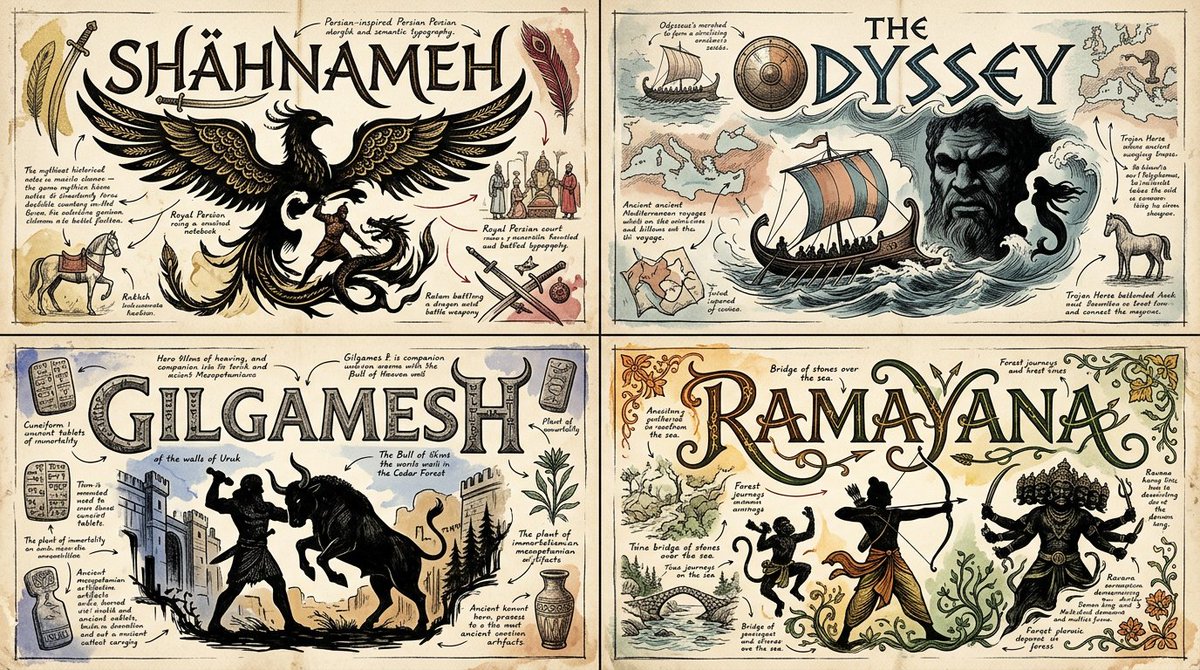
2x2 grid, 16:9, do this for 4 international classics like Shahnameh: INPUT = "$SUBJECT" STYLE_DNA = { "ILLUSTRATED_NOTEBOOK": { "medium": "aged ivory paper + editorial ink illustration", "marks": [ "fine black outlines", "crosshatched portraits", "muted hand-colored drawings", "scribbled arrows", "miniature explanatory doodles", "handwritten captions" ], "composition": "information flows through connected visual discoveries" }, "SEMANTIC_TYPOGRAPHY": { "medium": "bespoke vector-like calligram", "structure": [ "letterforms contain symbols", "letters morph into recognizable objects", "typographic strokes encode meaning", "organic and geometric letterform fusion", "color communicates conceptual character" ], "principle": "the word visually demonstrates its meaning" }, "MYTHIC_SILHOUETTE": { "medium": "high-contrast black-and-white emblem", "structure": [ "heroic silhouettes", "negative-space integration", "flowing ornamental forms", "symbolic animals or figures when relevant", "elegant literary typography" ], "principle": "image and lettering share one silhouette" } } def extract_semantic_dna(subject): return { "identity": infer_recognizable_identity(subject), "narrative": infer_meaningful_story(subject), "symbols": infer_authentic_visual_associations(subject), "geometry": infer_iconic_shapes(subject), "personality": infer_emotional_character(subject), "relationships": infer_semantic_connections(subject) } def construct_calligram(subject, dna): word = choose_primary_label(subject) candidates = generate_letterform_transformations( text=word, symbols=dna["symbols"], geometry=dna["geometry"] ) return optimize( candidates, objective={ "legibility": 0.40, "semantic_relevance": 0.30, "visual_elegance": 0.20, "originality": 0.10 }, preserve_letter_order=True, preserve_recognizable_word=True ) def illustrate_knowledge(dna): return create_ink_drawings( hero=dna["identity"], companions=select_meaningful_symbols(dna["symbols"]), connections=dna["relationships"], drawing_style="antique editorial sketchbook", detail="small but inspectable" ) def fuse_silhouettes(calligram, dna): return integrate_negative_space( main_word=calligram, visual_symbols=dna["geometry"], methods=[ "shared outlines", "figure-ground reversal", "letter-object morphing", "contour continuation", "internal silhouette cutouts" ], avoid="forced illegible letter distortion" ) def generate_artwork(subject): dna = extract_semantic_dna(subject) calligram = construct_calligram(subject, dna) knowledge = illustrate_knowledge(dna) emblem = fuse_silhouettes(calligram, dna) return compose( dominant_form=emblem, secondary_elements=knowledge, narrative_flow=infer_best_connector(dna), typographic_system={ "display": "expressive semantic calligram", "supporting": "elegant illustrated labels", "microtext": "restrained handwritten notes" }, material="cream archival paper and black ink", accents=infer_semantically_meaningful_colors(subject), complexity="high internal intelligence, clean overall silhouette", output="one integrated visual identity artwork" ) RESULT = generate_artwork(INPUT) CONSTRAINTS: - Do not hard-code a person, invention, myth, or historical era. - Do not add unrelated decorative symbols. - Preserve accurate spelling and readable lettering. - Use literal imagery only when semantically justified. - Favor clever figure-ground transformations over visual clutter. - Keep the overall composition coherent as one artwork.
Details
2x2 grid, 16:9, do this for creativity, hope, science, fortitude: class ToyBubbleDiorama:     def __ — AI image prompt — Nano Banana 2.1
GoogleNano Banana 2.1
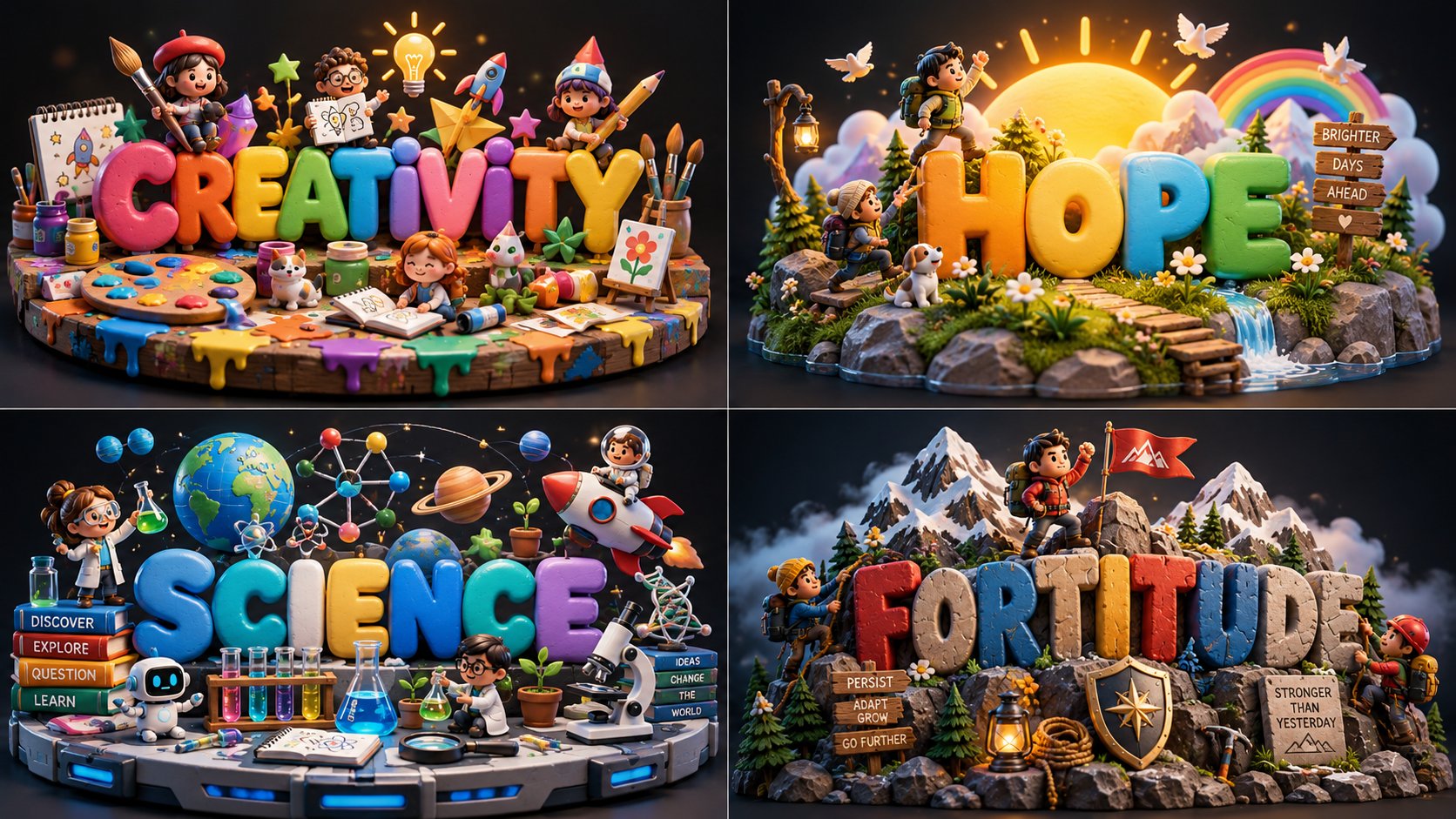
2x2 grid, 16:9, do this for creativity, hope, science, fortitude: class ToyBubbleDiorama: def __init__(self, topic): self.topic = topic self.title = derive_short_title(topic) self.moment = infer_core_moment(topic) self.props = infer_iconic_props(topic, count=3) self.characters = infer_mini_characters(topic) self.base = infer_environment_base(topic) self.palette = infer_playful_palette(topic) def letters(self): return { "form": "chunky rounded 3D bubble letters", "material": "soft toy plastic / clay / rubbery foam", "finish": "matte with gentle gloss highlights", "layout": "large centered title" } def scene(self): return { "props": self.props, "characters": self.characters, "base": self.base, "background": "dark studio backdrop" } def render(self): return """ Render one compact 3D diorama where colorful bubble letters tell the title and the surrounding props explain the topic. """ generate_image(ToyBubbleDiorama(TOPIC))
Details
ABSOLUTE IDENTITY LOCK — ALR: Use the uploaded reference image as the absolute source of truth for t — AI image prompt — Nano Banana 2.1
GoogleNano Banana 2.1
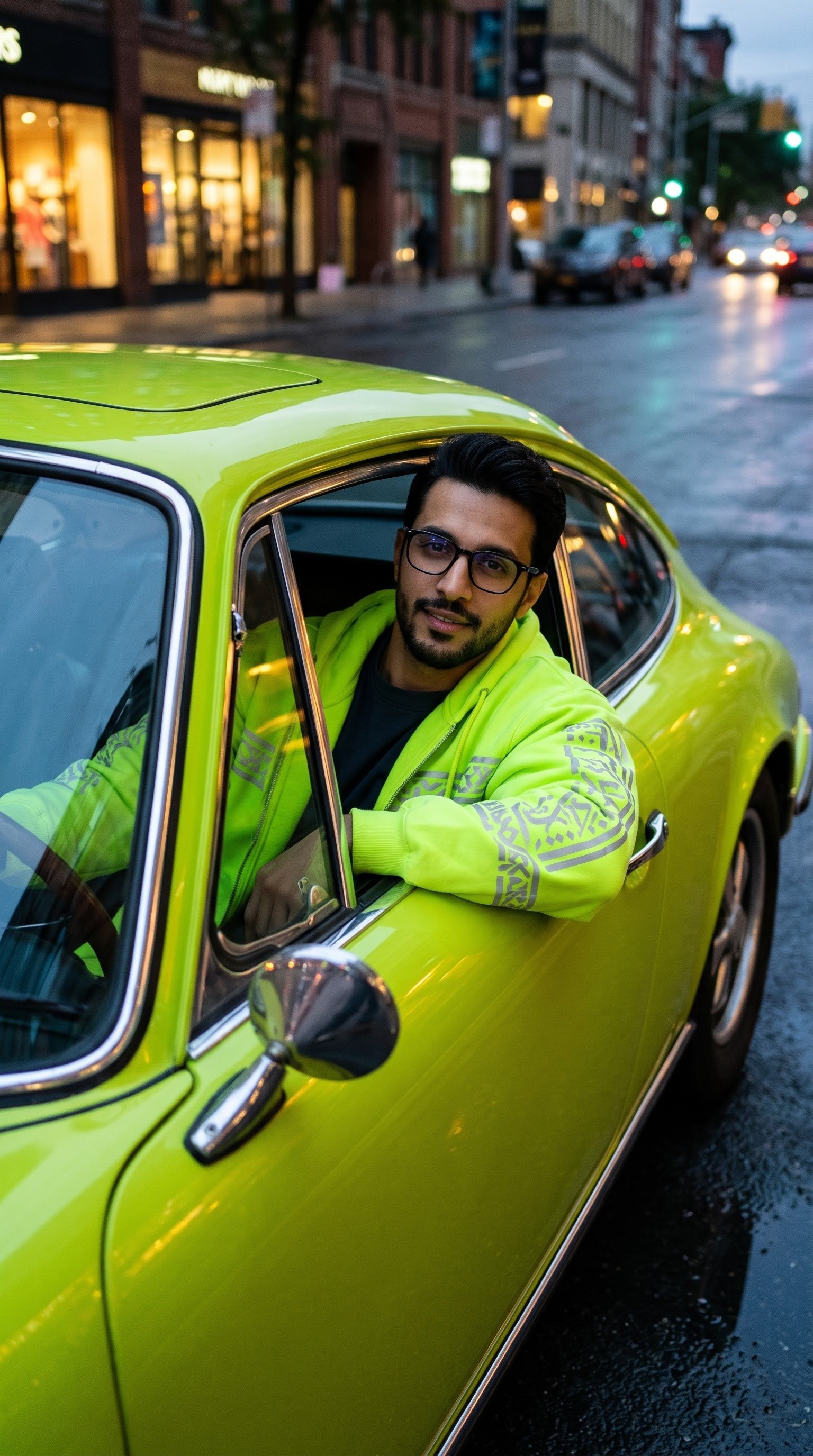
ABSOLUTE IDENTITY LOCK — ALR: Use the uploaded reference image as the absolute source of truth for the subject's personal identity and facial appearance. Preserve the exact face, facial features, bone structure, proportions, eyes, nose, lips, jawline, natural skin tone, and all recognizable identity characteristics. No facial alterations, beautification, reinterpretation, or identity drift. STRICT SCENE & STYLING LOCK: Reproduce the described scene exactly as specified. The neon lime-green vintage sports car, driver's-side window pose, arm positions, body posture, oversized neon lime-green hooded jacket, reflective silver calligraphic patterns, camera angle, framing, background, lighting, colors, and cinematic composition are mandatory and must not be changed, omitted, or reinterpreted. The reference image controls identity only. The written prompt exclusively controls the scene, pose, wardrobe, styling, and artistic direction. FINAL RULE: Combine the exact identity from the reference image with the exact visual composition and styling described in the prompt. No creative deviations from either requirement.
Details
2x2 grid, do this for 4 famous mathematicians TECHNIQUE: Single Crochet. TEXTURE: Visible loop stitc — AI image prompt — Nano Banana 2.1
GoogleNano Banana 2.1
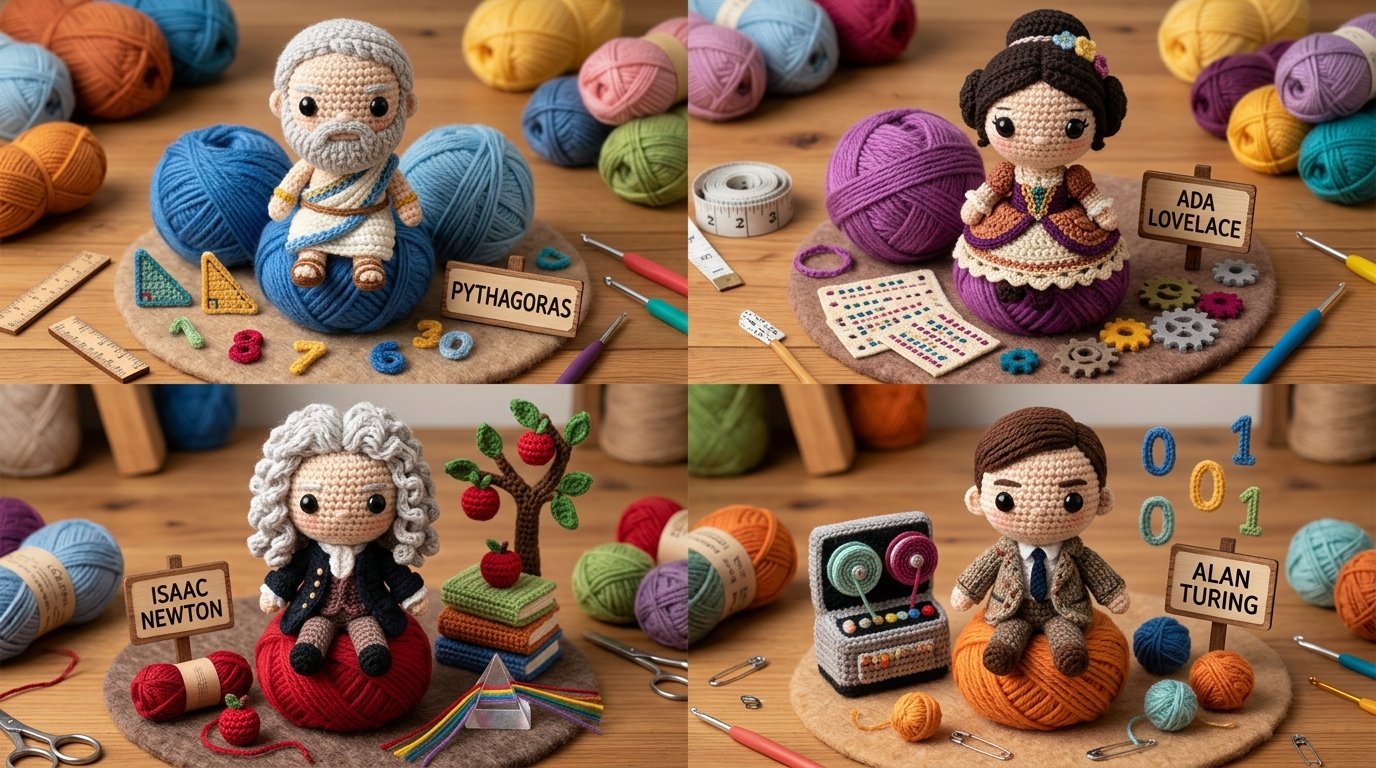
2x2 grid, do this for 4 famous mathematicians TECHNIQUE: Single Crochet. TEXTURE: Visible loop stitches. MATERIAL: Worsted weight yarn. - Convert entire surface to tight yarn loops. - Eyes are plastic safety eyes. - Increase size of head relative to body (chibi). -preserve cuddly, handmade look Output: one image}
Details
Browse all Nano Banana 2.1 promptsExplore AI Image Prompts