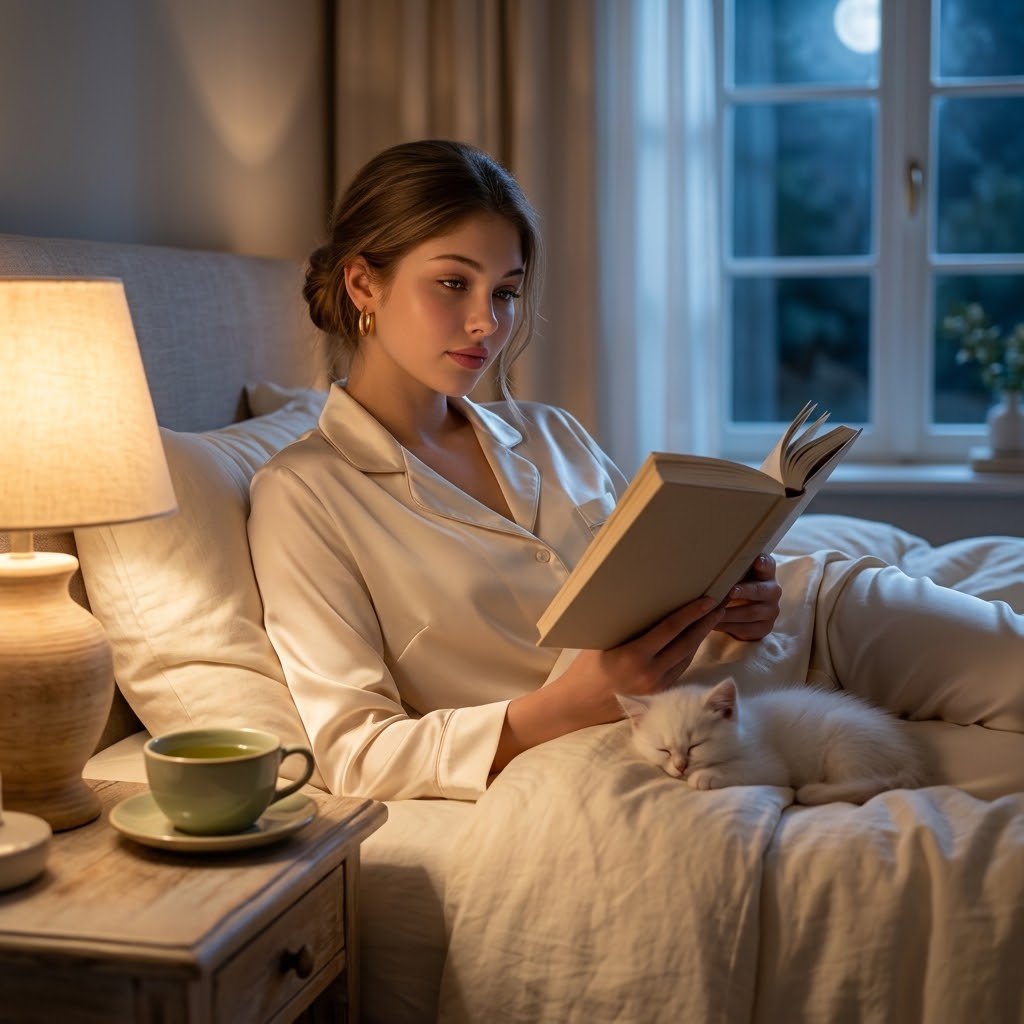
Cozy Bedroom Nighttime Reading Portrait

Create a photorealistic cinematic nighttime lifestyle portrait.Preserve the same reference woman’s recognizable facial structure, face shape, eyes, eyebrows, nose, lips, skin tone, complexion, and natural facial proportions from the reference. Maintain her identity-like appearance consistently. Natural skin texture, subtle pores, realistic details, no facial distortion. She is relaxing comfortably in an elegant cozy bedroom, sitting against soft pillows on a neatly made bed while reading a hardcover book. She wears luxurious ivory satin pajamas with a relaxed low bun and a few natural strands framing her face, plus delicate gold hoop earrings. A fluffy cream-colored cat sleeps peacefully beside her. A warm bedside lamp casts soft golden light while cool blue moonlight enters through a large window, creating a beautiful warm-and-cool cinematic contrast. A cup of tea sits on the wooden nightstand beside the lamp. Soft beige bedding, elegant neutral interiors, realistic fabric textures, intimate peaceful nighttime atmosphere. CAMERA & STYLE: Photorealistic cinematic photography, 50mm lens, natural perspective, shallow depth of field, soft bokeh, realistic skin and hair, subtle filmic lighting, soft shadows, premium luxury lifestyle photography, highly detailed, natural colors, 8K realism. Negative Prompt identity drift, different face, altered facial structure, distorted face, asymmetrical eyes, unnatural eyes, deformed hands, extra fingers, missing fingers, fused fingers, malformed limbs, bad anatomy, plastic skin, overly smooth skin, excessive makeup, unnatural hair, duplicate person, duplicate cat, distorted cat, floating objects, warped book, unreadable text, CGI, cartoon, illustration, 3D render, oversaturated colors, harsh lighting, excessive blur, low resolution, noise, artifacts, watermark, logo, text, cropped face, unnatural pose
Details
- Type
- AI Image Prompts
- Aspect Ratio
- 1:1
- Updated
- Sep 29, 2026
How to use this prompt
- 1Copy the full prompt with the copy button above.
- 2Open Nano Banana Pro by Google, or any image generator with a similar style range.
- 3Paste the prompt, then swap the subject and style keywords to match your idea.
- 4Match the example's settings (1:1 · Cinematic · Realistic · Portrait), then iterate — small wording changes shift the output a lot.
Frequently asked questions
Which AI model generated this image?
This image was generated with Nano Banana Pro by Google. The prompt on this page is the exact text used to create it.
What settings does this prompt use?
The example was generated with Nano Banana Pro using: 1:1 · Cinematic · Realistic · Portrait. Reusing these settings gives the closest match.
How do I get similar results?
Copy the prompt as-is first, then replace only the subject while keeping the style, lighting, and composition keywords. Generate a few variations — outputs differ between runs.
Can I modify this prompt?
Yes. Prompts work best as starting points — adjust descriptors, aspect ratio, or style tags to make the output your own.