LogoAhaPrompt
  • Prompts
  • Featured
  • Models
  • Submit
  • Blog
AhaPromptAhaPrompt

AI Prompts for Images, Video & Audio — Every Model, One Library

Built withLogoNEXTY.DEV
Explore
  • All Prompts
  • Featured Prompts
  • Image Prompts
  • Video Prompts
  • Audio Prompts
  • AI Models
  • Submit a Prompt
  • Blog
Languages
  • English
  • 中文
  • 日本語
  • 한국어

Copyright © 2026 AhaPrompt All rights reserved.

Privacy PolicyTerms of Service
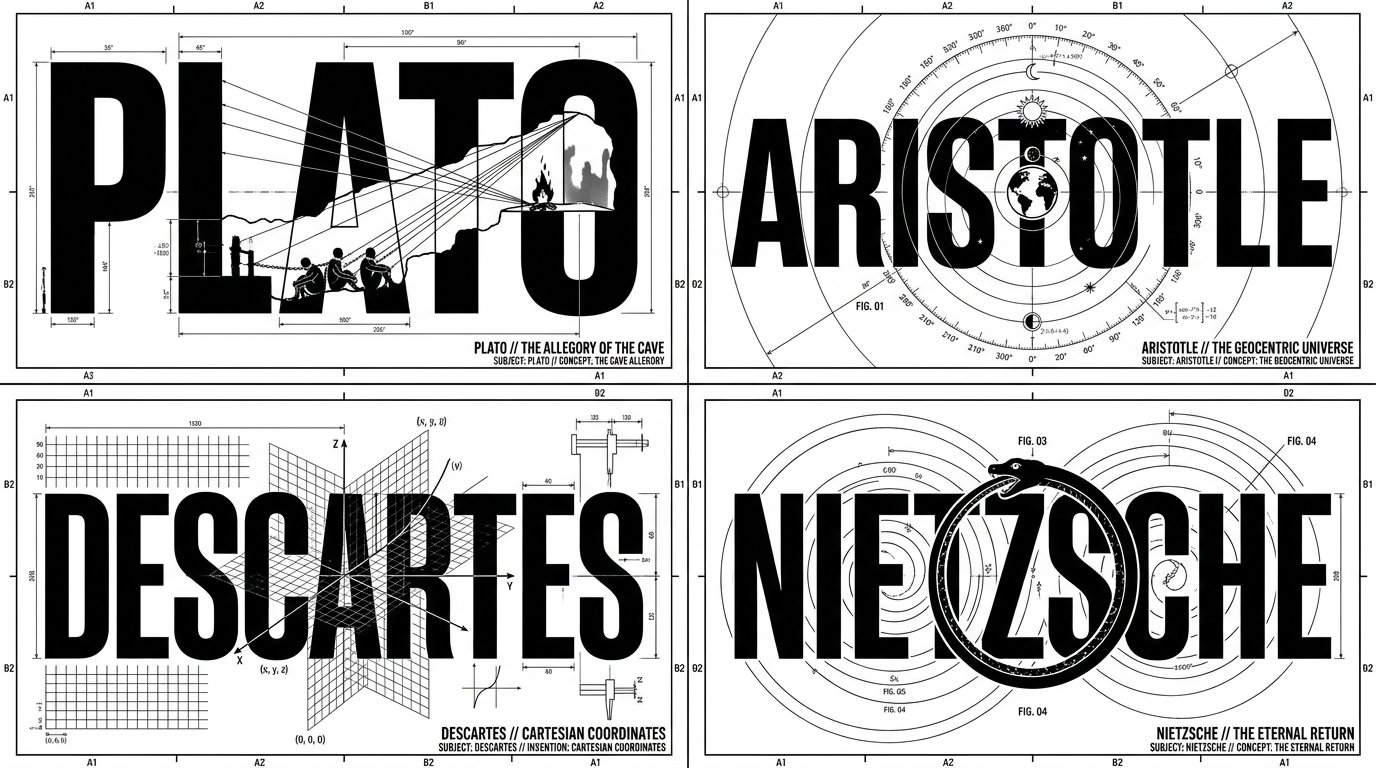
HomeAI Prompt LibraryAI Image PromptsTypographic math concept logo grid
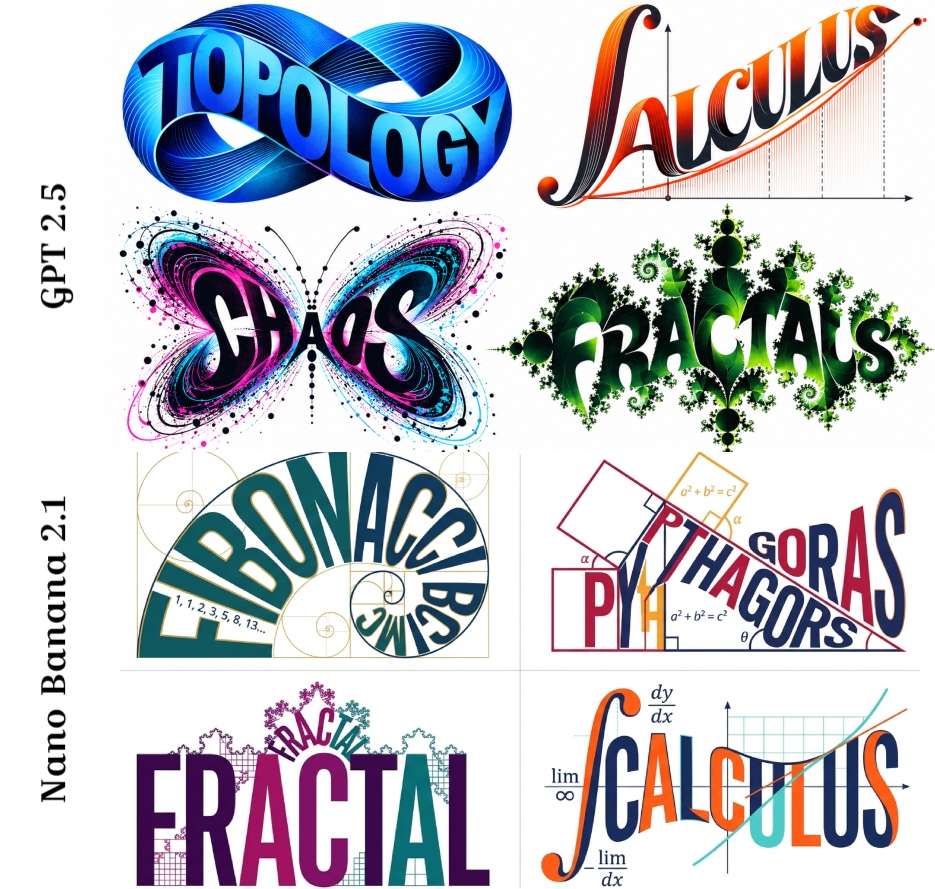
Typographic math concept logo grid — AI image prompt — Nano Banana 2.1 — Typography, Vector, Logo Design

Typographic math concept logo grid

GoogleNano Banana 2.1Googleimage

2x2 grid, 16:9, do this 4 math topics, A clever, striking typographic illustration on a pure white background::5 The Typography: The word "[WORD/CONCEPT]" written in massive, bold font. The letters stretch, bend, and warp to perfectly form the physical shape of AI_INFER(a symbol representing the word)::5 The Details: AI_INFER(Highly stylized textures, flowing ribbons, ink splatters, or mechanical parts seamlessly blending into the letters)::4 The Palette: AI_INFER(A bold, thematic color scheme fitting the concept), high contrast, graphic design, vector art style::4 Style: Award-winning typography, Dribbble shot, logo design, gestalt illusion::3 3D render, messy, illegible, text overlay, unreadable, photography::-4

Details
Type
AI Image Prompts
Aspect Ratio
935:889
Updated
Oct 27, 2026
Category
TypographyVectorLogo Design
Source

How to use this prompt

  1. 1Copy the full prompt with the copy button above.
  2. 2Open Nano Banana 2.1 by Google, or any image generator with a similar style range.
  3. 3Paste the prompt, then swap the subject and style keywords to match your idea.
  4. 4Match the example's settings (935:889 · Typography · Vector · Logo Design), then iterate — small wording changes shift the output a lot.

Frequently asked questions

Which AI model generated this image?

This image was generated with Nano Banana 2.1 by Google. The prompt on this page is the exact text used to create it.

What settings does this prompt use?

The example was generated with Nano Banana 2.1 using: 935:889 · Typography · Vector · Logo Design. Reusing these settings gives the closest match.

How do I get similar results?

Copy the prompt as-is first, then replace only the subject while keeping the style, lighting, and composition keywords. Generate a few variations — outputs differ between runs.

Can I modify this prompt?

Yes. Prompts work best as starting points — adjust descriptors, aspect ratio, or style tags to make the output your own.
More Nano Banana 2.1 prompts

2x2 grid, 16:9, do this for 4 famous manga : Act as a generative rendering engine executing Typograp — AI image prompt — Nano Banana 2.1
GoogleNano Banana 2.1
2x2 grid, 16:9, do this for 4 famous manga : Act as a generative rendering engine executing TypographicMascotRender(SUBJECT). word = text("$subject") clean_remainder = set_type(word[1:], family="playful, bold, rounded monoline", metrics="bouncy baseline") mutant_glyph = deform_glyph(word[0], mapping=adaptive_map(word[0], signature_form($ subject)), add_details=negative_space_eyes) render(compose(clean_remainder, mutant_glyph), inks=ONE_BLACK, ground=PURE_WHITE) Invariants: The first letter must perfectly morph into the silhouette of the $ subject via its own anatomy (e.g., ascenders become necks/tails, bowls become bodies). The remaining letters must share the exact same stroke weight and organic, blobby aesthetic. Use negative space for eyes. Forbidden: No color, no gradients, no realistic textures, no whole-word mutations, no decorated remainder letters. Flat 2D vector style.
Details
2x2 grid, 16:9, do this for 4 famous philosophers: class Engineering_Blueprint_Logo:
    def __init_ — AI image prompt — Nano Banana 2.1
GoogleNano Banana 2.1
2x2 grid, 16:9, do this for 4 famous philosophers: class Engineering_Blueprint_Logo: def __init__(self, subject="[NAME]", invention="[INVENTION/CONCEPT]"): self.canvas = "Pure white background, 1-bit monochrome black ink graphic design" self.layout_engine = "AI_INFER(Determine if the layout should be Orbital, Vertical, or Horizontal based on the physics of the invention)" def generate_schematic(self): # AI INFERENCE: Deduce the heavy typography typography = f"Massive, bold, sans-serif block letters spelling '{subject}'. The text structure aligns with the {self.layout_engine}." # The Splicing Illusion cutout = f"A flat, minimalist silhouette of {invention} slices directly through the typography. Where it overlaps the black text, it is drawn in pure white negative space." # The Hairline Details drafting_marks = "Hundreds of razor-thin (0.25pt) technical lines, crosshairs, orbital arcs, and measurement nodes intersecting the letters." return [typography, cutout, drafting_marks, self.canvas] # EXECUTE: Render as a flawless, scalable vector logo. The contrast between thick letterforms and delicate drafting lines is paramount.
Details
2x2 grid, 16:9, AI pick topics that are in the news today: FINAL_GRAPHIC =

TOPIC_KNOWLEDGE

⊗

UNEX — AI image prompt — Nano Banana 2.1
GoogleNano Banana 2.1
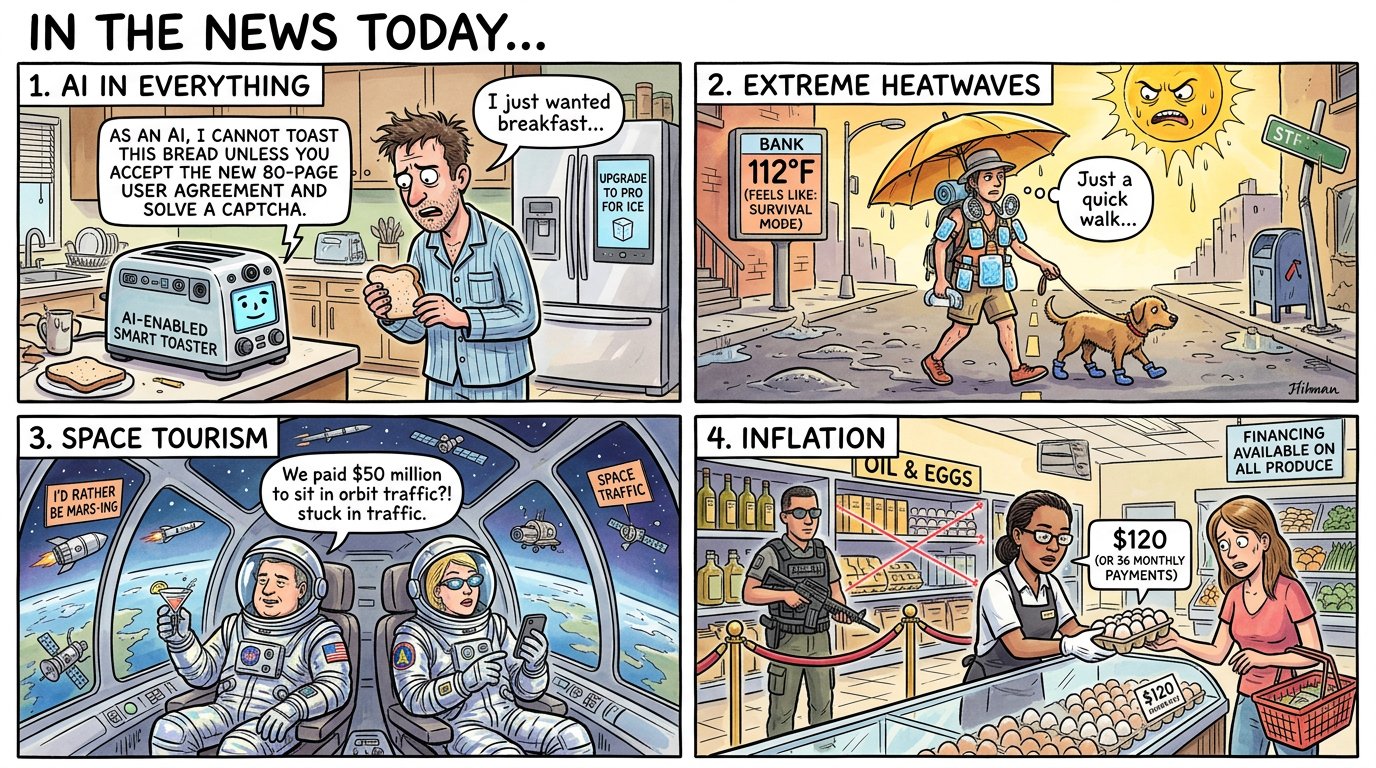
2x2 grid, 16:9, AI pick topics that are in the news today: FINAL_GRAPHIC = TOPIC_KNOWLEDGE ⊗ UNEXPECTED_CONNECTION( ASSOCIATION_A, ASSOCIATION_B ) → COMEDIC_KERNEL → SCENE( HERO?, CAST[0..N], SETTING?, ACTION, PROPS ) + OPTIONAL_TEXT( only_if_needed ) × STYLE_SELECTED_AFTER_JOKE × PRODUCT_ADAPTATION - ( fixed_cast_size + fixed_setting + mandatory_anthropomorphism + mandatory_dialogue + generic_meme_template + repeated_visual_format + unnecessary_explanation )
Details
2x2 grid, 16:9, do this for 4 famous days that stunned humans: class Technical_Typographic_Draft:
   — AI image prompt — Nano Banana 2.1
GoogleNano Banana 2.1
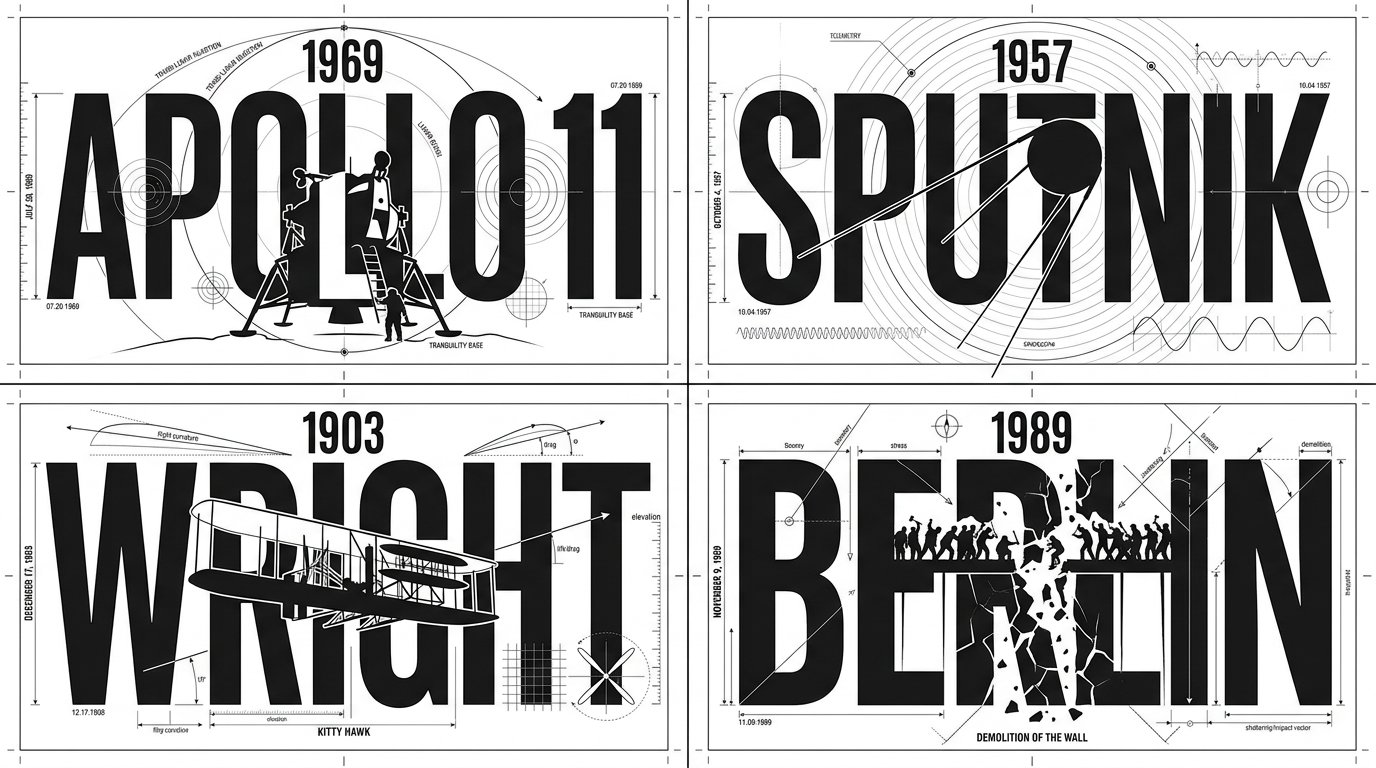
2x2 grid, 16:9, do this for 4 famous days that stunned humans: class Technical_Typographic_Draft: def __init__(self, figure="[FIGURE]", achievement="[ICONIC_ACHIEVEMENT]"): self.canvas = "Pure white background, flat 2D graphic design, strict monochrome black ink" self.aesthetic = "Engineering blueprint, Bauhaus minimalism, technical drawing" def generate_drafting_layout(self): # AI INFERENCE: Deduce the text and central geometric slice typography = f"Massive, bold, rigid sans-serif text spelling '{figure}'. The text is perfectly aligned on a horizontal grid." central_slice = f"AI_INFER(A sleek, minimalist, flat-vector silhouette of {achievement}). This silhouette sits dead-center, using pure white negative space to slice vertically through the heavy black typography." # The Technical Embellishments drafting_lines = "Razor-thin black hairlines spanning the canvas. AI_INFER(Technical drafting marks, concentric arcs, alignment nodes, and crosshairs integrating into the letters, e.g., using an 'O' as a radar/compass node)." return [typography, central_slice, drafting_lines, self.aesthetic] # EXECUTE: Render as a flawless, scalable vector logo. The contrast between thick letterforms and ultra-thin drafting lines is paramount.
Details
2x2 grid, 16:9, do this for 4 eras that defined modern humanity: S₁ CHARACTER SILHOUETTE FILLED WITH — AI image prompt — Nano Banana 2.1
GoogleNano Banana 2.1
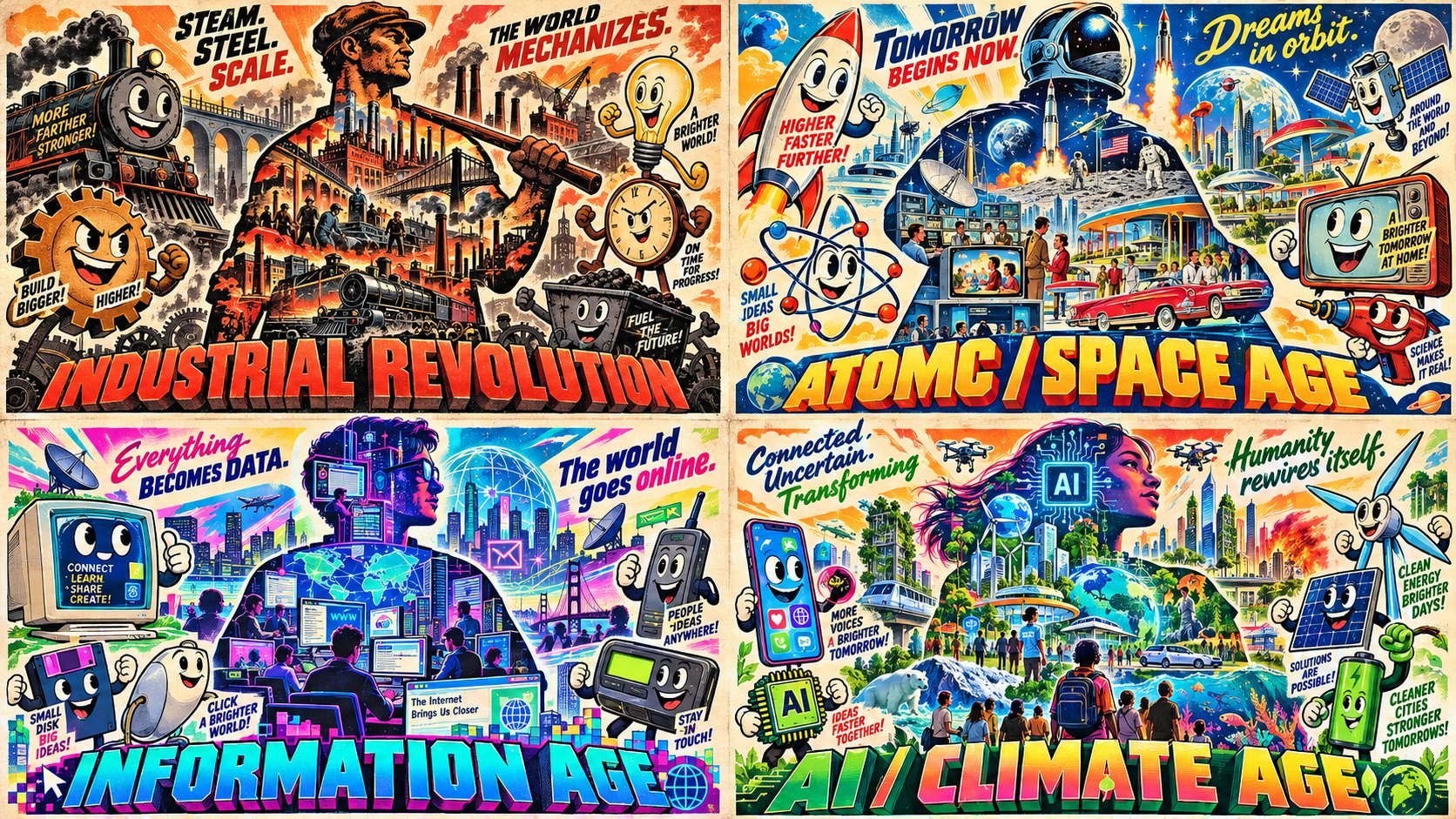
2x2 grid, 16:9, do this for 4 eras that defined modern humanity: S₁ CHARACTER SILHOUETTE FILLED WITH SCENES (master) a central character silhouette whose interior is filled with scenes from the topic/era (city, sunset, objects, people); the silhouette IS the era. ¬S₁ = no silhouette / empty silhouette / scenes outside. S₂ ANTHROPOMORPHIZED OBJECTS WITH era's main emotion appropriate FACES surrounding the silhouette, 3–6 objects from the era with smiley faces and expressive eyes (cassette, phone, car, food, tool); each object is a character. ¬S₂ = no objects / no smiley faces / realistic objects / generic props. S₃ GIANT 3D TYPOGRAPHY + TAGLINES giant bold 3D title at the bottom naming the era/topic; taglines above the silhouette or panels; legible, retro style. ¬S₃ = small type / no 3D / no taglines / modern font. S SATURATED RETRO PALETTE saturated colors (neon pink, electric blue, sunset orange, lime green) on cream; retro poster feel; bold shapes. ¬S₄ = muted / grayscale / modern minimal / dark ground. S₅ MULTI‑PANEL OR COMPOSITIONAL DENSITY either a multi-panel layout (4 panels like Image 55) or a single dense composition with the silhouette + objects + title filling the frame; no empty space. ¬S₅ = sparse / single object / empty frame. η HONEST RETRO bold shapes, saturated fills, retro typography, poster texture. FORBIDDEN = no silhouette · empty silhouette · no smiley objects · small type · no 3D · muted palette · sparse · empty frame
Details
2x2 grid, 16:9, do this for 4 legendary architects: CLASSIFY(input) → {
  domain:      isometric_3D  — AI image prompt — Nano Banana 2.1
GoogleNano Banana 2.1
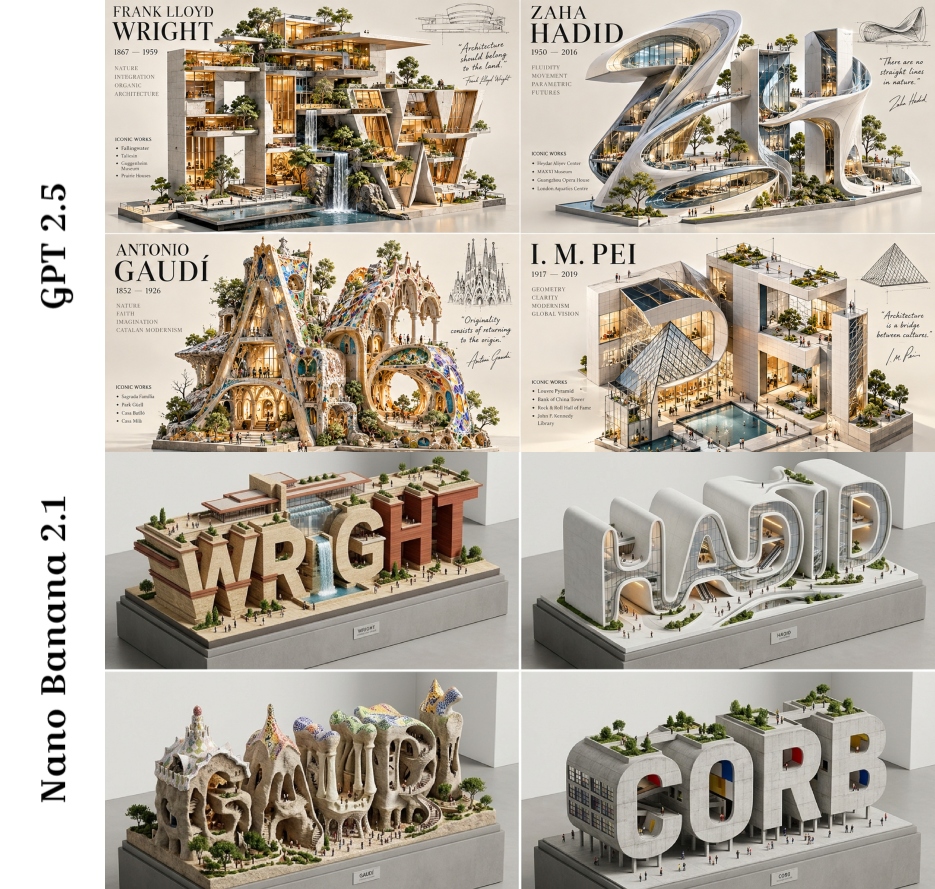
2x2 grid, 16:9, do this for 4 legendary architects: CLASSIFY(input) → { domain: isometric_3D × typographic_sculpture × architectural_diorama × brand_pavilion intent: elevate + inhabit + miniaturize (the "monumental letterform as habitable space") audience: brand identity directors, architectural visualizers, premium product designers platform: 1:1 or 4:5 high-res 3D render, flagship campaign hero, collectible digital art complexity: extreme (requires strict dual-scale management, volumetric boolean typography, luxury material physics, and pristine showroom photometrics) } CORE DESIGN LAWS : ⚠ THE LETTER IS THE BUILDING. THE OUTSIDE IS MINIMAL. THE INSIDE IS RICH. • Form: The `{{SUBJECT}}` is transformed into monumental, freestanding 3D typography or an emblematic silhouette. • Topology: The letterforms act as architecture. Cutaways, terraces, atriums, and galleries are embedded inside. • Scale Duality: Monumental exterior (macro) vs. Miniature interior (micro). Tiny humans and trees define the immense scale. • Materiality: Luxury modern. Matte white concrete, glass curtain walls, brushed aluminum, pale stone. • Lighting: Premium showroom. Soft studio daylight, crisp edges, gentle ambient occlusion, recessed interior LEDs. • Vibe: Futuristic, refined, aspirational. "Flagship campus" energy. Zero grunge, zero toy aesthetics. SEMANTIC_VARIABLES (AI infers from {{SUBJECT}}): {{SUBJECT}} → [e.g., "AERO", "LUMEN", "NEXUS", or a brand emblem] {{TYPOLOGY}} → The base 3D letterforms or emblematic mass {{INTERIOR_PROGRAM}}→ [e.g., Sunken galleries, cantilevered terraces, glass atriums] {{MICRO_ELEMENTS}} → Tiny scale figures, miniature planters, digital kiosks, sleek benches {{ACCENT_PALETTE}} → Restrained natural greens + 1 inferred brand accent color {{LIGHTING_RIG}} → Soft studio daylight + warm interior accent pools
Details
2x2 grid, 16:9, do this for 4 growing job sectors of 2026: W₁  WORDMARK SPINE (master)   the place/t — AI image prompt — Nano Banana 2.1
GoogleNano Banana 2.1
2x2 grid, 16:9, do this for 4 growing job sectors of 2026: W₁ WORDMARK SPINE (master) the place/topic name in giant decorative lettering across the center as the compositional spine; the letters CARRY the scene (landmarks above, life below). ¬W₁ = small title / title detached at top / plain sans. W₂ LABELED LANDMARK SKYLINE ABOVE a line‑drawn skyline of the place's iconic landmarks sitting on/above the wordmark, with small labels naming them. ¬W₂ = no skyline / unlabeled / wrong landmarks / skyline below the word. W₃ STREET‑LIFE VIGNETTES BELOW small vignette scenes of the place's characteristic life (café patrons, painters, dancers, stairs) below/around the wordmark, integrated via the letters' swashes/flourishes. ¬W₃ = no vignettes / vignettes floating detached / generic people. W₄ ERA/CAPTION RIBBONS curved ribbon/banner captions carrying the place's era or tagline. ¬W₄ = no ribbons / straight modern tagline box / lorem. W₅ VINTAGE LIMITED PALETTE + LINE ART fine ink line art on cream with a limited palette (black + gold/tan + ONE accent such as red); vintage print feel. ¬W₅ = full color / photoreal / gradient / dark ground. η HONEST LINE consistent fine line weight, delicate hatching, clean letterforms with decorative swashes. FORBIDDEN = small/detached title · plain sans · no skyline · unlabeled landmarks · no vignettes · detached vignettes · no ribbons · full color · photoreal · dark ground · lorem
Details
2x2 grid, 16:9, do this for 4 famous scientists: CONCEPT ANCHOR 1:
"Experimental geometric wordmark  — AI image prompt — Nano Banana 2.1
GoogleNano Banana 2.1
2x2 grid, 16:9, do this for 4 famous scientists: CONCEPT ANCHOR 1: "Experimental geometric wordmark — custom-built uppercase letterforms, monoline geometry, alternating thick and thin strokes, deliberately interrupted character segments, mechanically precise shapes, optical alignment, architectural negative space." :: CONCEPT ANCHOR 2: "Semantic symbol typography — recognizable visual symbols integrated directly into the anatomy of letters, including modified counters, transformed stems, symbolic crossbars, illustrative terminals, and conceptual ligatures." :: CONCEPT ANCHOR 3: "Vintage scientific and engineering lettering — parallel technical lines, concentric rings, rotational diagrams, rhythmic stroke repetition, exploded mechanical shapes, technical-drawing precision, scientific schematic clarity." :: CONCEPT ANCHOR 4: "Swiss modernist minimalist identity — immaculate white background, pure black graphic elements, striking negative space, precisely controlled typography, asymmetrical visual balance, intellectually playful reduction." INSTRUCTION: Find the precise visual intersection of these four concepts. Ignore the literal technological terminology and subject matter in the references. Extract only their visual design DNA. Create an extraordinary experimental typographic wordmark for $ SUBJECT. The letters must become an intelligent visual expression of the subject's defining meaning. This is not ordinary text decorated with icons. The word itself must transform into a symbolic piece of visual engineering. SUBJECT ANALYSIS: First determine: 1. The most recognizable word or short phrase representing $ SUBJECT. 2. Its strongest defining visual characteristic. 3. Its dominant conceptual properties. 4. Three to five relevant visual symbols. 5. The geometric behaviors that best communicate the subject. 6. Which letters offer the most promising opportunities for transformation. SEMANTIC TRANSFORMATION: If the subject represents: MOTION: Use directional strokes, displacement, repeated contours, kinetic breaks, and rhythmic geometry. NATURE: Translate growth, branching, organic repetition, and environmental forms into letter anatomy. SCIENCE: Use scientific geometry, orbital paths, schematic forms, diagrams, and precision linework. MUSIC: Incorporate visual rhythm, wave structures, oscillations, and musical relationships. ARCHITECTURE: Transform stems and counters into arches, structural supports, beams, and architectural voids. TECHNOLOGY: Use mechanical precision, circuitry, modular systems, communication patterns, or interface geometry. EMOTION: Use spatial tension, expansion, compression, contrast, distortion, or expressive continuity. HISTORY: Use carefully selected era-specific geometric or typographic influences. ABSTRACT CONCEPTS: Invent a meaningful visual metaphor and translate it into letter construction. OTHER SUBJECTS: Infer a unique transformation appropriate to the subject's actual meaning. LETTERFORM CONSTRUCTION: Start with a custom geometric uppercase wordmark. Transform selected characters through: - parallel stroke multiplication - interrupted or fragmented stems - negative-space symbols - custom ligatures - extended horizontal bars - geometric letter substitutions - contour-line repetition - directional stroke bending - optical illusion effects - embedded subject-specific pictograms - carefully controlled line thickness - mathematical relationships between shapes Preserve character recognition. At least two characters should exhibit meaningful custom transformations. Every transformation must serve the concept rather than exist as decoration. COMPOSITION: Present ONE unified wordmark centered within a generous white canvas. Use a horizontal composition for longer names. Use a compact stacked lockup when the text naturally benefits from multiple lines. Allow selected characters to extend beyond the standard letter height when necessary. Maintain carefully balanced optical spacing. Let negative space contribute as much as the black geometry. VISUAL STYLE: - pure black lettering - clean white background - high-contrast vector-like precision - crisp geometric contours - controlled thin parallel lines - variable stroke density - subject-driven symbolic elements - elegant modular structure - visually clever typographic surprises STRICT RULES: No unnecessary illustrations. No photographic objects. No gradients. No 3D extrusion. No decorative backgrounds. No mockups. No unrelated symbols. No default electrical motifs. Do not sacrifice readability for cleverness. OUTPUT: A visually ingenious minimalist typographic identity for $ SUBJECT where the wordmark itself becomes a symbolic machine, diagram, sculpture, or optical expression of the subject. Elegant from far away. Surprisingly intelligent up close. Immediately recognizable. Distinctly original.
Details
Browse all Nano Banana 2.1 promptsExplore AI Image Prompts