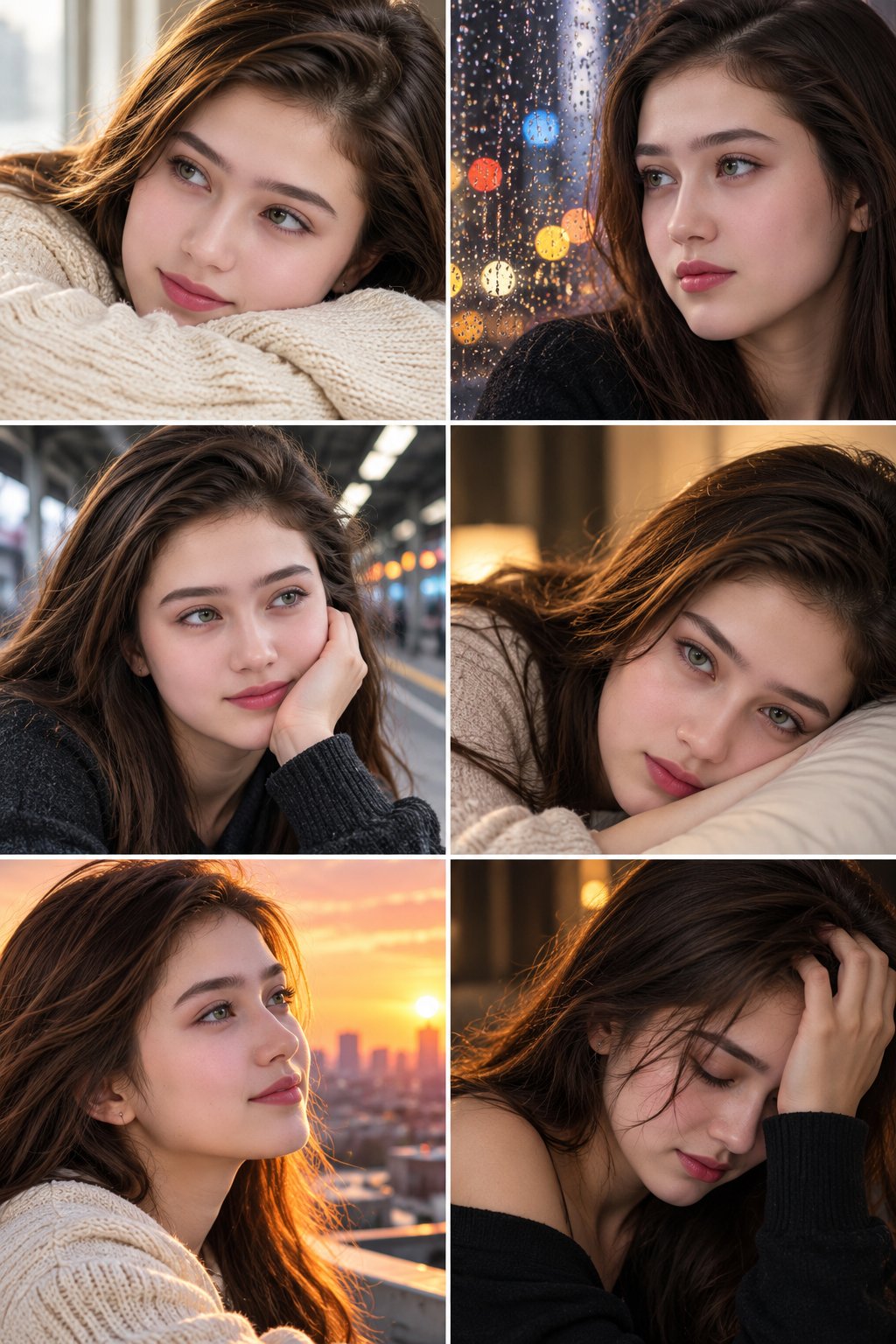
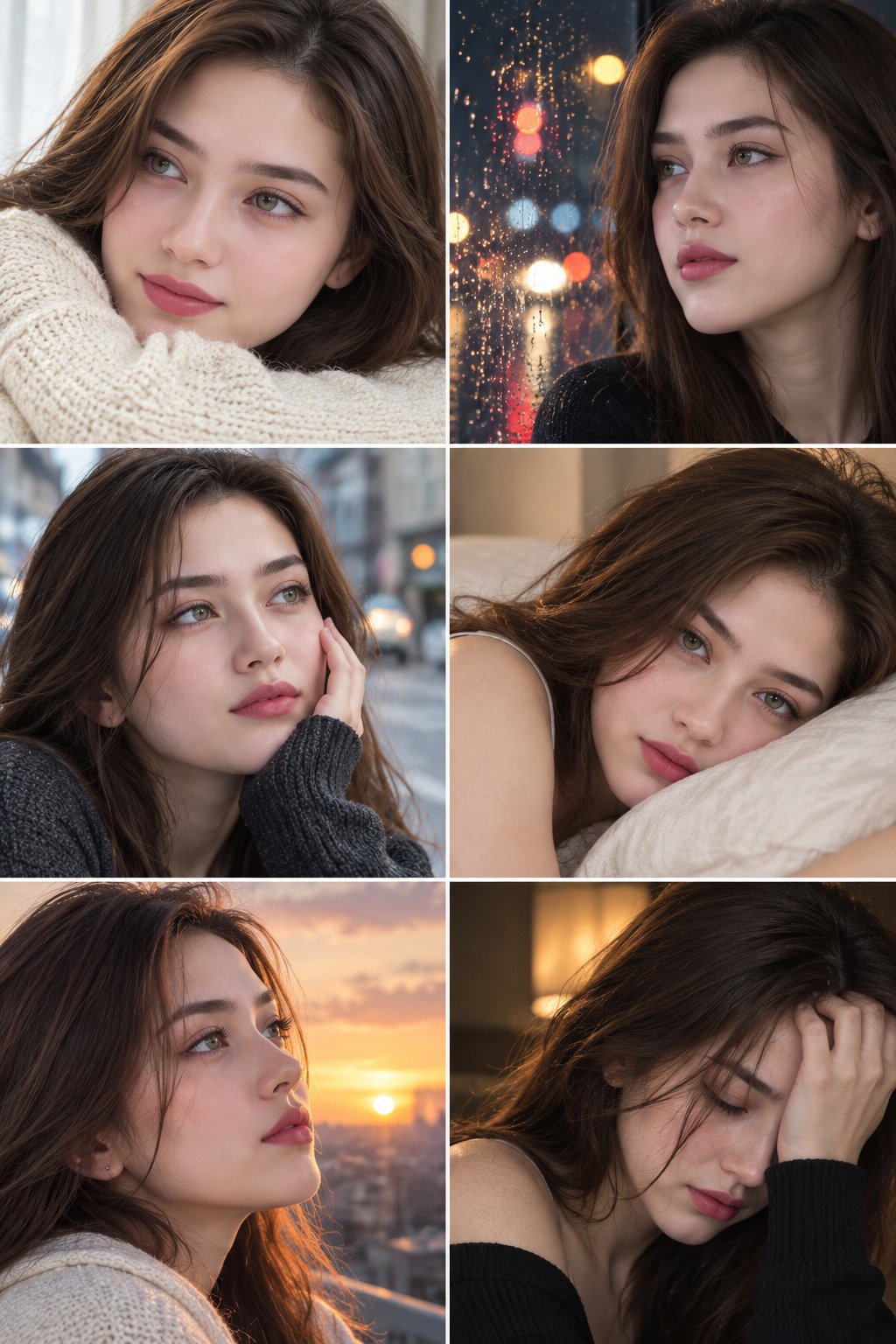
Six-Panel Cinematic Woman Portrait Collage
 GPT Image 2.5OpenAIimage
A photorealistic 6-panel cinematic emotional portrait collage of the same beautiful young woman with long, voluminous chestnut-brown hair, soft natural waves, delicate facial features, expressive brown eyes, subtle eyeliner, rosy cheeks, and natural pink lips. Create six distinct close-up portraits arranged in a precise 2-column by 3-row grid, separated by thin clean white borders. Panel 1, top left: the woman resting her face against a cozy cream knitted sweater, looking thoughtfully to the side in soft natural window light. Panel 2, top right: she gazes through a rain-covered window at night, with colorful city lights and warm bokeh reflections behind the glass, wearing a dark top. Panel 3, middle left: she rests her cheek against one hand while wearing a charcoal-gray knitted sweater, looking wistfully toward a softly blurred urban street. Panel 4, middle right: she lies sideways on a soft cream pillow, with loose brown hair framing her face and a quiet, vulnerable expression. Panel 5, bottom left: a cinematic side-profile close-up of her looking toward a beautiful orange-pink sunset over a distant city skyline, wearing a cream sweater. Panel 6, bottom right: she closes her eyes and gently touches her forehead with one hand, wearing a black off-shoulder knit top, expressing emotional exhaustion in warm, dim indoor lighting. Maintain exactly the same facial identity, eye shape, nose, lips, skin tone, and hair color across all six panels. Natural skin texture, individual hair strands, realistic eyes, delicate expressions, subtle film grain, shallow depth of field, cinematic color grading, soft shadows, melancholic romantic atmosphere, premium editorial photography, ultra-realistic details.
Details
- Type
- AI Image Prompts
- Aspect Ratio
- 2:3
- Updated
- Oct 17, 2026
How to use this prompt
- 1Copy the full prompt with the copy button above.
- 2Open GPT Image 2.5 by OpenAI, or any image generator with a similar style range.
- 3Paste the prompt, then swap the subject and style keywords to match your idea.
- 4Match the example's settings (2:3 · Cinematic · Realistic · Portrait), then iterate — small wording changes shift the output a lot.
Frequently asked questions
Which AI model generated this image?
This image was generated with GPT Image 2.5 by OpenAI. The prompt on this page is the exact text used to create it.
What settings does this prompt use?
The example was generated with GPT Image 2.5 using: 2:3 · Cinematic · Realistic · Portrait. Reusing these settings gives the closest match.
How do I get similar results?
Copy the prompt as-is first, then replace only the subject while keeping the style, lighting, and composition keywords. Generate a few variations — outputs differ between runs.
Can I modify this prompt?
Yes. Prompts work best as starting points — adjust descriptors, aspect ratio, or style tags to make the output your own.