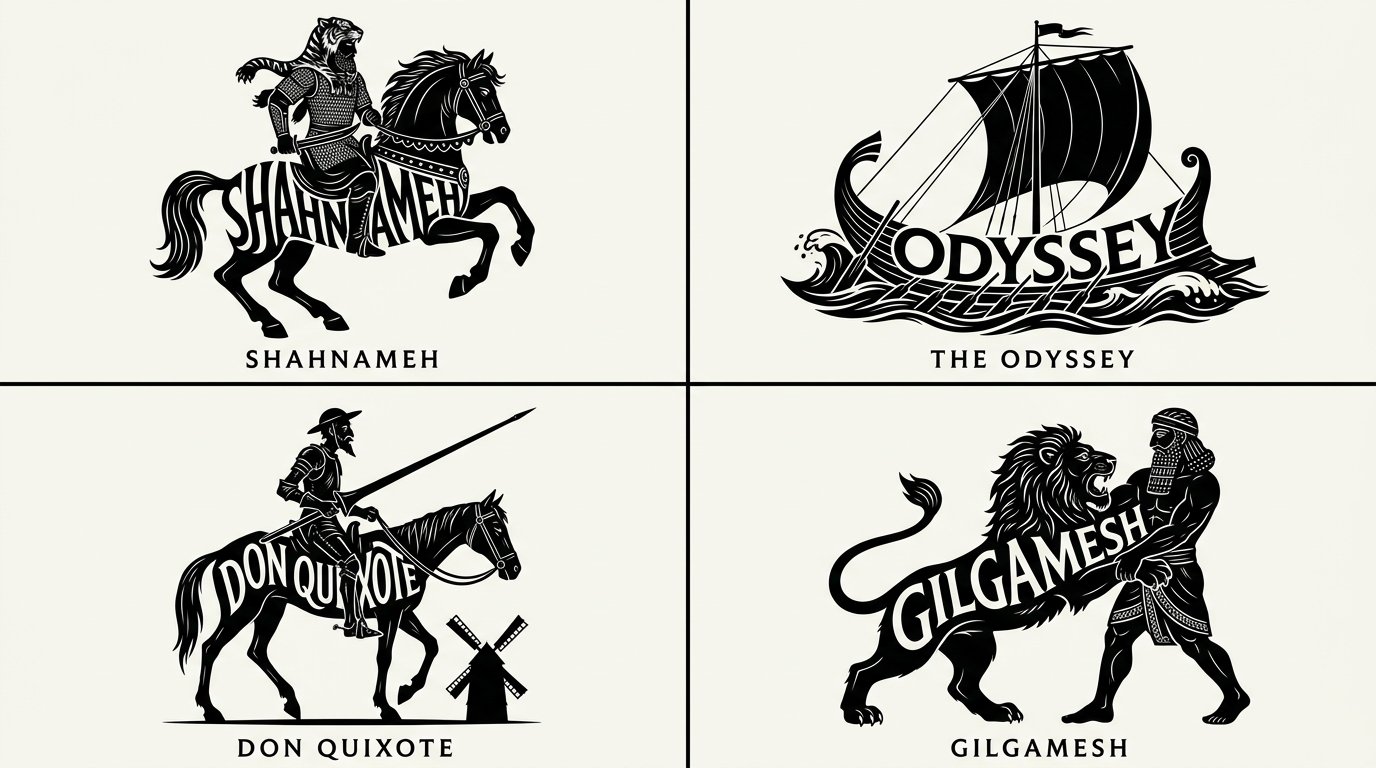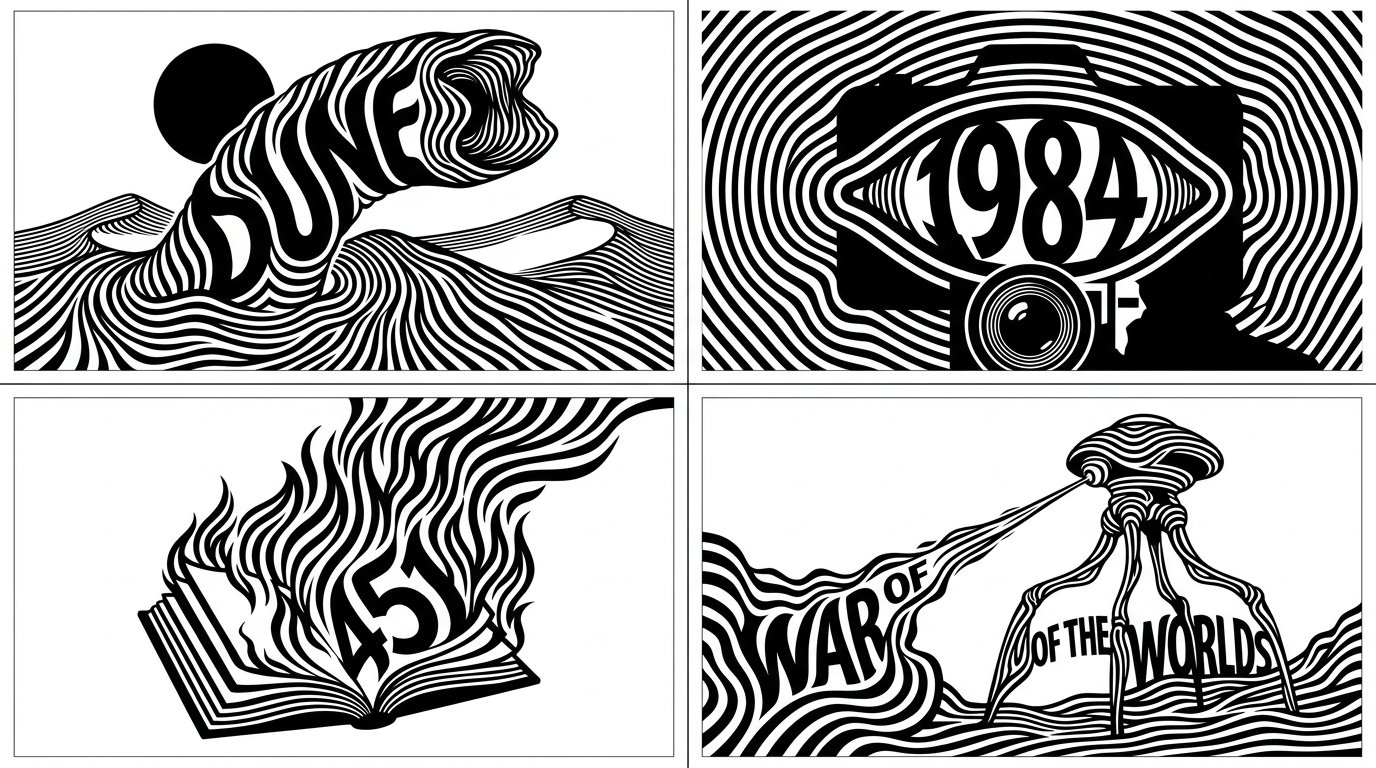
Optical Stripe Typographic Sci-Fi Book Emblems
2x2 grid, 16:9, do this for 4 famous scifi books class OpticalStripeTypographicSilhouette: def __init__(self, topic): self.topic = topic self.word = derive_short_display_word(topic) self.silhouette = infer_iconic_silhouette(topic) self.stripe_map = infer_contour_stripe_paths(topic, self.silhouette) self.typography = integrate_word_into_body(self.word, self.silhouette) self.negative_space = solve_white_space_for_readability(topic) def silhouette_system(self): return { "subject": self.silhouette, "style": "flat black-and-white vector silhouette", "recognition": "instant at thumbnail scale" } def stripe_system(self): return { "paths": self.stripe_map, "behavior": "flowing contour bands that describe form", "palette": "black stripes on white ground", "texture": "none, pure graphic ink" } def word_system(self): return { "text": self.word, "integration": "embedded inside silhouette through negative space", "readability": "clear but discovered" } def render(self): return """ Render as a clean optical typographic emblem: iconic silhouette, flowing contour stripes, hidden readable word, black ink on pure white. """
Details
- Type
- AI Image Prompts
- Aspect Ratio
- 43:24
- Updated
- Oct 13, 2026
How to use this prompt
- 1Copy the full prompt with the copy button above.
- 2Open Nano Banana 2.1 by Google, or any image generator with a similar style range.
- 3Paste the prompt, then swap the subject and style keywords to match your idea.
- 4Match the example's settings (43:24 · Vector · Poster · Sci-Fi), then iterate — small wording changes shift the output a lot.
Frequently asked questions
Which AI model generated this image?
This image was generated with Nano Banana 2.1 by Google. The prompt on this page is the exact text used to create it.
What settings does this prompt use?
The example was generated with Nano Banana 2.1 using: 43:24 · Vector · Poster · Sci-Fi. Reusing these settings gives the closest match.
How do I get similar results?
Copy the prompt as-is first, then replace only the subject while keeping the style, lighting, and composition keywords. Generate a few variations — outputs differ between runs.
Can I modify this prompt?
Yes. Prompts work best as starting points — adjust descriptors, aspect ratio, or style tags to make the output your own.