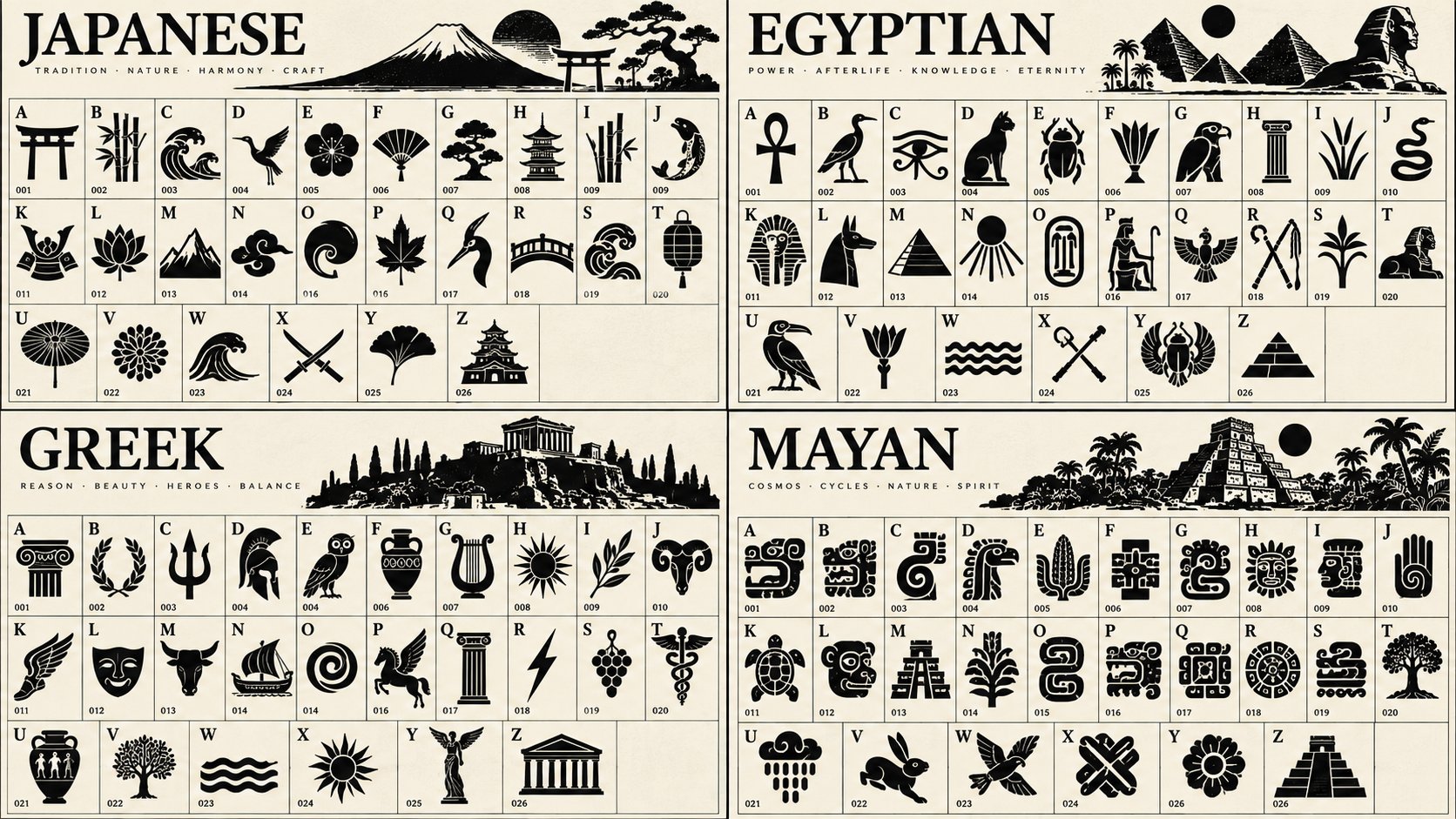
Mesoamerican Totem Glyph Alphabet Grid

// ── SEMANTIC INFERENCE ────────────────────────────────────────── THEME_AESTHETIC = infer_motif_language($ TOPIC) // Mesoamerican, Cyberpunk circuitry, botanical, nautical, astral MOTIF_PRIMITIVES = infer_shape_vocabulary(THEME_AESTHETIC) // hooks, spirals, dots, sweeping tails, gears, leaves GRID_LAYOUT = 26_cells (A-Z), strict orthogonal grid INK_STYLE = solid_black_blocks, negative_space_carving // ── GLYPH GENERATION FIELD ───────────────────────────────────── // Each glyph is a dense mass carved by negative space. Φ(x,y) = solid_mass(GRID_CELL) - carve_potential(MOTIF_PRIMITIVES) F = ∇Φ // flow of the outer silhouette Curl = ∇×Φ // internal spirals, loops, and curves Div = ∇·F // density of dots, eye-holes, and negative space gaps // ── ITERATION (A to Z) ───────────────────────────────────────── for letter in A..Z: // 1. Base mass: Assign a random organic/geometric bounding shape BASE = random_organic_blob(THEME_AESTHETIC) // 2. Apply topic-specific motifs for i in 1..3: MOTIF = select_random(MOTIF_PRIMITIVES) FUSE(BASE, MOTIF, via=Curl) // 3. Carve negative space CARVE(BASE, shape='internal_eye_or_gap', via=Div) CARVE(BASE, shape='sweeping_slash', via=F) // 4. Metadata RENDER_LABEL(letter, top_left) RENDER_ID(format="00" + index, bottom_left) // 5. Place in grid PLACE(BASE, grid=GRID_LAYOUT) // ── ACCURACY CHECK PROTOCOL ──────────────────────────────────── ACCURACY_CHECK = { grid_check : exactly 26 cells, A-Z, silhouette_check: all glyphs are solid black masses, carve_check : negative space does not break the outer silhouette, theme_check : motifs (e.g., if $ TOPIC is 'Marine Biology', look for fins/waves) } IF ANY check fails → regenerate affected glyphs. // ── RENDER ───────────────────────────────────────────────────── RENDER_BOARD( layout := GRID_LAYOUT, palette := { ink: black, paper: light_grey }, style := 'bold_iconic_totem_glyphs' )
Details
- Type
- AI Image Prompts
- Aspect Ratio
- 1672:941
- Updated
- Nov 1, 2026
Category
How to use this prompt
- 1Copy the full prompt with the copy button above.
- 2Open Nano Banana 2.1 by Google, or any image generator with a similar style range.
- 3Paste the prompt, then swap the subject and style keywords to match your idea.
- 4Match the example's settings (1672:941 · Abstract · Black & White · Minimalist), then iterate — small wording changes shift the output a lot.
Frequently asked questions
Which AI model generated this image?
This image was generated with Nano Banana 2.1 by Google. The prompt on this page is the exact text used to create it.
What settings does this prompt use?
The example was generated with Nano Banana 2.1 using: 1672:941 · Abstract · Black & White · Minimalist. Reusing these settings gives the closest match.
How do I get similar results?
Copy the prompt as-is first, then replace only the subject while keeping the style, lighting, and composition keywords. Generate a few variations — outputs differ between runs.
Can I modify this prompt?
Yes. Prompts work best as starting points — adjust descriptors, aspect ratio, or style tags to make the output your own.