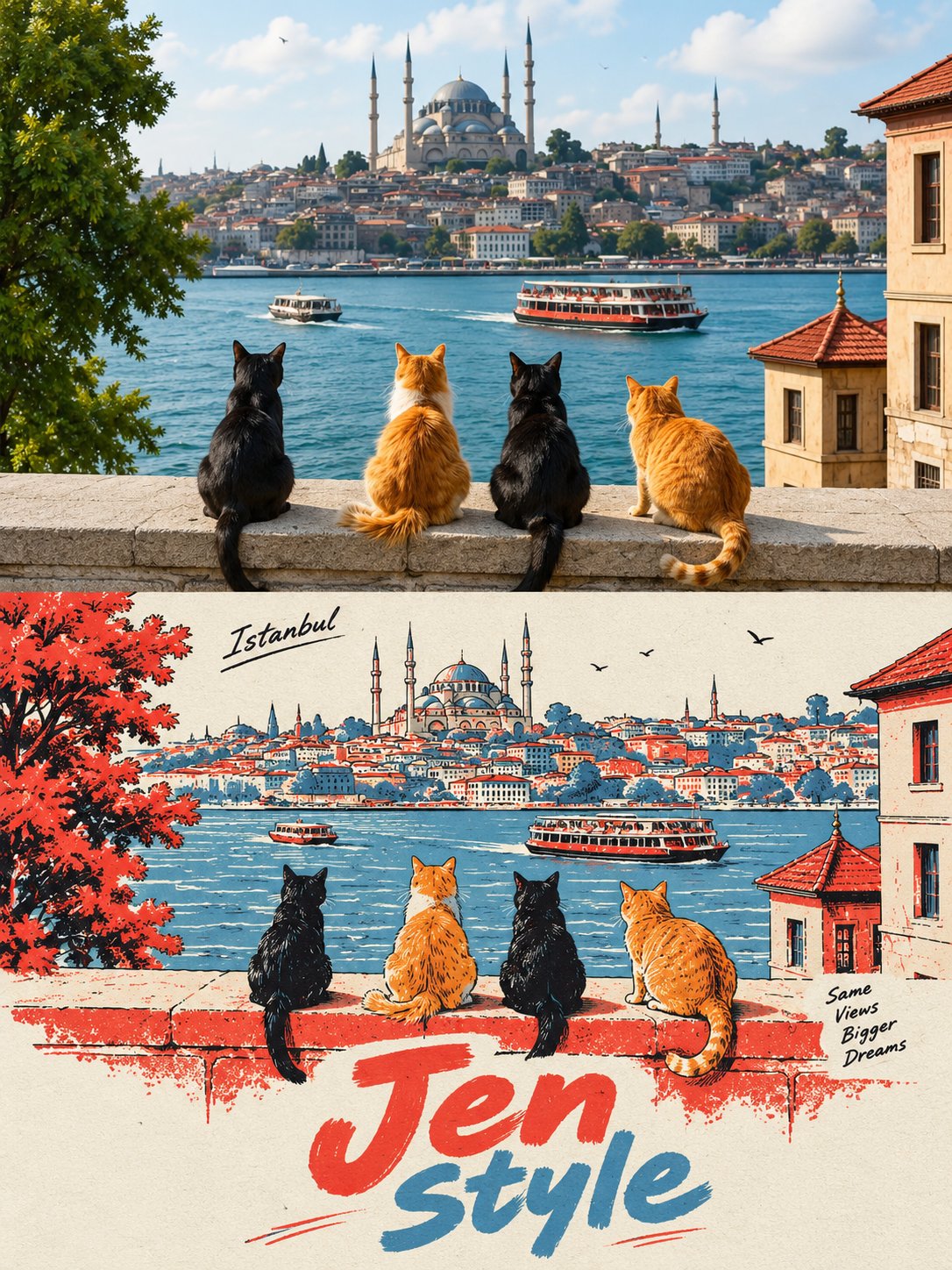
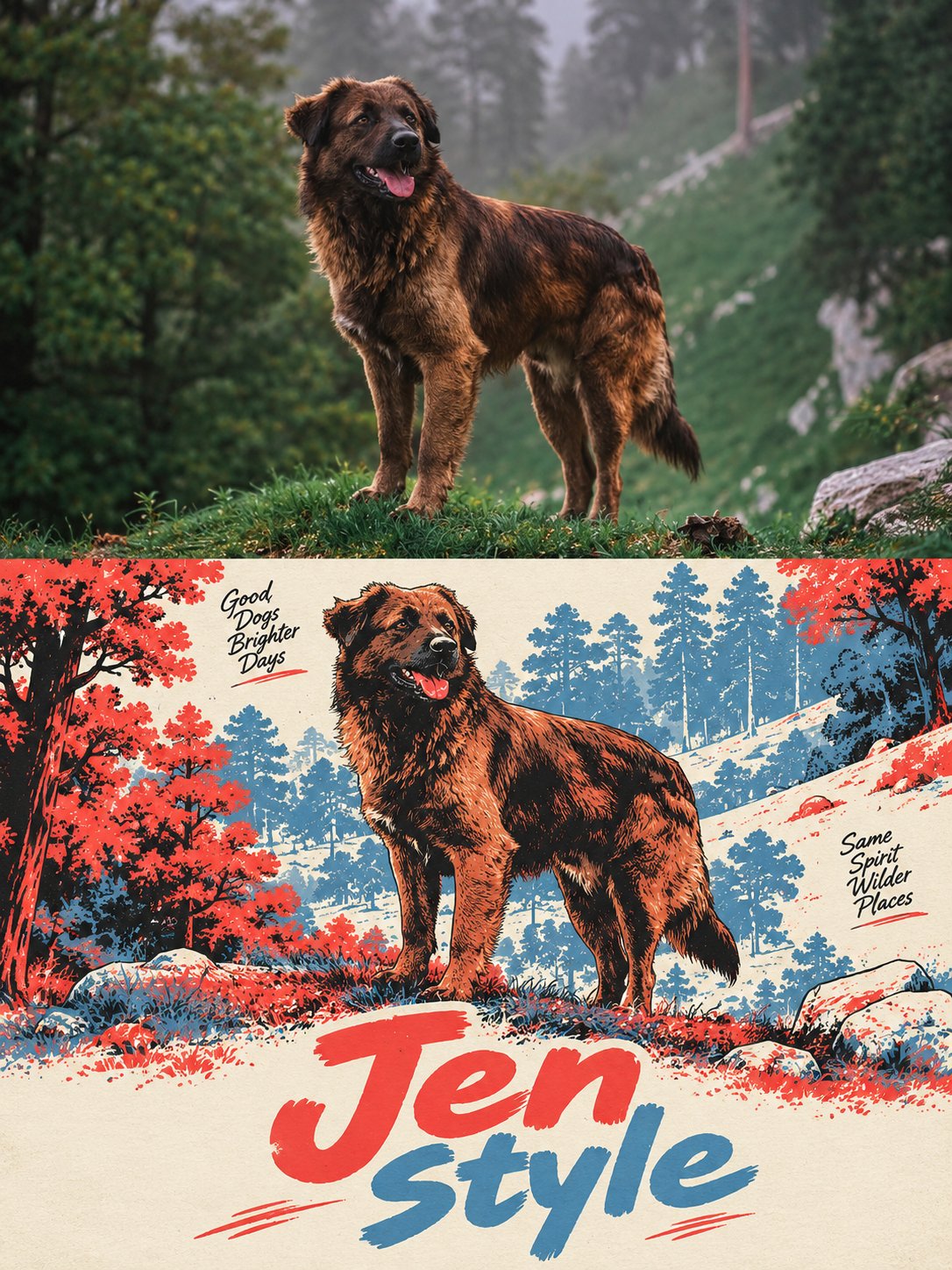
Japanese Comic Poster Comparison
 GPT Image 2.5OpenAIimage
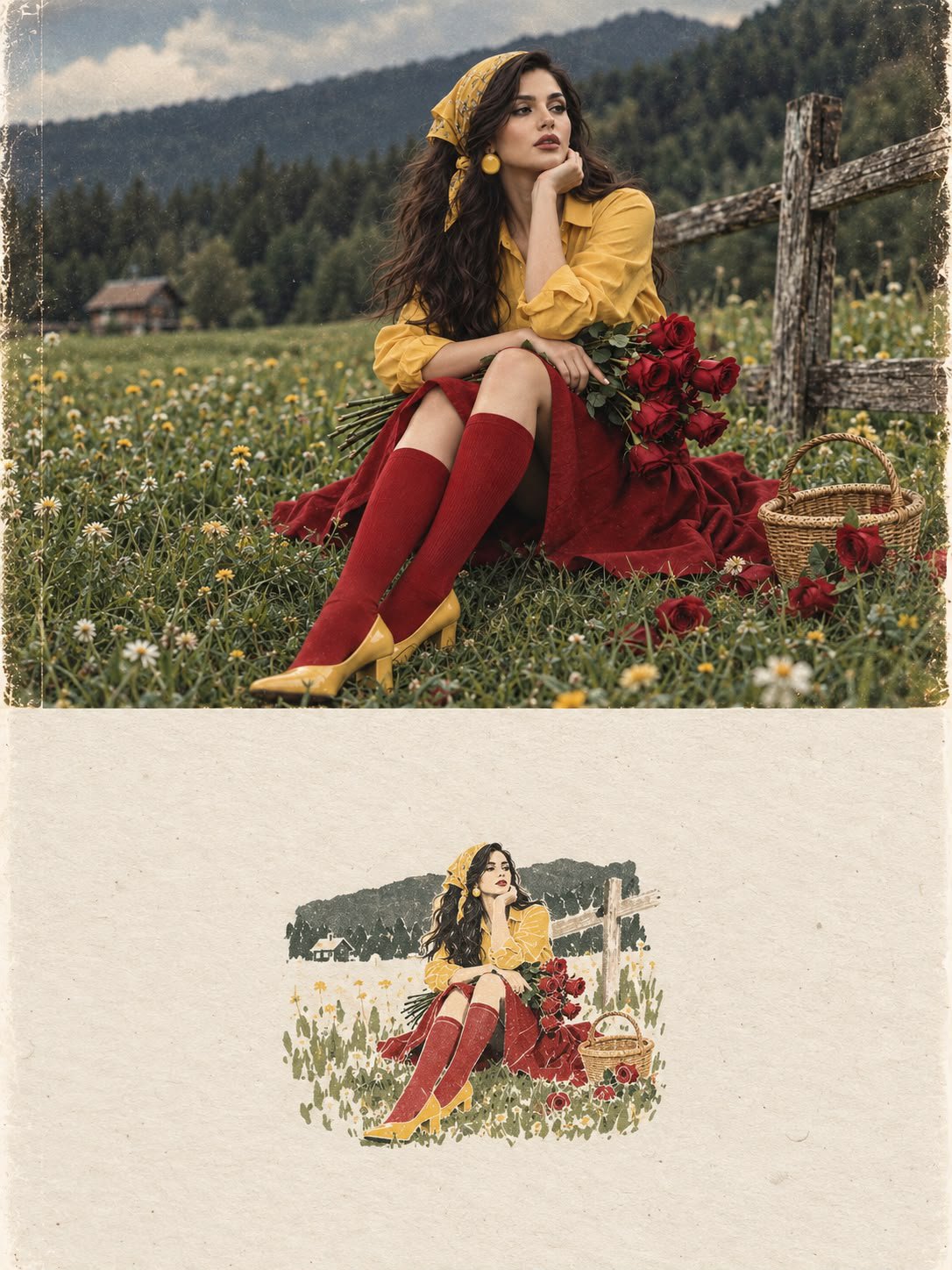
UNIVERSAL PROMPT JAPANESE COMIC POSTER | 3:4 Create a 3:4 vertical comparison image divided into two equal horizontal halves, seamlessly joined without borders or gaps. TOP HALF: Display the uploaded photograph exactly as it is, without editing, recoloring, or adding text. Preserve proportions; crop only peripheral background if necessary. BOTTOM HALF: Redraw the same subject as a Japanese hand-drawn comic poster with minimalist, limited-color screen-print aesthetics. Preserve the subject's recognizable features, pose, proportions, colors, and relationships between objects. Adapt naturally to people, animals, objects, or landscapes. Keep the essential scenery and add nothing absent from the original photograph. ART STYLE: Delicate, slightly irregular ink-black outlines (#02030B), simplified shapes, clean opaque color blocks, and minimal hard-edged shadows. Use warm red (#E9444B), muted gray-blue (#5296BD), and off-white paper (#ECEDE5), with red dominant over blue. Avoid photorealistic textures, dense hatching, 3D effects, and excessive details. LAYOUT & TEXT: Position the illustration in the upper-middle of the bottom half, with generous negative space and bold, hand-carved typography below. Add a small handwritten, subject-related caption at the top and a short handwritten annotation beside the subject, both in black. The main headline reads “Jen” in warm red on the first line and “Style” in gray-blue on the second. Each appears once. Keep all text within the bottom half, fully legible and uncropped. Replace sample text only when the user provides alternatives. FINAL RESULT: One complete 3:4 image, with the untouched original photograph above and its Japanese hand-drawn, limited-color poster interpretation below. No extra borders, watermarks, invented elements, or decorative clutter.
Details
- Type
- AI Image Prompts
- Aspect Ratio
- 3:4
- Updated
- Oct 27, 2026
Category
How to use this prompt
- 1Copy the full prompt with the copy button above.
- 2Open GPT Image 2.5 by OpenAI, or any image generator with a similar style range.
- 3Paste the prompt, then swap the subject and style keywords to match your idea.
- 4Match the example's settings (3:4 · Poster · Comic · Minimalist), then iterate — small wording changes shift the output a lot.
Frequently asked questions
Which AI model generated this image?
This image was generated with GPT Image 2.5 by OpenAI. The prompt on this page is the exact text used to create it.
What settings does this prompt use?
The example was generated with GPT Image 2.5 using: 3:4 · Poster · Comic · Minimalist. Reusing these settings gives the closest match.
How do I get similar results?
Copy the prompt as-is first, then replace only the subject while keeping the style, lighting, and composition keywords. Generate a few variations — outputs differ between runs.
Can I modify this prompt?
Yes. Prompts work best as starting points — adjust descriptors, aspect ratio, or style tags to make the output your own.