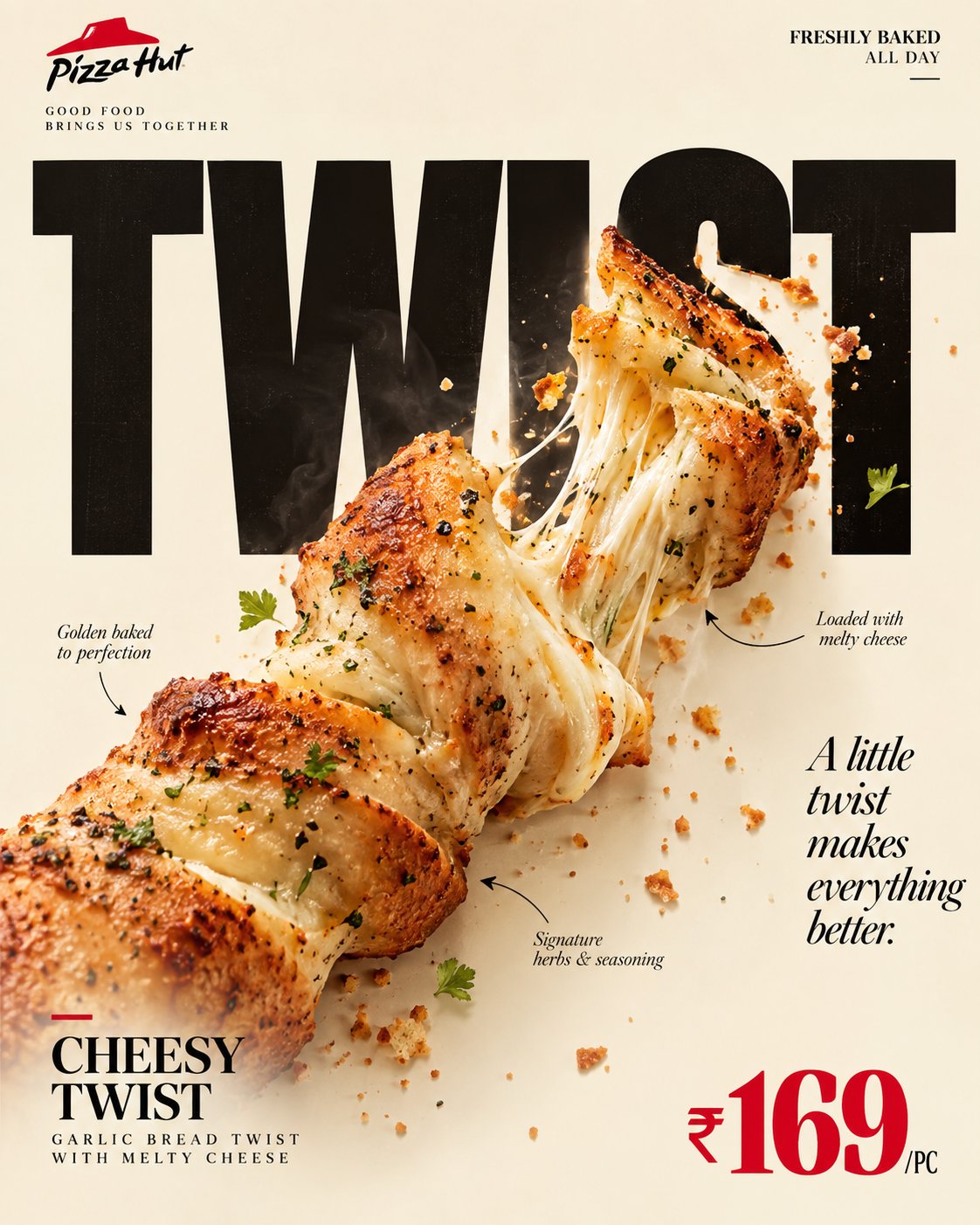
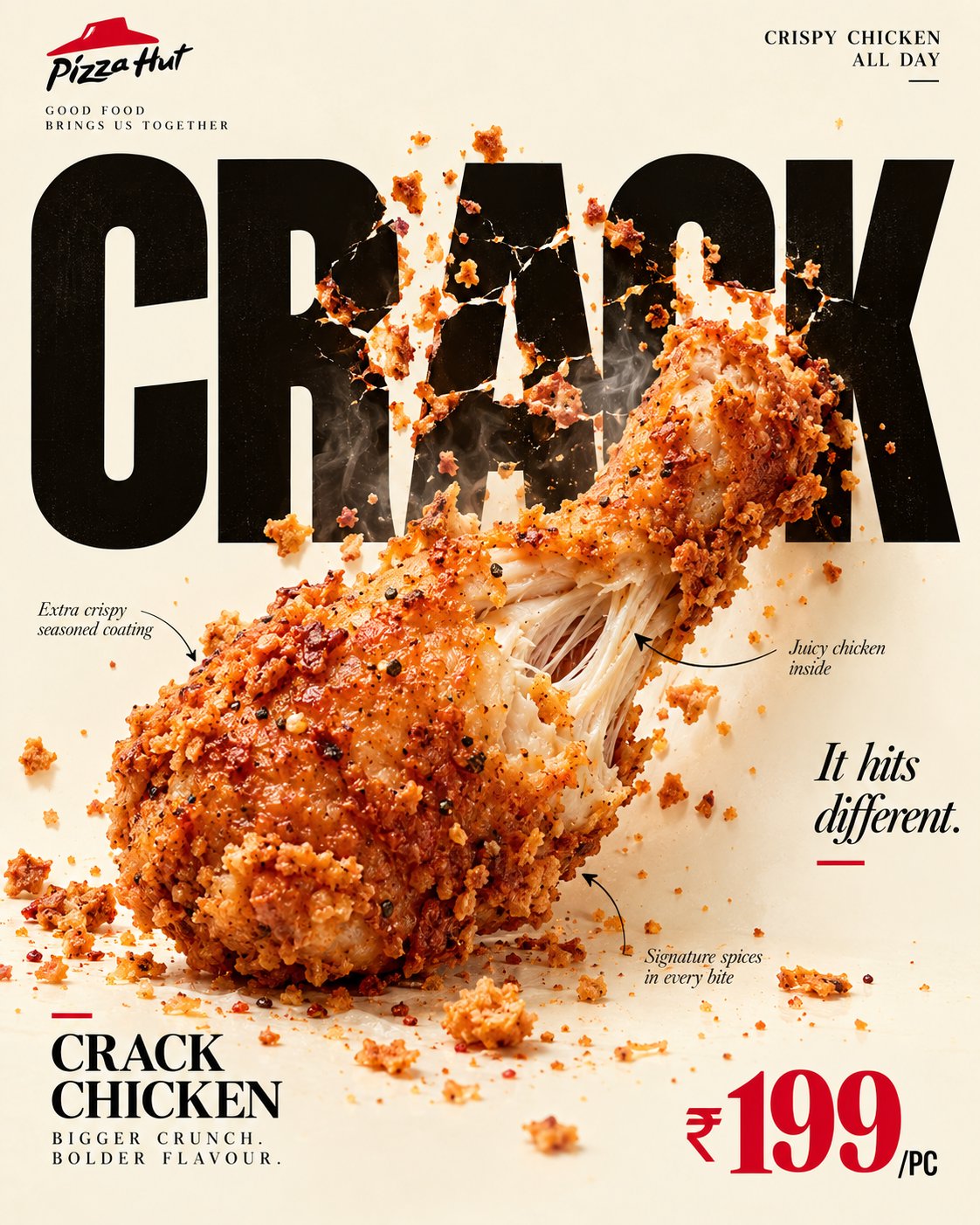
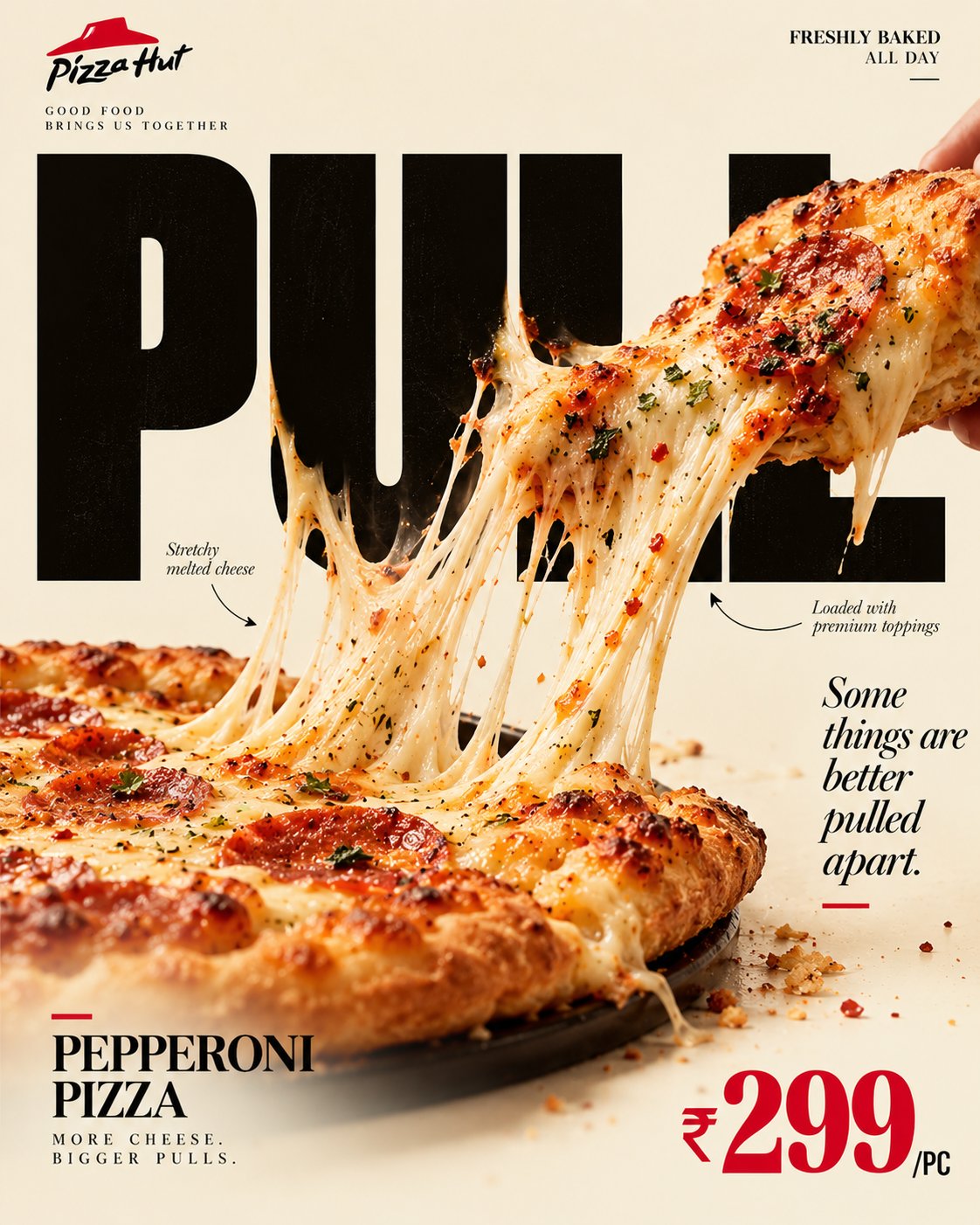
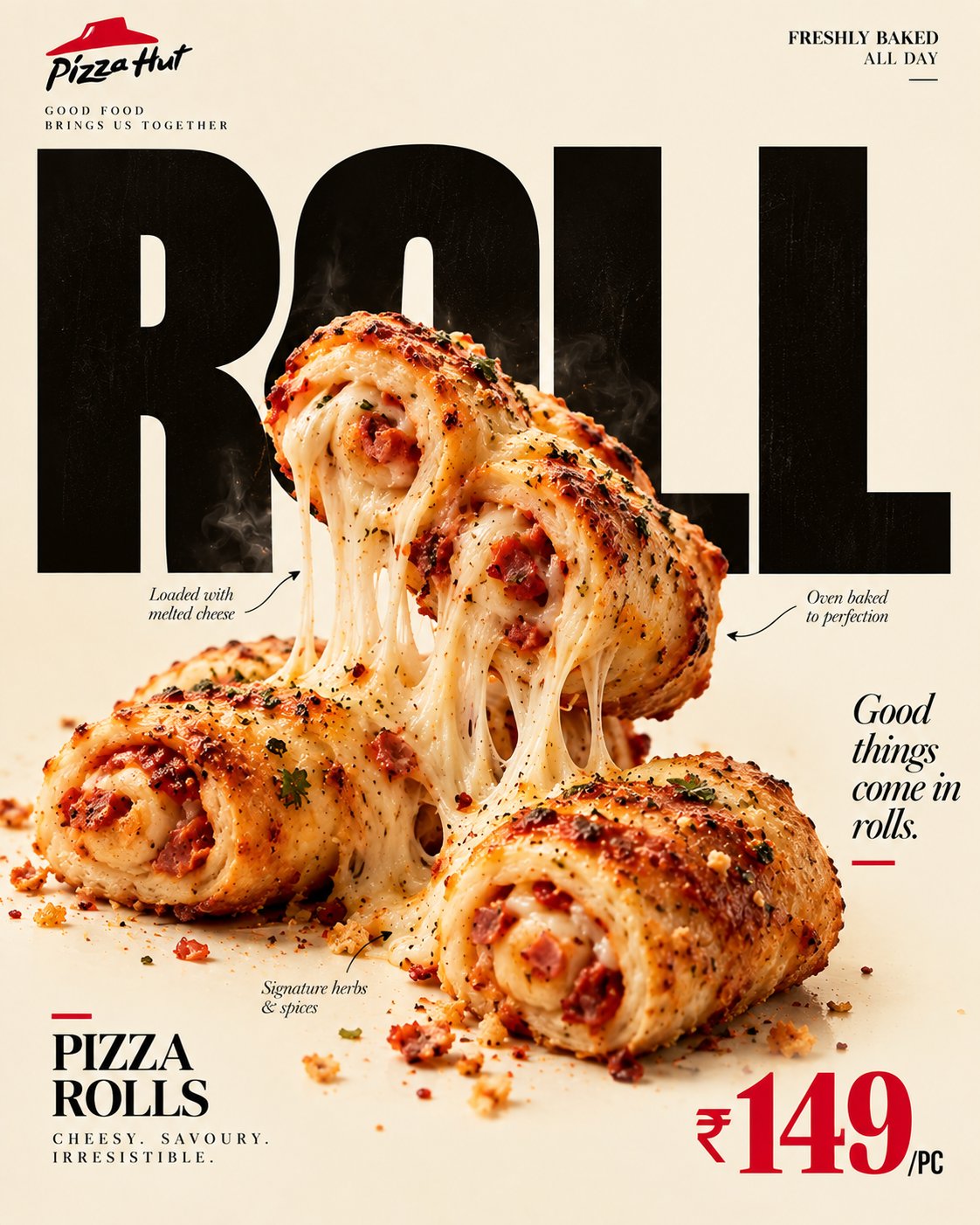
Editorial Food Poster With Typography Interaction
 GPT Image 2.5OpenAIimage
Create a premium editorial food poster, vertical 4:5. Use a warm cream/ivory background, sophisticated magazine-style layout, generous negative space, black typography, natural food colors, and one accent color: [ACCENT COLOR]. CORE IDEA: Photorealistic [FOOD] physically interacts with a huge [HEADLINE] in one shared environment. Choose ONE mechanism — [DRIP / PUSH / POUR / WRAP / SNAP / PEEL]. The food must visibly reshape or affect specific letters through believable physics such as gravity, weight, tension, viscosity, or fracture. Untouched letters remain crisp, geometric, black, and fully readable. No generic 3D text, floating food, random distortion, or decorative overlap. LAYOUT: Top left: [BRAND NAME] + small tagline. Top right: [HOURS / PROMISE]. Center: massive [HEADLINE] in Heavy Grotesk, with the food interaction as the main focal point. Mid-right: short italic-serif quote. Bottom left: [PRODUCT NAME] + descriptor. Bottom right: [PRICE] in the accent color + unit. Add 2–3 thin annotation arrows highlighting realistic food details. FOOD: Ultra-realistic studio photography with authentic texture, moisture, crumbs, gloss, steam, garnish, and contact shadows. FINAL STYLE: Clever, tactile, minimal, luxurious, contemporary editorial advertising. The poster should be instantly understandable at thumbnail size: first glance = food + headline; second glance = how the food physically transforms the typography.
Details
- Type
- AI Image Prompts
- Aspect Ratio
- 561:701
- Updated
- Sep 29, 2026
Category
How to use this prompt
- 1Copy the full prompt with the copy button above.
- 2Open GPT Image 2.5 by OpenAI, or any image generator with a similar style range.
- 3Paste the prompt, then swap the subject and style keywords to match your idea.
- 4Match the example's settings (561:701 · Typography · Poster · Food), then iterate — small wording changes shift the output a lot.
Frequently asked questions
Which AI model generated this image?
This image was generated with GPT Image 2.5 by OpenAI. The prompt on this page is the exact text used to create it.
What settings does this prompt use?
The example was generated with GPT Image 2.5 using: 561:701 · Typography · Poster · Food. Reusing these settings gives the closest match.
How do I get similar results?
Copy the prompt as-is first, then replace only the subject while keeping the style, lighting, and composition keywords. Generate a few variations — outputs differ between runs.
Can I modify this prompt?
Yes. Prompts work best as starting points — adjust descriptors, aspect ratio, or style tags to make the output your own.
![Create a premium vertical 4:5 editorial travel poster for [COUNTRY], where the outline of the countr — AI image prompt — GPT Image 2.5](https://cdn.ahaprompt.app/harvest-media/import-1789369064970-j9jipe.jpg)
![Create a sophisticated, dreamy editorial magazine cover titled “[COUNTRY NAME] — A COUNTRY IN ONE DR — AI image prompt — GPT Image 2.5](https://cdn.ahaprompt.app/harvest-media/import-1789368946131-xefjx1.jpg)
![Create a premium educational travel poster featuring [STRUCTURE NAME], one of the world’s most famou — AI image prompt — GPT Image 2.5](https://cdn.ahaprompt.app/harvest-media/import-1789369131185-x1iuzs.jpg)
![Create a premium cinematic luxury tourism poster for [COUNTRY / DESTINATION] in a STRICT 4:5 vertica — AI image prompt — GPT Image 2.5](https://cdn.ahaprompt.app/harvest-media/import-1789369001673-dctuvc.jpg)
![Create a premium contemporary editorial art poster for [LOCATION] in a playful Japanese design-ZINE — AI image prompt — GPT Image 2.5](https://cdn.ahaprompt.app/harvest-media/import-1789139846025-v6z310.jpg)
![2x2 grid, 9:16, 4 goat chess players who passed away [SUBJECT] :: single standalone vertical tribute — AI image prompt — GPT Image 2.5](https://cdn.ahaprompt.app/harvest-media/import-1789139801507-ah2jvt.jpg)