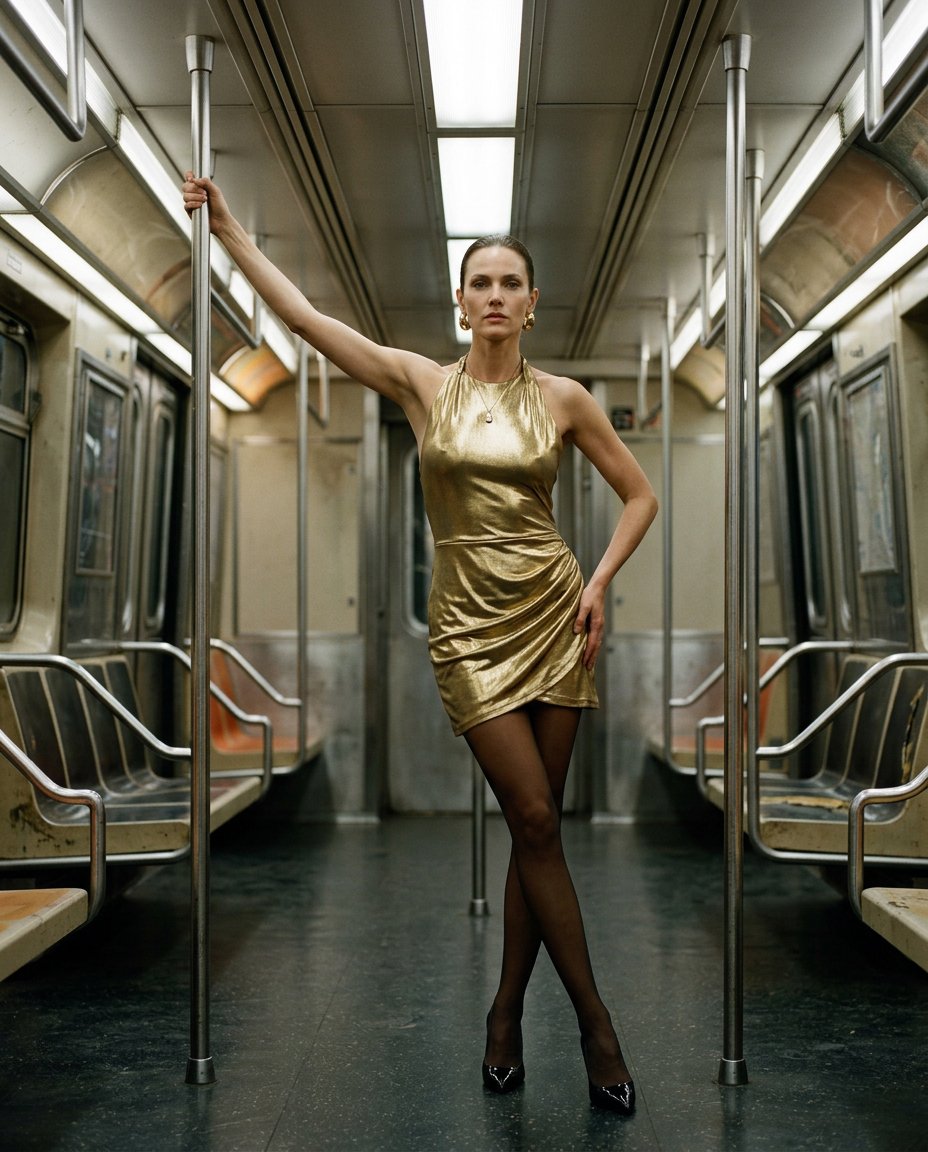
High-Fashion Editorial in Subway Car
 Nano BananaGoogleimage
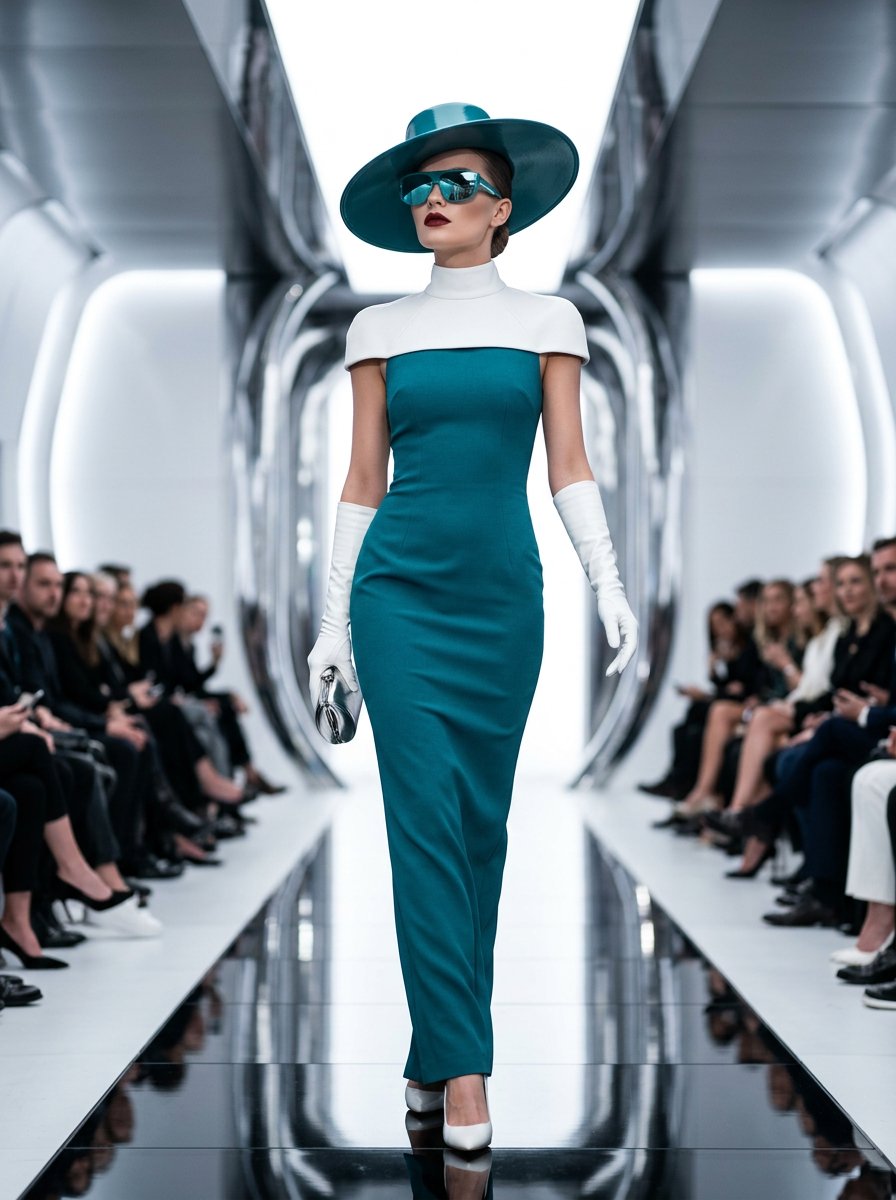
Create a high-fashion editorial inside an ordinary, slightly worn city subway car. The visual tension comes from an impeccably dressed adult woman occupying a space built for routine commuting, with fluorescent ceiling panels, stainless-steel poles, faded molded seats, scuffed flooring and repeating doorways stretching behind her. Photograph vertically from several feet away at slightly below waist height, using the subway aisle as a strong one-point perspective. Keep her full body dominant in the frame without losing the repetitive geometry of the empty car. She stands between two vertical poles with an elongated, off-balance stance: one arm reaches high to grip a pole while her torso shifts subtly in the opposite direction, one hip settling outward and one leg crossing loosely behind the other. Her free hand rests low at the waist. She meets the camera with an unreadable, composed expression. Style her in a short liquid-gold lamé halter dress with a clean fitted bodice, narrow waist and softly draped mini skirt. The metallic fabric should behave like real lightweight lamé, forming natural tension and folds rather than rigid segmented panels. Pair it with dark espresso sheer tights, sharply pointed black patent heels, sculptural gold earrings and one fine pendant. Keep the styling controlled so the gold dress remains the singular fashion statement. Use the train's cool overhead fluorescent light as the primary illumination, interrupted by warmer reflections traveling across the gold fabric and polished steel. Let the far end of the carriage fall slightly darker. Preserve real skin texture, metal scratches, seat wear, fabric reflections and restrained photographic grain. The final image should feel expensive, severe and slightly improbable: evening fashion photographed without apology inside public transit, not a futuristic set or glamorous train interior. No readable advertisements, text, logos or watermarks.
Details
- Type
- AI Image Prompts
- Aspect Ratio
- 29:36
- Updated
- Oct 6, 2026
How to use this prompt
- 1Copy the full prompt with the copy button above.
- 2Open Nano Banana by Google, or any image generator with a similar style range.
- 3Paste the prompt, then swap the subject and style keywords to match your idea.
- 4Match the example's settings (29:36 · Cinematic · Fashion · Cityscape), then iterate — small wording changes shift the output a lot.
Frequently asked questions
Which AI model generated this image?
This image was generated with Nano Banana by Google. The prompt on this page is the exact text used to create it.
What settings does this prompt use?
The example was generated with Nano Banana using: 29:36 · Cinematic · Fashion · Cityscape. Reusing these settings gives the closest match.
How do I get similar results?
Copy the prompt as-is first, then replace only the subject while keeping the style, lighting, and composition keywords. Generate a few variations — outputs differ between runs.
Can I modify this prompt?
Yes. Prompts work best as starting points — adjust descriptors, aspect ratio, or style tags to make the output your own.