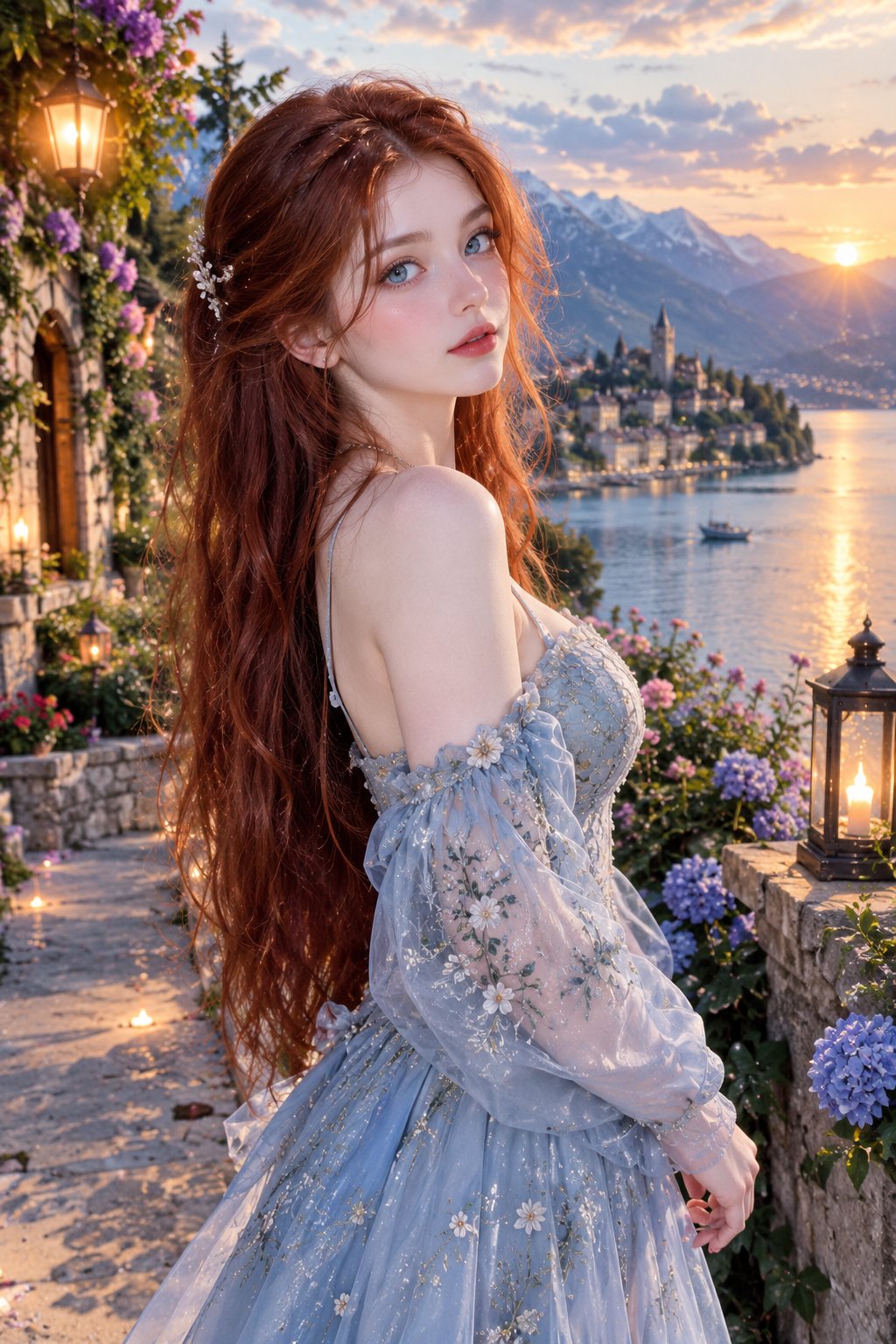
Fairytale Woman on Alpine Lake Terrace
 GPT Image 2.5OpenAIimage
A breathtaking cinematic photorealistic portrait of a beautiful adult woman standing on a flower-lined stone terrace overlooking a magical alpine lake at sunset. She has porcelain-white skin, striking crystal-blue eyes, and long, flowing natural red-auburn hair gently moving in the breeze. She wears an elegant ice-blue fairytale gown with delicate floral embroidery, subtle sparkling details, sheer embroidered sleeves, layered flowing fabric, and refined couture styling. Her expression is soft, graceful, and captivating, with natural facial features and realistic skin texture. The environment is completely realistic yet feels magical: a peaceful turquoise lake, distant snow-covered mountains, a charming European lakeside village, elegant stone architecture, blooming hydrangeas and roses, warm vintage lanterns, tiny glowing candlelights, and golden sunset reflections across the water. Everything should obey real-world lighting, physics, and textures while creating an enchanting dreamlike atmosphere. Ultra-photorealistic, cinematic photography, natural skin pores, realistic hair strands, realistic fabric texture, volumetric golden-hour light, soft depth of field, subtle atmospheric haze, detailed background, realistic reflections, HDR, 8K detail, professional fashion editorial photography. Composition: vertical full-body portrait, woman standing naturally in the foreground, slightly turned toward the camera, scenic environment clearly visible behind her, balanced composition, 50mm lens, f/1.8, shallow depth of field, cinematic framing, eye-level camera, natural perspective.
Details
- Type
- AI Image Prompts
- Aspect Ratio
- 2:3
- Updated
- Oct 9, 2026
How to use this prompt
- 1Copy the full prompt with the copy button above.
- 2Open GPT Image 2.5 by OpenAI, or any image generator with a similar style range.
- 3Paste the prompt, then swap the subject and style keywords to match your idea.
- 4Match the example's settings (2:3 · Cinematic · Fantasy · Portrait), then iterate — small wording changes shift the output a lot.
Frequently asked questions
Which AI model generated this image?
This image was generated with GPT Image 2.5 by OpenAI. The prompt on this page is the exact text used to create it.
What settings does this prompt use?
The example was generated with GPT Image 2.5 using: 2:3 · Cinematic · Fantasy · Portrait. Reusing these settings gives the closest match.
How do I get similar results?
Copy the prompt as-is first, then replace only the subject while keeping the style, lighting, and composition keywords. Generate a few variations — outputs differ between runs.
Can I modify this prompt?
Yes. Prompts work best as starting points — adjust descriptors, aspect ratio, or style tags to make the output your own.