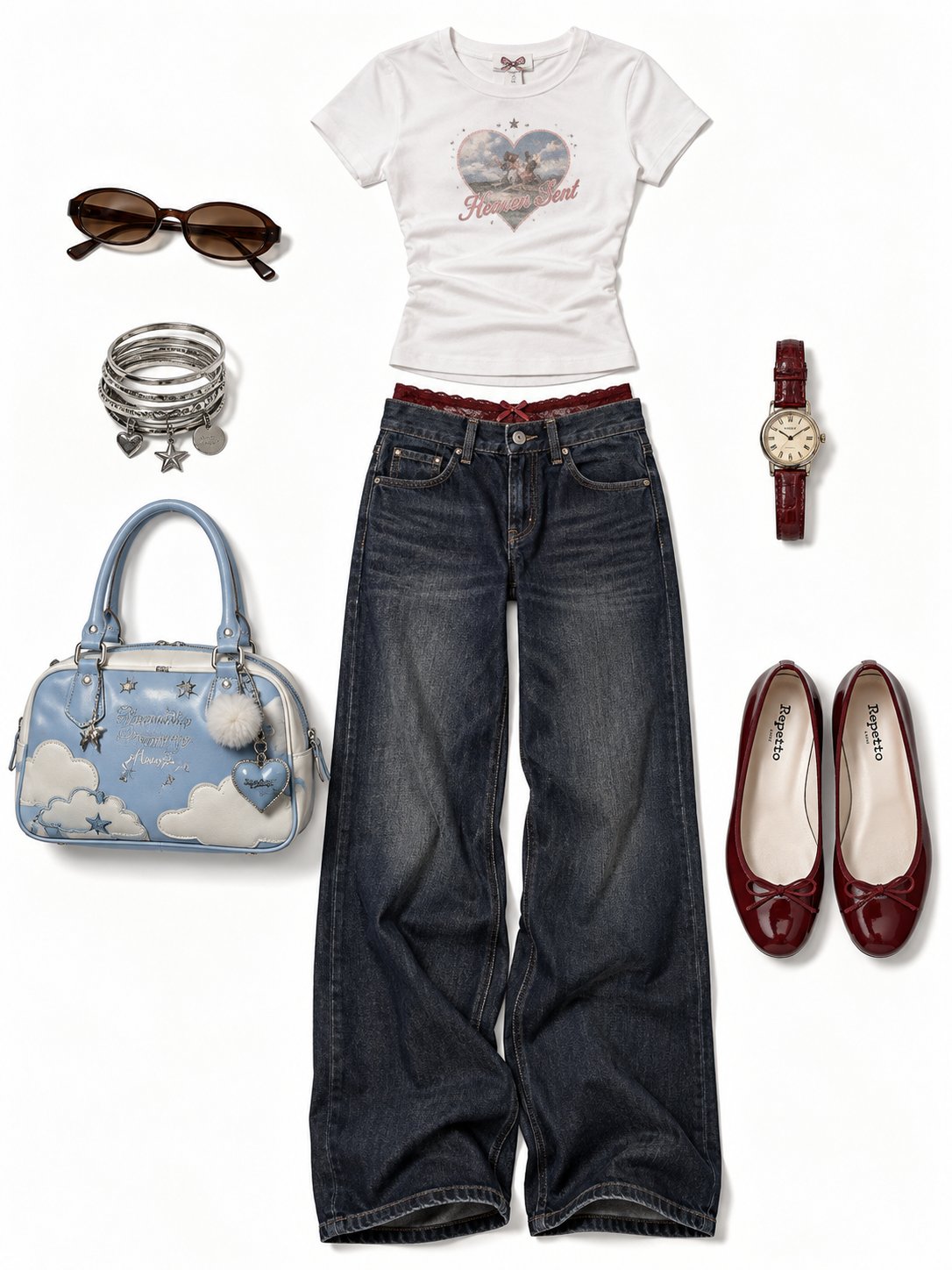
Y2K Fashion Flat-Lay Outfit Collage
 GPT Image 2.5OpenAIimage
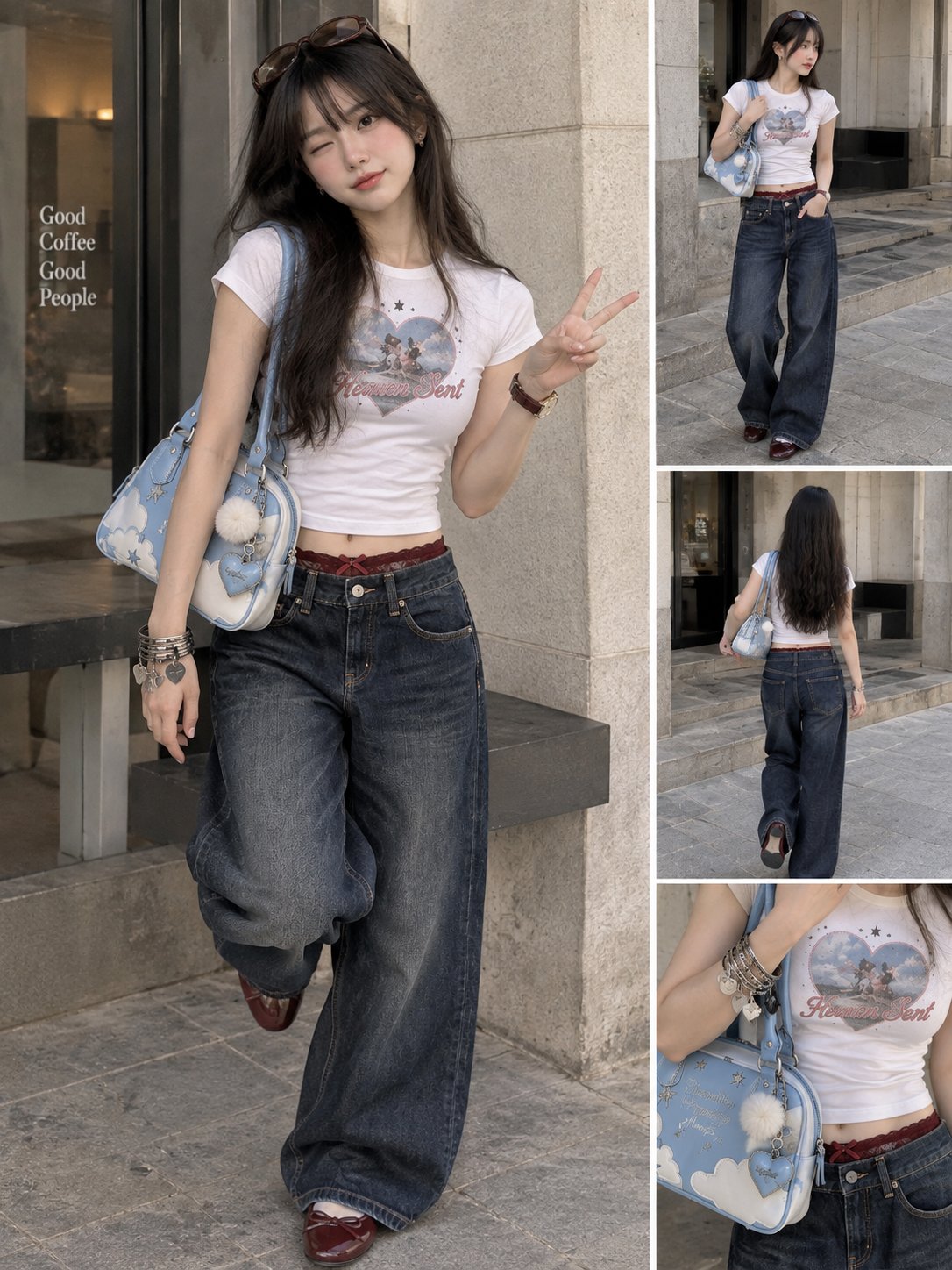
Create a realistic Y2K fashion flat-lay outfit collage on a clean pure white background, matching the reference composition and spacing. At the top center, place a fitted plain white short-sleeve T-shirt with a subtle vintage graphic/logo on the chest. Below it, place dark indigo wide-leg low-rise jeans, neatly arranged vertically with realistic denim texture and natural fabric folds. A delicate deep red lace waistband should be slightly visible above the jeans. On the left side, arrange brown-tinted oval sunglasses and a stack of vintage silver bangles. Next to the jeans on the left, place a sky-blue themed handbag with a completely different design from the original bag: soft sky-blue and white color palette, cute cloud and star pattern, small decorative charms, silver hardware, short handles, and a nostalgic early-2000s fashion aesthetic. The bag should look stylish and unique, not like the original Union Jack design. On the right side, place a small vintage wristwatch with a warm gold face and dark red-brown leather strap. At the bottom-right, place a pair of glossy dark-red ballet flats with delicate bow details. Keep every item separated with generous white negative space, similar to a high-end fashion catalog flat lay. No person, no mannequin, no body. Style: photorealistic product photography, realistic fabric and leather textures, natural soft shadows, clean cutout appearance, subtle vintage Y2K aesthetic, elegant coordinated color palette, crisp details, accurate proportions, minimal composition, pure white background, vertical 3:4 aspect ratio.
Details
- Type
- AI Image Prompts
- Aspect Ratio
- 3:4
- Updated
- Sep 21, 2026
How to use this prompt
- 1Copy the full prompt with the copy button above.
- 2Open GPT Image 2.5 by OpenAI, or any image generator with a similar style range.
- 3Paste the prompt, then swap the subject and style keywords to match your idea.
- 4Match the example's settings (3:4 · Fashion · Vintage · Realistic), then iterate — small wording changes shift the output a lot.
Frequently asked questions
Which AI model generated this image?
This image was generated with GPT Image 2.5 by OpenAI. The prompt on this page is the exact text used to create it.
What settings does this prompt use?
The example was generated with GPT Image 2.5 using: 3:4 · Fashion · Vintage · Realistic. Reusing these settings gives the closest match.
How do I get similar results?
Copy the prompt as-is first, then replace only the subject while keeping the style, lighting, and composition keywords. Generate a few variations — outputs differ between runs.
Can I modify this prompt?
Yes. Prompts work best as starting points — adjust descriptors, aspect ratio, or style tags to make the output your own.
![Create a premium contemporary editorial art poster for [LOCATION] in a playful Japanese design-ZINE — AI image prompt — GPT Image 2.5](https://cdn.ahaprompt.app/harvest-media/import-1789139846025-v6z310.jpg)
![Create a premium cinematic luxury tourism poster for [COUNTRY / DESTINATION] in a STRICT 4:5 vertica — AI image prompt — GPT Image 2.5](https://cdn.ahaprompt.app/harvest-media/import-1789369001673-dctuvc.jpg)
![Create a sophisticated, dreamy editorial magazine cover titled “[COUNTRY NAME] — A COUNTRY IN ONE DR — AI image prompt — GPT Image 2.5](https://cdn.ahaprompt.app/harvest-media/import-1789368946131-xefjx1.jpg)