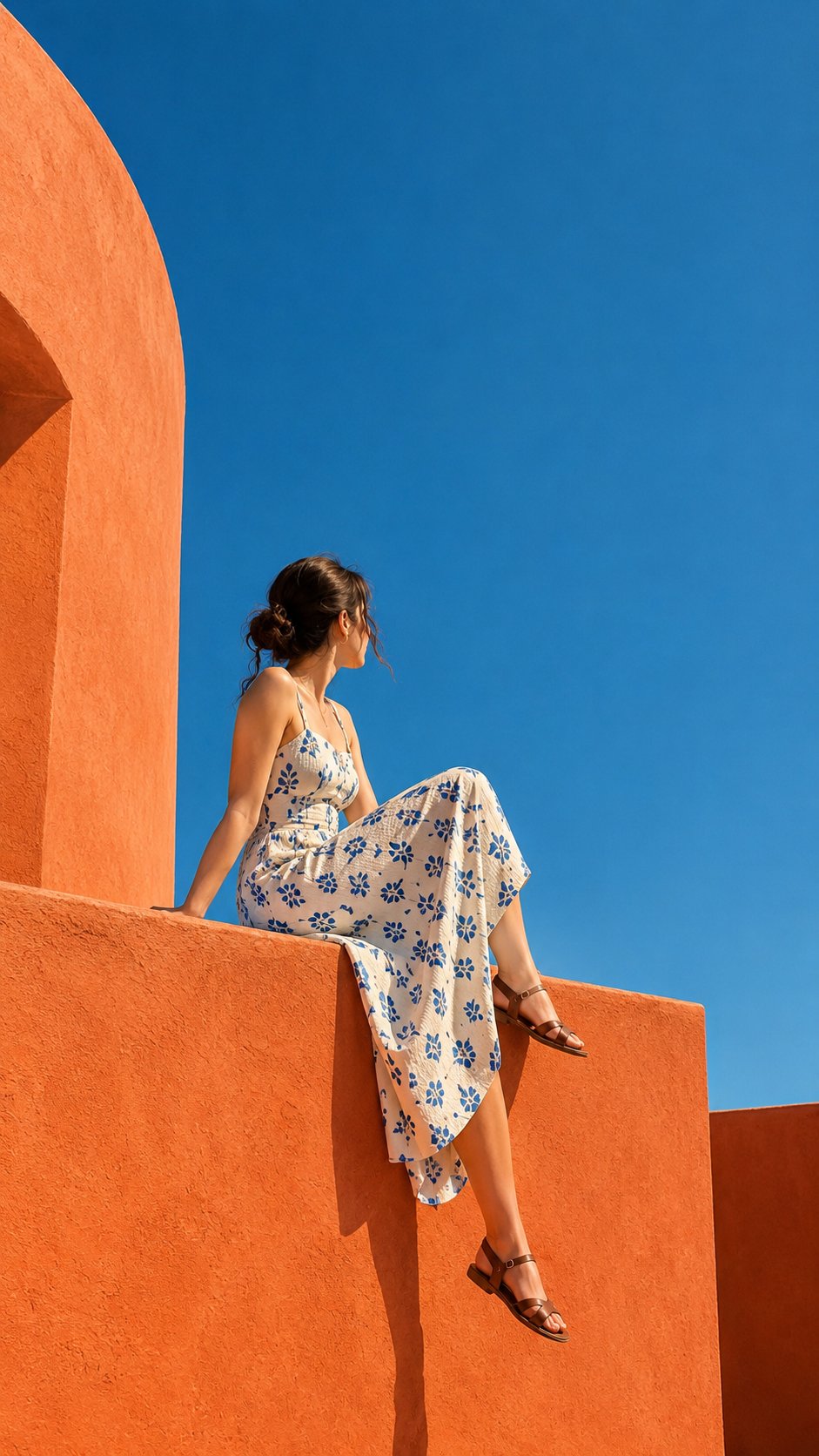
Woman on Terracotta Rooftop Ledge
 GPT Image 2.5OpenAIimage
{ "aspect_ratio": "9:16", "style": "editorial lifestyle photography, bold minimalist architecture", "scene": "a stylish young European woman sitting casually on a wide terracotta rooftop ledge beside a modern curved architectural wall", "composition": "vertical portrait frame, subject placed in the lower-middle area, large clean turquoise-blue sky surrounding her, strong geometric architecture creating an asymmetrical composition", "camera": "low-angle medium-long shot from slightly below, subtle perspective distortion, subject viewed mostly from the side", "character": { "appearance": "beautiful young European woman, natural features, dark brown shoulder-length hair loosely tied back", "pose": "sitting sideways with one leg bent on the ledge and the other hanging down, one hand resting behind her, head turned slightly toward the open sky", "expression": "quiet, relaxed, candid" }, "outfit": { "dress": "flowing sleeveless cream dress with small cobalt-blue abstract patterns", "shoes": "minimal brown leather sandals" }, "architecture": { "color": "burnt orange / terracotta", "design": "smooth curved wall with one diagonal architectural edge", "texture": "subtle sunlit plaster texture" }, "background": { "sky": "clear vivid turquoise-blue sky", "clouds": "none", "environment": "minimal and uncluttered" }, "lighting": "strong warm afternoon sunlight with crisp natural shadows", "color_palette": "terracotta orange, turquoise blue, cream, cobalt accents", "photography": "high-resolution realistic editorial photography, natural textures, deep focus, vibrant colors, clean composition", "avoid": [ "exact recreation of reference", "same pose", "same dress pattern", "same architecture", "same framing", "text", "logo", "watermark", "extra people", "artificial AI look" ] }
Details
- Type
- AI Image Prompts
- Aspect Ratio
- 941:1672
- Updated
- Oct 4, 2026
Category
How to use this prompt
- 1Copy the full prompt with the copy button above.
- 2Open GPT Image 2.5 by OpenAI, or any image generator with a similar style range.
- 3Paste the prompt, then swap the subject and style keywords to match your idea.
- 4Match the example's settings (941:1672 · Architecture · Fashion · Portrait), then iterate — small wording changes shift the output a lot.
Frequently asked questions
Which AI model generated this image?
This image was generated with GPT Image 2.5 by OpenAI. The prompt on this page is the exact text used to create it.
What settings does this prompt use?
The example was generated with GPT Image 2.5 using: 941:1672 · Architecture · Fashion · Portrait. Reusing these settings gives the closest match.
How do I get similar results?
Copy the prompt as-is first, then replace only the subject while keeping the style, lighting, and composition keywords. Generate a few variations — outputs differ between runs.
Can I modify this prompt?
Yes. Prompts work best as starting points — adjust descriptors, aspect ratio, or style tags to make the output your own.
![Create a premium educational travel poster featuring [STRUCTURE NAME], one of the world’s most famou — AI image prompt — GPT Image 2.5](https://cdn.ahaprompt.app/harvest-media/import-1789369131185-x1iuzs.jpg)