Woman Beside White Horse Through Hibiscus
 Nano BananaGoogleimage
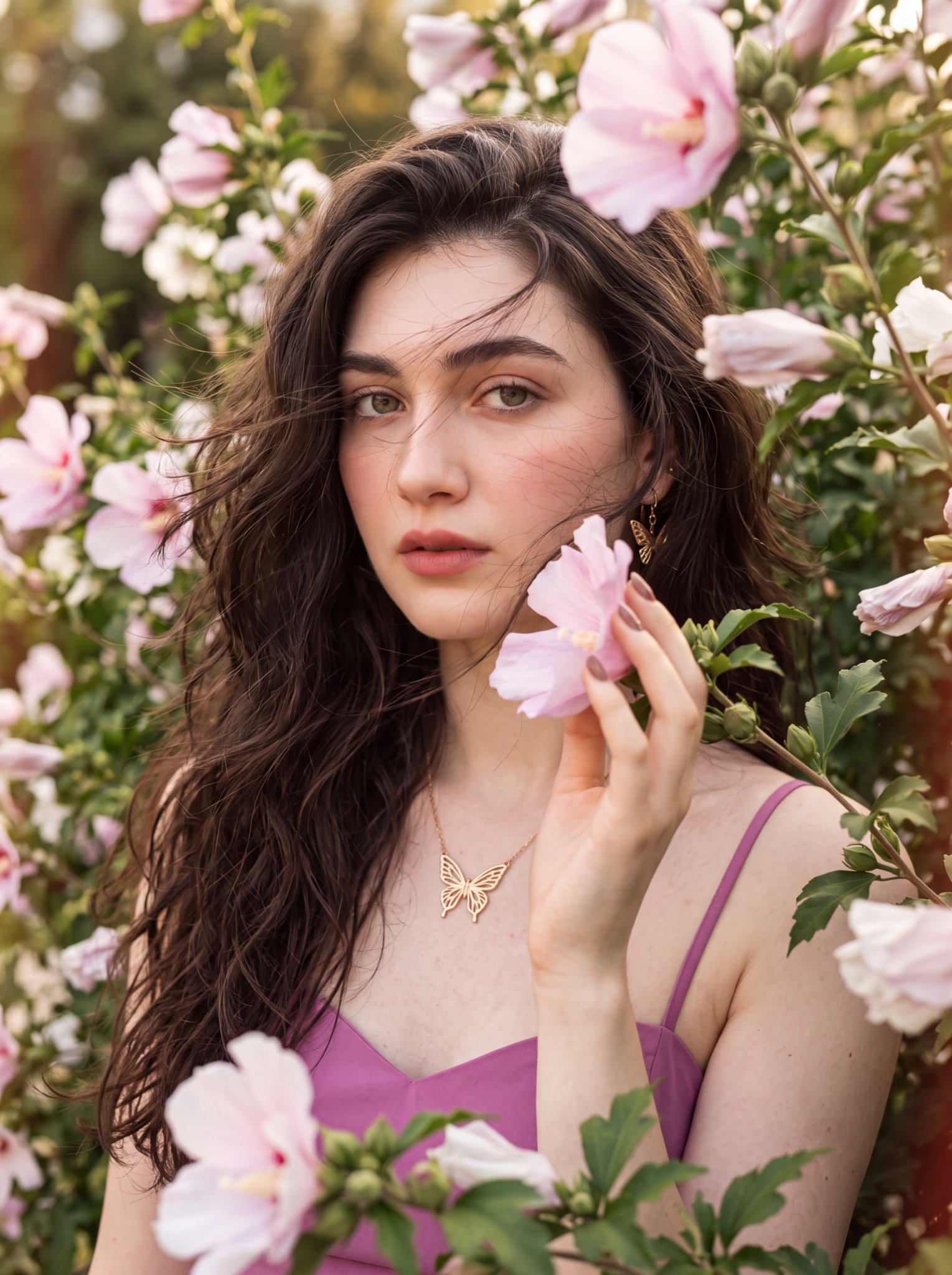
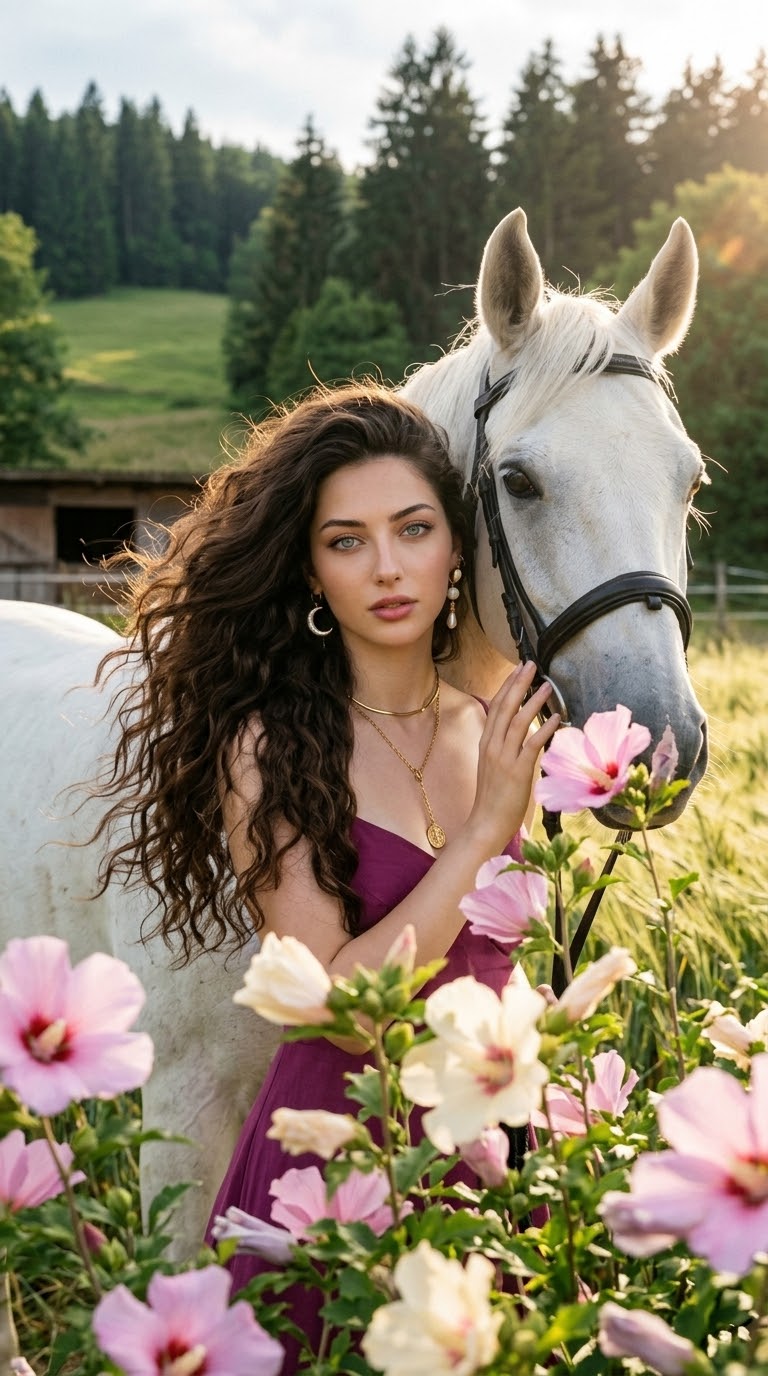
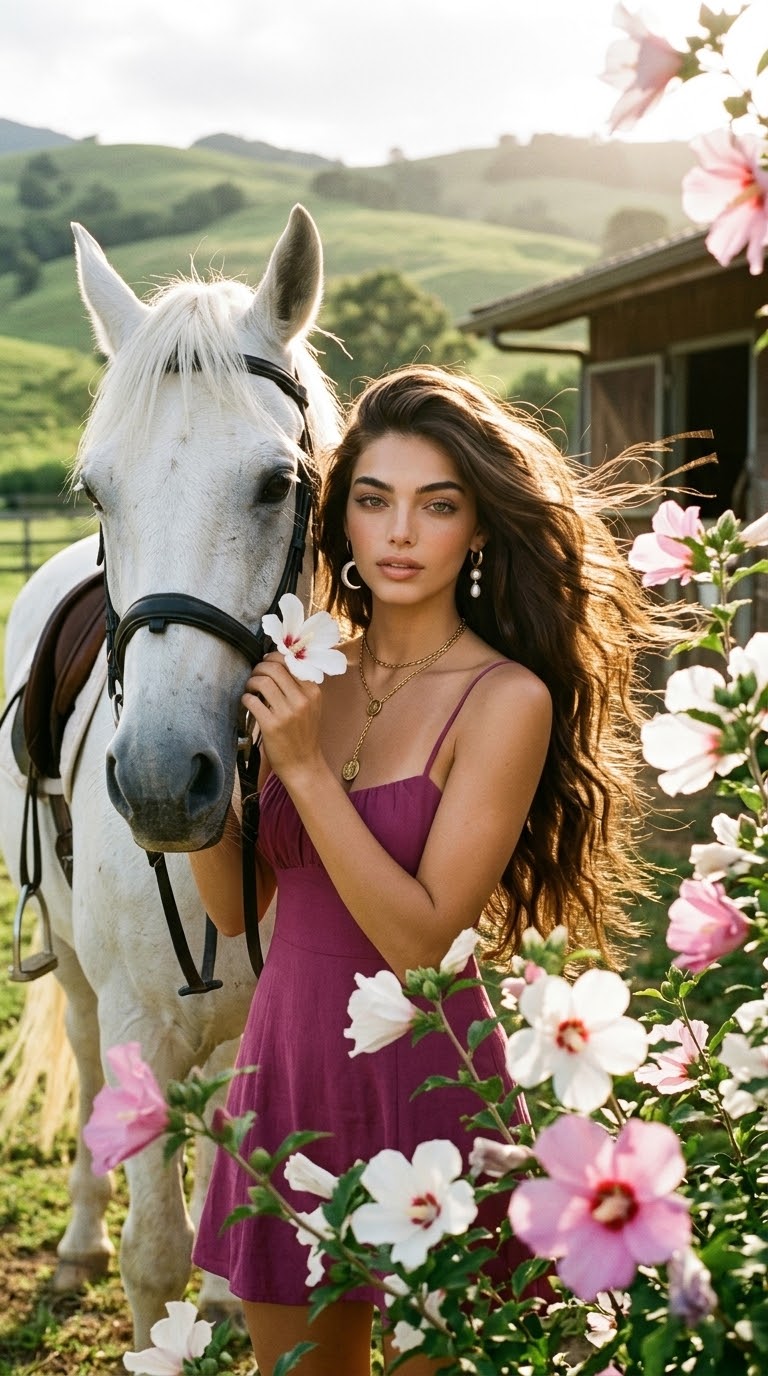
Create a highly photorealistic, emotionally intimate editorial portrait of a young woman standing beside a magnificent white horse in a beautiful countryside setting. Capture her from a refined three-quarter side angle, with her head naturally turned toward the camera and making direct eye contact. FACIAL IDENTITY & HAIR Preserve her exact facial identity, recognizable facial features, proportions, and natural appearance. Do not change or reinterpret her face. She has an unmistakable deep side part — NEVER a center or middle part. Her hair is extremely long, voluminous, and richly colored Dark Mocha Mousse, with naturally defined curls. A strong countryside breeze dramatically sweeps the curls toward one side. Individual curls, wispy flyaways, and loose strands move independently with realistic weight and texture. The wind should feel physically believable rather than artificially styled. No ribbons, bows, hats, headwear, clips, or hair accessories. MAKEUP Soft-glam Korean-inspired makeup with a natural, refined finish. Visible realistic pores and authentic skin texture, luminous complexion, soft rosy blush, subtle brown eyeliner, naturally defined eyes, delicate lashes, and softly blended rosy-nude gradient lips. Keep the skin realistic and imperfect with tiny natural variations. No plastic-looking skin or excessive retouching. OUTFIT & JEWELLERY She wears a sophisticated magenta-plum fitted mini dress with delicate thin straps and a subtle heart-shaped neckline, only partially visible within the close portrait crop. Around her neck is a distinctive vintage-inspired gold lariat necklace featuring a delicate antique coin pendant suspended from a fine chain, layered with an extremely thin gold collar chain. She wears asymmetrical gold earrings: one is a small sculptural crescent shape, while the other is a delicate dangling pearl-and-gold drop. The jewellery feels artistic, feminine, understated, and luxurious rather than flashy. The jewellery should have realistic metallic reflections catching the warm sunlight. WOMAN & HORSE INTERACTION She stands very close beside the horse, creating a natural sense of trust and quiet companionship. One hand is gently raised near her face, naturally moving a nearby hibiscus flower away from her line of sight. Her fingers, knuckles, joints, nails, and wrist must be anatomically accurate and naturally posed. Her other hand remains completely outside the frame. Beside her is a large elegant white horse, standing calmly and peacefully. The horse has a realistic black leather bridle and rich brown leather saddle. Its coat shows individual hairs, subtle tonal variation, realistic muscle structure, and authentic equine texture. The horse’s head is slightly turned toward her, creating a subtle visual connection between the two subjects. The horse should feel calm, alive, and naturally positioned rather than posed for a photoshoot. FLORAL FOREGROUND Place the camera at eye level directly among dense blooming hibiscus flowers, photographing THROUGH the flowers. Soft-pink, blush, and ivory-white hibiscus blossoms surround the camera. Some petals, leaves, stems, and buds are extremely close to the lens, naturally overlapping the outer edges and corners of the frame. Create depth through real physical layering of flowers rather than artificial digital bokeh. The flowers must never cover her eyes, facial features, or the important details of the horse. A few nearby petals and leaves move naturally in the wind. LIGHTING Warm late-afternoon golden-hour sunlight comes from behind and slightly to the side of the subjects. Bright sunlight filters through the hibiscus flowers and moving strands of hair, creating a subtle natural golden lens flare and delicate atmospheric glow. Use realistic backlighting, soft warm highlights, gentle natural shadows, and believable exposure. No studio lighting. COMPOSITION Vertical 9:16 composition. Use a very intimate, close portrait framing. The woman should occupy approximately 85–95% of the visual frame. The crop should show head to upper chest only on the woman while still allowing part of the horse’s head and neck to remain visible beside her. No wide establishing view. No distant subject. The camera feels physically close to the flowers and subjects, as though the photographer is standing directly inside the garden. CAMERA & ANALOG FILM AESTHETIC Photographed with the character and optical rendering of a vintage Canon analog film camera with a premium portrait lens. Authentic vintage film character, subtle organic film grain, delicate halation around bright highlights, gentle light leaks, slightly faded warm tones, natural contrast, soft highlight roll-off, realistic shadow detail, and subtle exposure imperfections. Preserve authentic raw human skin texture. Strong wind should be visibly apparent through her moving curls, loose strands, flower petals, wheat stalks, and grass. Use mild natural motion blur ONLY on physically moving hair, petals, and grass. Her eyes, face, jewellery, hands, and horse remain sharp and highly detailed. NEGATIVE PROMPT center part, middle part, straight middle-parted hair, hair accessories, ribbons, bows, hat, headwear, altered facial identity, changed facial proportions, face swap, different facial features, excessive makeup, plastic skin, porcelain skin, beauty filter, over-smoothed skin, excessive facial retouching, CGI, 3D render, illustration, anime, cartoon, artificial face, studio portrait, smartphone photography, modern digital DSLR appearance, excessive HDR, excessive sharpening, artificial bokeh, completely blurred background, wide shot, distant subject, full body, waist-down, horse far away, horse covering face, flower covering face, flowers covering eyes, obscured facial features, closed eyes, unnatural gaze, stiff pose, unnatural hands, malformed fingers, extra fingers, missing fingers, fused fingers, distorted joints,
Details
- Type
- AI Image Prompts
- Aspect Ratio
- 24:43
- Updated
- Oct 8, 2026
How to use this prompt
- 1Copy the full prompt with the copy button above.
- 2Open Nano Banana by Google, or any image generator with a similar style range.
- 3Paste the prompt, then swap the subject and style keywords to match your idea.
- 4Match the example's settings (24:43 · Nature · Realistic · Portrait), then iterate — small wording changes shift the output a lot.
Frequently asked questions
Which AI model generated this image?
This image was generated with Nano Banana by Google. The prompt on this page is the exact text used to create it.
What settings does this prompt use?
The example was generated with Nano Banana using: 24:43 · Nature · Realistic · Portrait. Reusing these settings gives the closest match.
How do I get similar results?
Copy the prompt as-is first, then replace only the subject while keeping the style, lighting, and composition keywords. Generate a few variations — outputs differ between runs.
Can I modify this prompt?
Yes. Prompts work best as starting points — adjust descriptors, aspect ratio, or style tags to make the output your own.