Tropical Foliage Fashion Editorial
 Nano BananaGoogleimage
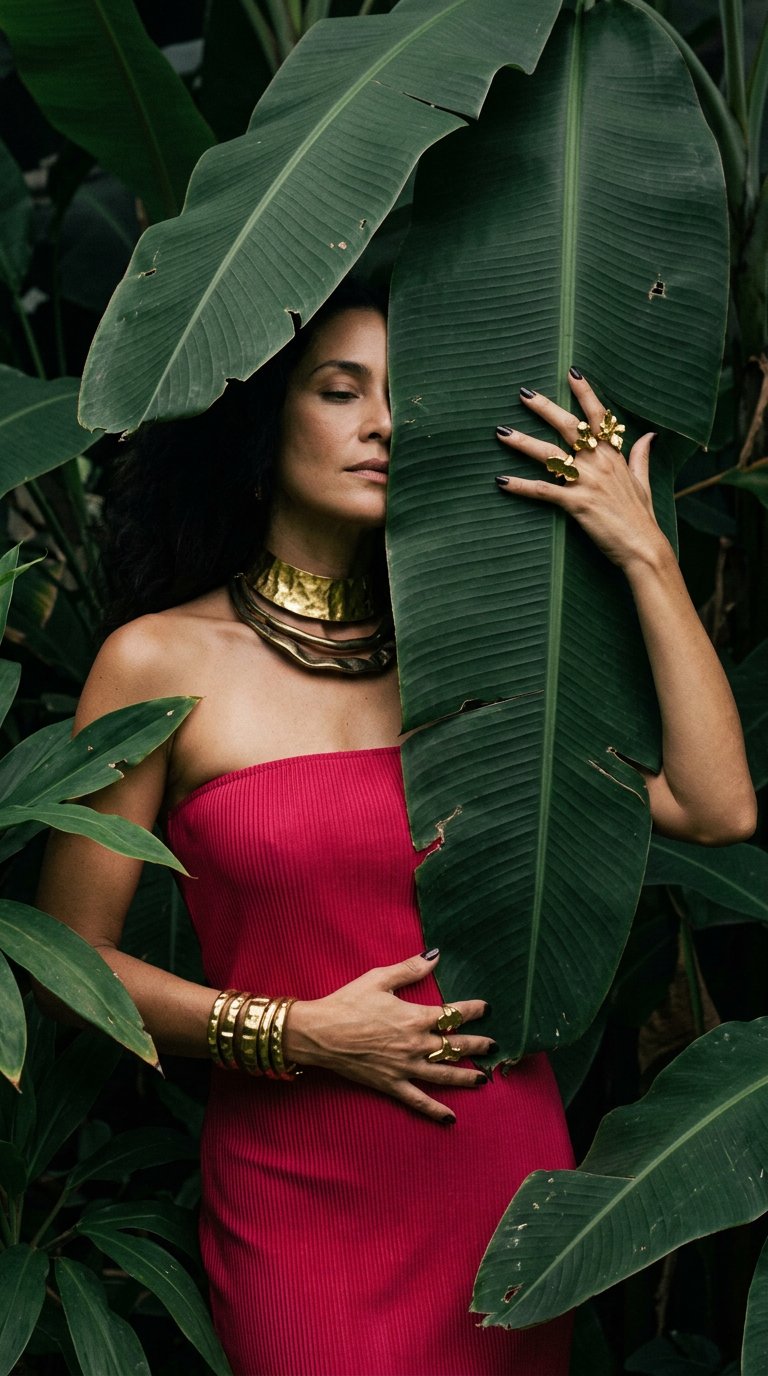
Create a vertical fashion editorial of an adult woman standing inside dense tropical foliage, framed tightly from approximately the upper hips to above the head so oversized banana and broad-leaf plants occupy nearly the entire image. Treat the foliage as active foreground structure rather than background decoration. Let one enormous dark-green banana leaf rise vertically through the center-right of the frame, overlapping the torso and partially interrupting the face. Another broad leaf enters from the left and cuts across the upper head and shoulder zone. Keep additional leaves layered behind her at different depths so there is almost no clean background or open negative space. Build the body around tactile interaction with the plants. Keep one hand high against the large central leaf, fingers spread and curling slightly into the surface as though drawing it closer. Let the opposite hand settle firmly at the waist or lower abdomen, creating one grounded anchor point. Keep the torso subtly twisted beneath the leaf rather than square to camera. Lift the chin and turn the face slightly sideways into the foliage, eyes lowered or half-closed, expression calm and absorbed rather than directly performative. Dress her in a fitted strapless column dress in saturated fuchsia-crimson with a narrow ribbed or finely pleated vertical texture. Keep the silhouette simple and close to the body so the dress reads as one concentrated warm color field against the surrounding dark greens. Avoid extra ruffles, prints or flowing fabric that would compete with the leaves. Build the jewelry as a concentrated antique-gold system rather than delicate accessories. Use a broad rigid collar close around the neck with a slightly irregular hammered surface, layered over a second darker sculptural neck band. Add several heavy stacked bangles or cuffs on one wrist, plus multiple substantial cast-gold rings across the raised hand, including irregular botanical or talisman-like forms. Keep the opposite hand simpler so the jewelry remains visually concentrated rather than symmetrical. Use dark glossy nails to sharpen the hand-to-leaf interaction. Keep earrings minimal or absent so the neck jewelry and rings remain dominant. Style the hair dark, loose and mostly absorbed into the foliage, with only enough volume and texture visible around the head and shoulders to keep the silhouette human. Avoid polished salon styling or elaborate updos. Use restrained directional light from slightly high camera-left, warm enough to catch the cheek, collarbone, shoulders, forearms, gold jewelry and selected ridges of the leaves while allowing the rest of the environment to fall into deep green-black shadow. Do not add bright tropical fill, rim light or golden-hour glow. Let the jewelry produce compact metallic highlights and the leaves retain matte fibrous texture with only narrow reflected edges. Preserve the material contrast: skin should read warm and soft, the dress matte-to-satin with fine vertical texture, gold hard and reflective, leaves thick, waxy and slightly scarred or split. Keep small imperfections in the foliage rather than idealized flawless plants. Keep the palette tightly controlled to deep forest green, near-black shadow, saturated fuchsia-crimson, warm skin and antique gold. Render with dense shadow, fine grain, modest optical softness, restrained highlight bloom and slightly compressed editorial color rather than clean contemporary tropical photography. The first read should be the huge leaves physically interrupting the woman; the second the fuchsia dress emerging as one hot color block through the green; the third the heavy gold collar, stacked cuffs and ring-covered hand gripping the leaf.
Details
- Type
- AI Image Prompts
- Aspect Ratio
- 24:43
- Updated
- Nov 5, 2026
How to use this prompt
- 1Copy the full prompt with the copy button above.
- 2Open Nano Banana by Google, or any image generator with a similar style range.
- 3Paste the prompt, then swap the subject and style keywords to match your idea.
- 4Match the example's settings (24:43 · Nature · Fashion · Portrait), then iterate — small wording changes shift the output a lot.
Frequently asked questions
Which AI model generated this image?
This image was generated with Nano Banana by Google. The prompt on this page is the exact text used to create it.
What settings does this prompt use?
The example was generated with Nano Banana using: 24:43 · Nature · Fashion · Portrait. Reusing these settings gives the closest match.
How do I get similar results?
Copy the prompt as-is first, then replace only the subject while keeping the style, lighting, and composition keywords. Generate a few variations — outputs differ between runs.
Can I modify this prompt?
Yes. Prompts work best as starting points — adjust descriptors, aspect ratio, or style tags to make the output your own.