Split Scene Reality and Child Drawing
 GPT Image 2.5OpenAIimage
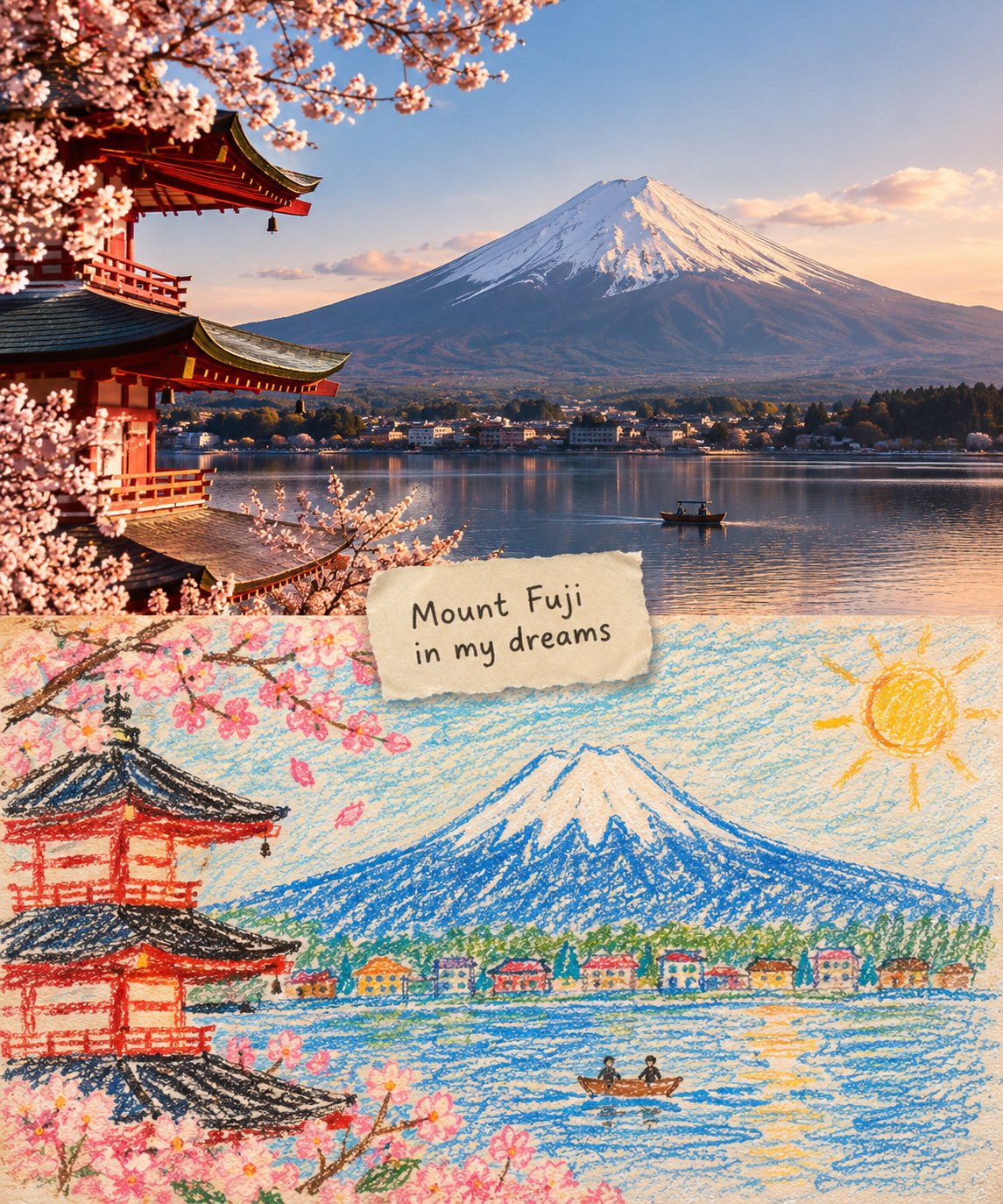
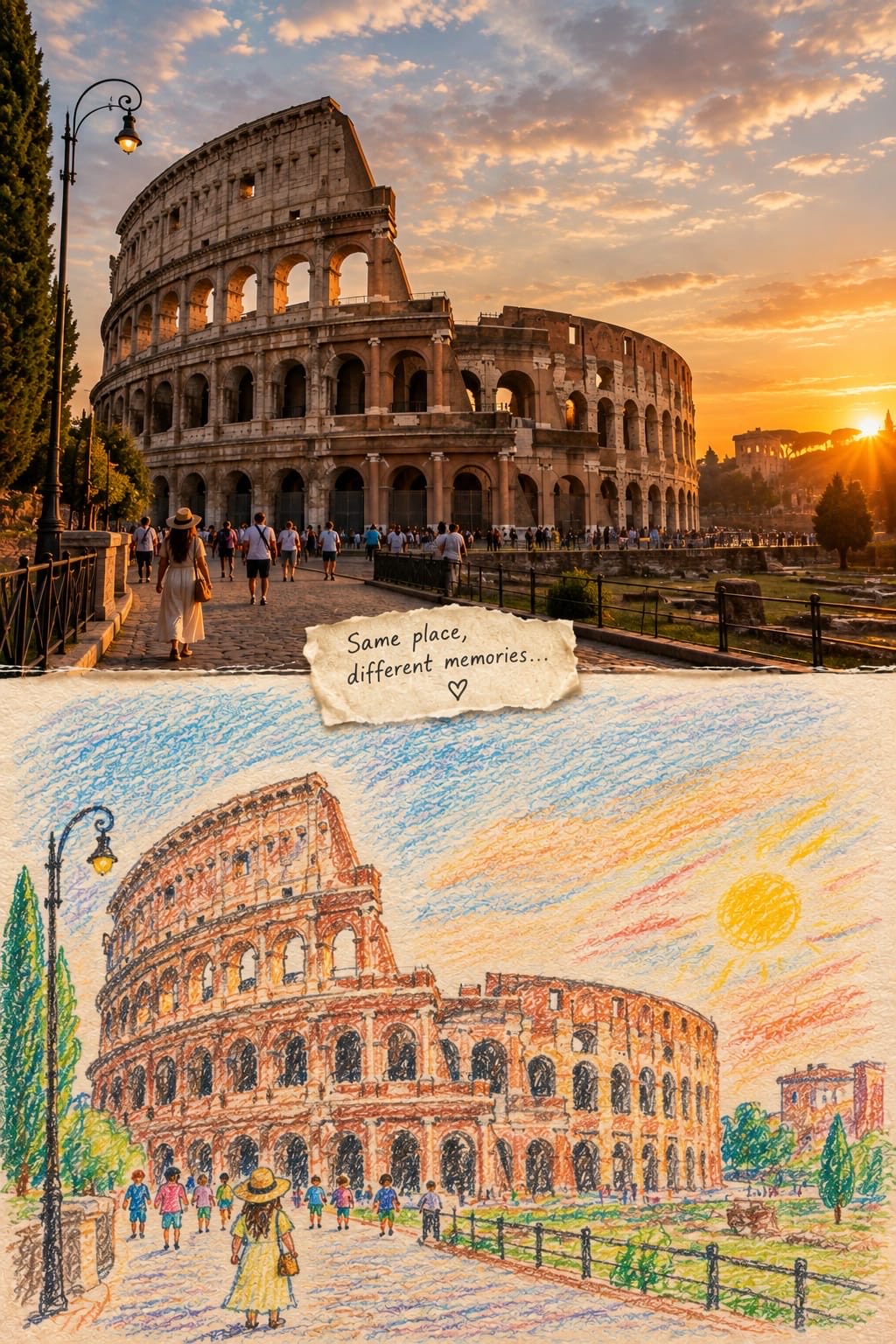
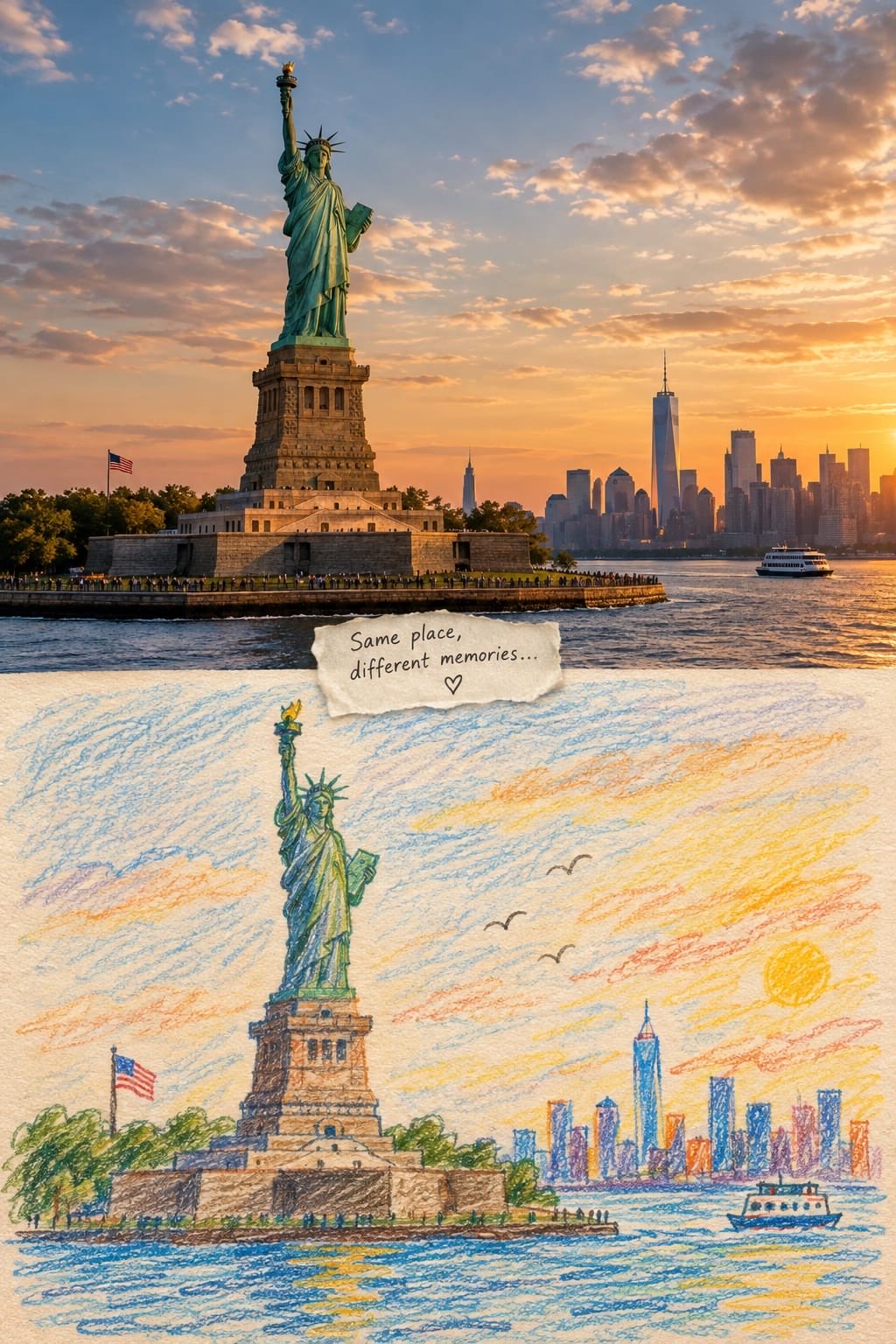
Create a visually striking split-scene artwork showing [LANDMARK / CITY / COUNTRY] in two artistic worlds. Top half: a cinematic, photorealistic view of [LANDMARK], captured during a beautiful [morning/golden-hour/evening], with authentic architecture, local people, atmosphere, street details, natural lighting, realistic textures, and strong cinematic depth. Include recognizable cultural details that immediately establish the location. Bottom half: the exact same scene reimagined as a handmade child’s drawing, created with rough colored pencils, wax crayons, imperfect strokes, scribbled textures, uneven outlines, innocent proportions, visible paper grain, playful colors, and charming imperfections. Keep the important landmarks and visual elements recognizable but make them feel lovingly drawn from memory. Between the two worlds, place a small torn piece of cream paper with handwritten text: “[SHORT EMOTIONAL PHRASE]”. The transition should feel like reality turning into a childhood memory. Warm nostalgic atmosphere, tactile paper texture, subtle imperfections, editorial composition, emotionally charming, highly detailed, artistic but believable. No clean digital illustration, no glossy 3D render, no overly polished cartoon. The strongest visual hook is keeping the same composition in both halves so the viewer immediately recognizes that the crayon drawing is the child’s imaginative/memory version of the real place.
Details
- Type
- AI Image Prompts
- Aspect Ratio
- 5:6
- Updated
- Oct 1, 2026
Category
How to use this prompt
- 1Copy the full prompt with the copy button above.
- 2Open GPT Image 2.5 by OpenAI, or any image generator with a similar style range.
- 3Paste the prompt, then swap the subject and style keywords to match your idea.
- 4Match the example's settings (5:6 · Digital Art · Cinematic · Realistic), then iterate — small wording changes shift the output a lot.
Frequently asked questions
Which AI model generated this image?
This image was generated with GPT Image 2.5 by OpenAI. The prompt on this page is the exact text used to create it.
What settings does this prompt use?
The example was generated with GPT Image 2.5 using: 5:6 · Digital Art · Cinematic · Realistic. Reusing these settings gives the closest match.
How do I get similar results?
Copy the prompt as-is first, then replace only the subject while keeping the style, lighting, and composition keywords. Generate a few variations — outputs differ between runs.
Can I modify this prompt?
Yes. Prompts work best as starting points — adjust descriptors, aspect ratio, or style tags to make the output your own.
![Create a premium cinematic luxury tourism poster for [COUNTRY / DESTINATION] in a STRICT 4:5 vertica — AI image prompt — GPT Image 2.5](https://cdn.ahaprompt.app/harvest-media/import-1789369001673-dctuvc.jpg)
![Create a premium vertical 4:5 editorial travel poster for [COUNTRY], where the outline of the countr — AI image prompt — GPT Image 2.5](https://cdn.ahaprompt.app/harvest-media/import-1789369064970-j9jipe.jpg)
![Create a premium contemporary editorial art poster for [LOCATION] in a playful Japanese design-ZINE — AI image prompt — GPT Image 2.5](https://cdn.ahaprompt.app/harvest-media/import-1789139846025-v6z310.jpg)