Photorealistic Person Holding Clay Doll Self
 GPT Image 2.5OpenAIimage
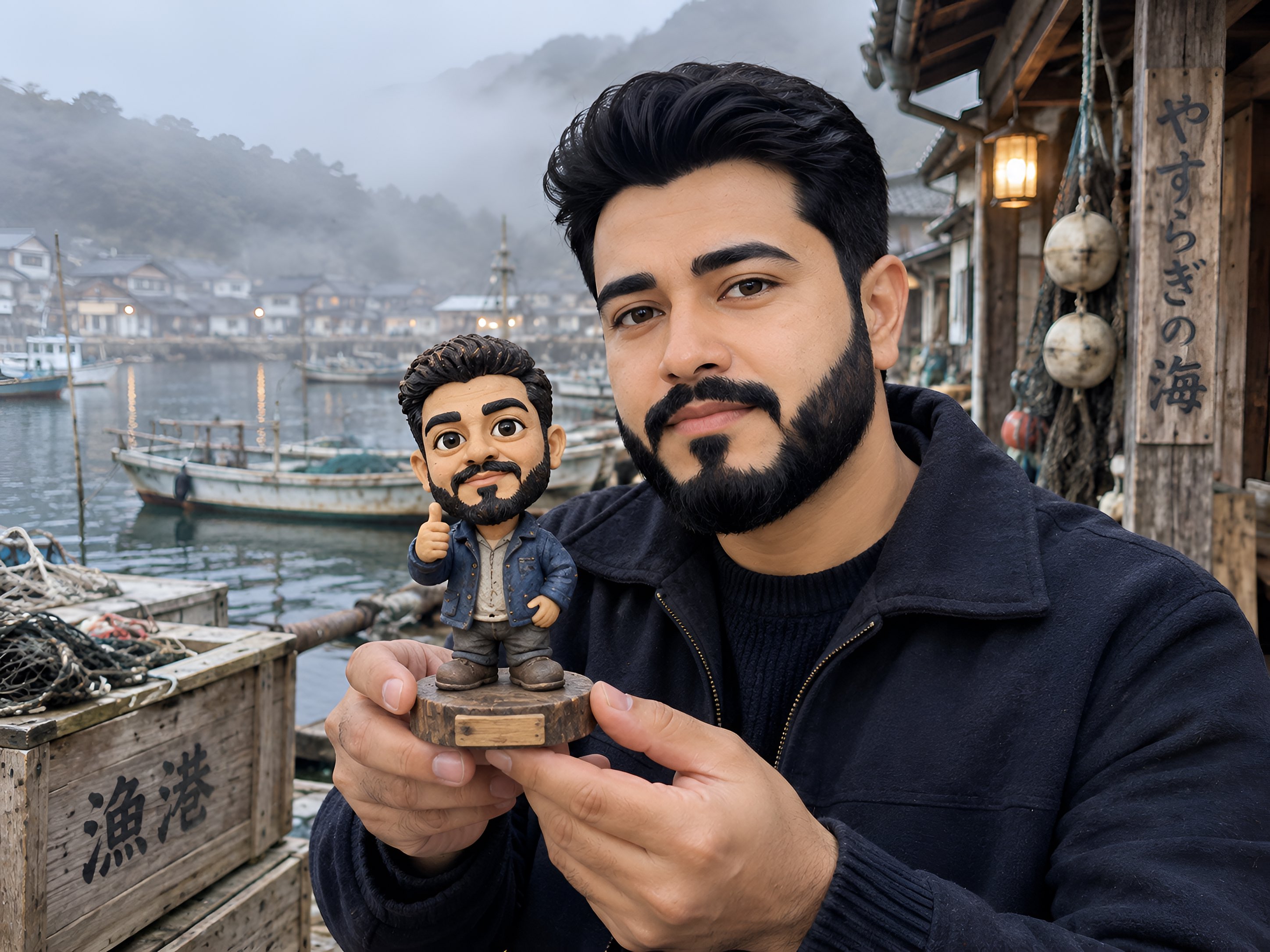
Use the uploaded portrait photo as the primary identity reference. Preserve the person’s recognizable facial identity as accurately as possible, including face shape, apparent age, hairstyle, eyebrows, eyes, nose, mouth, jawline, skin tone, expression, and overall character. Create a cinematic, photorealistic 4:3 portrait scene on a quiet early-morning fishing pier in a small Japanese coastal town. Show the same person from the uploaded photograph standing on weathered wooden planks beside a wooden crate, with calm gray-blue water, moored wooden boats, hanging fishing nets, mist over the harbor, and distant tiled-roof houses fading into fog. The person should be clearly visible and photographed realistically, wearing a simple dark jacket or knit sweater. They hold a handmade clay doll of themselves toward the camera with both hands. The doll is a small, slightly exaggerated artisan clay figurine of the same person, sculpted in the style of a charming Japanese folk toy or tourist souvenir. It should look handmade from matte clay, with visible fingerprints, tool marks, and a slightly imperfect surface. Keep it clearly recognizable as the same person. Push the doll’s features theatrically: oversized head, big expressive eyes, a comically large nose or grin, simplified body, wild hair or hat shape, and a playful pose. Keep it cute, humorous, and artistic rather than grotesque. The doll can wear a tiny version of similar clothing and stand on a small rustic wooden or clay base. Important: clearly show both versions in a single image: the real, photorealistic person and the clay doll version of the same person in their hands. Use soft overcast morning light, high detail, natural skin texture, believable hands holding the figurine, a calm harbor atmosphere, and a vintage Japanese seaside souvenir feel.
Details
- Type
- AI Image Prompts
- Aspect Ratio
- 4:3
- Updated
- Sep 21, 2026
How to use this prompt
- 1Copy the full prompt with the copy button above.
- 2Open GPT Image 2.5 by OpenAI, or any image generator with a similar style range.
- 3Paste the prompt, then swap the subject and style keywords to match your idea.
- 4Match the example's settings (4:3 · Cinematic · Realistic · Portrait), then iterate — small wording changes shift the output a lot.
Frequently asked questions
Which AI model generated this image?
This image was generated with GPT Image 2.5 by OpenAI. The prompt on this page is the exact text used to create it.
What settings does this prompt use?
The example was generated with GPT Image 2.5 using: 4:3 · Cinematic · Realistic · Portrait. Reusing these settings gives the closest match.
How do I get similar results?
Copy the prompt as-is first, then replace only the subject while keeping the style, lighting, and composition keywords. Generate a few variations — outputs differ between runs.
Can I modify this prompt?
Yes. Prompts work best as starting points — adjust descriptors, aspect ratio, or style tags to make the output your own.
![Create a premium cinematic luxury tourism poster for [COUNTRY / DESTINATION] in a STRICT 4:5 vertica — AI image prompt — GPT Image 2.5](https://cdn.ahaprompt.app/harvest-media/import-1789369001673-dctuvc.jpg)
![Create a premium vertical 4:5 editorial travel poster for [COUNTRY], where the outline of the countr — AI image prompt — GPT Image 2.5](https://cdn.ahaprompt.app/harvest-media/import-1789369064970-j9jipe.jpg)