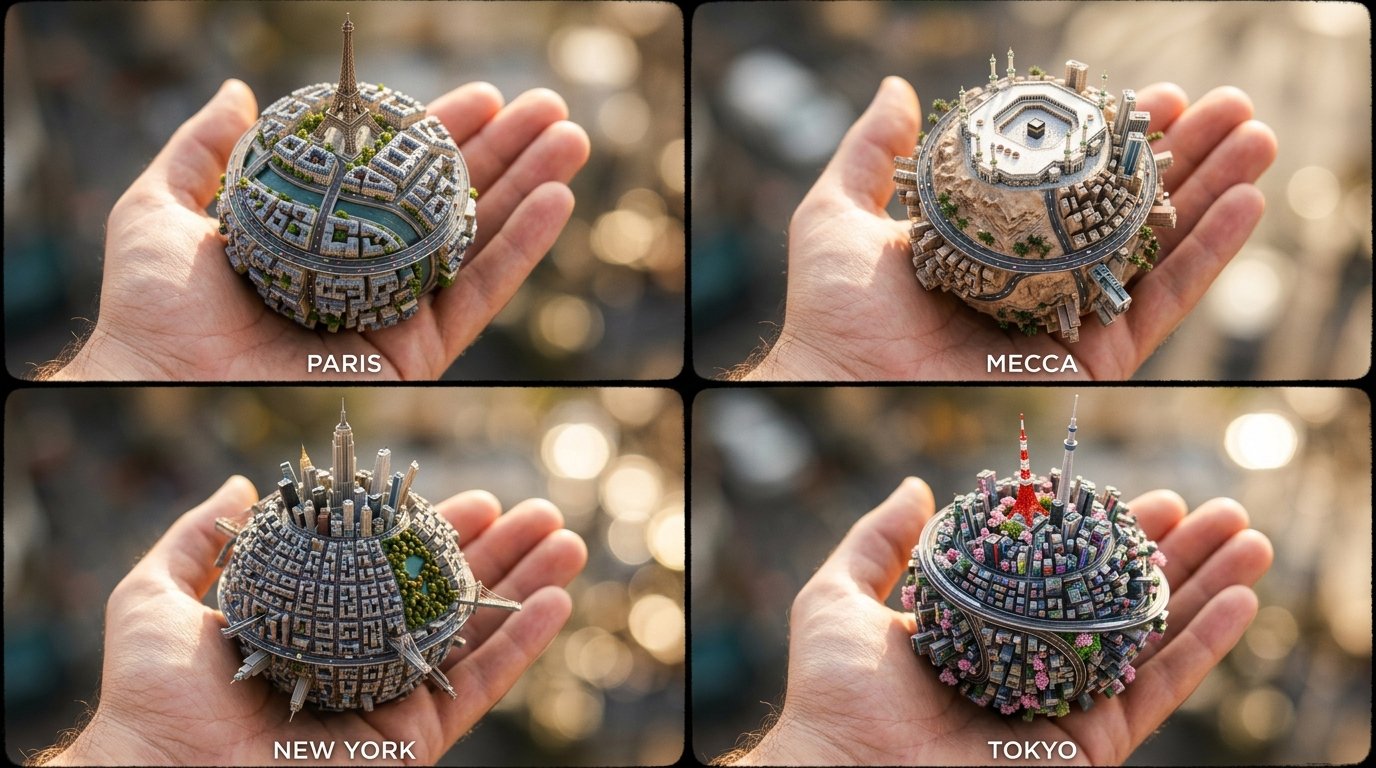
Miniature Scientist Workspace Diorama Grid

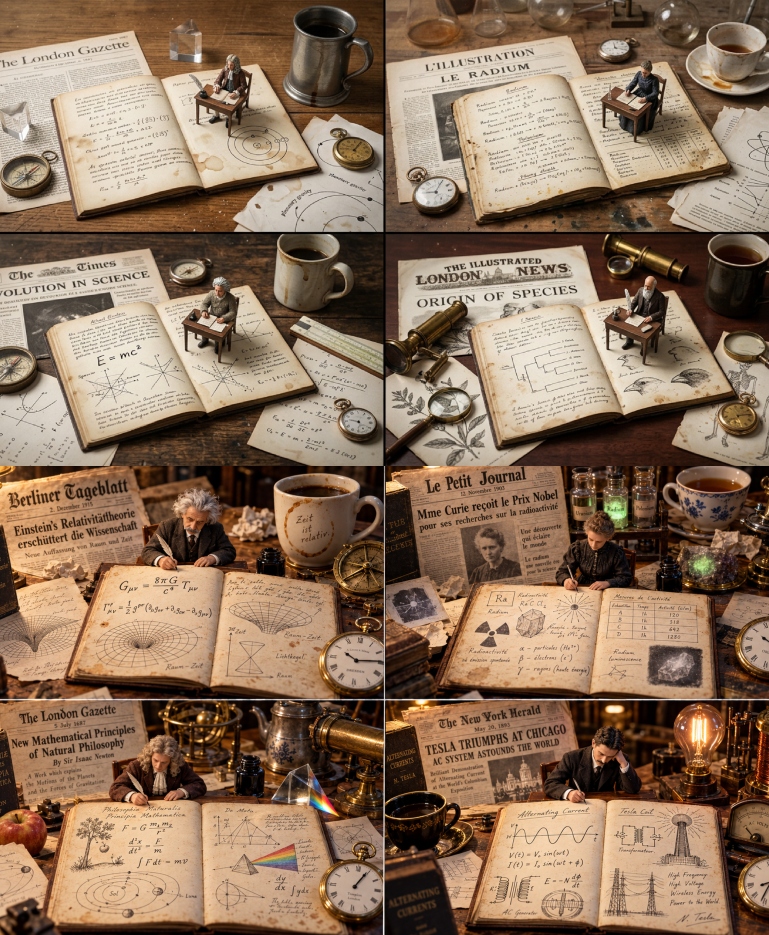
2x2 grid, do this for 4 famous scientists: A macro photograph of a historical scientist's workspace viewed from a 45-degree angle. CENTERPIECE: An antique notebook lying open, its aged pages filled with handwritten equations and diagrams specific to [SCIENTIFIC CONCEPT]. The paper shows coffee stains, ink smudges, and marginal notes. Sitting directly on these pages is a miniature hyper-realistic figurine of [SCIENTIST], approximately 1:12 scale, positioned at a tiny wooden desk, actively working with a miniature quill/pen. ENVIRONMENT OBJECTS (giant scale relative to figurine): A newspaper dated [RELEVANT YEAR] with headline announcing a discovery, partially visible An oversized [PERIOD-SPECIFIC COFFEE/TEA VESSEL] with realistic liquid staining [SCIENTIFIC INSTRUMENT 1] such as a brass compass or glass lens [SCIENTIFIC INSTRUMENT 2] relevant to the field A pocket watch showing [SYMBOLIC TIME] Scattered papers with [SPECIFIC DIAGRAMS] MATERIAL DETAILS: Worn wooden desk surface with visible grain and scratches Aged paper with yellowing and foxing Tarnished brass on instruments Dust particles visible in light beams Authentic period typography on all text elements LIGHTING: Warm tungsten lighting from an implied desk lamp (upper left), creating a focused pool of light on the working figurine with natural shadow falloff. Subtle rim lighting on metallic objects. PERSPECTIVE: Slightly elevated macro view, as if looking down at the desk from a standing position, with shallow depth of field keeping the figurine and central notebook sharp while giant background objects blur softly. ASPECT RATIO: 4:5 STYLE: Hyper-realistic photographic diorama, museum-quality miniature photography
Details
- Type
- AI Image Prompts
- Aspect Ratio
- 769:935
- Updated
- Oct 22, 2026
Category
How to use this prompt
- 1Copy the full prompt with the copy button above.
- 2Open Nano Banana Pro by Google, or any image generator with a similar style range.
- 3Paste the prompt, then swap the subject and style keywords to match your idea.
- 4Match the example's settings (769:935 · Historical · Macro · Realistic), then iterate — small wording changes shift the output a lot.
Frequently asked questions
Which AI model generated this image?
This image was generated with Nano Banana Pro by Google. The prompt on this page is the exact text used to create it.
What settings does this prompt use?
The example was generated with Nano Banana Pro using: 769:935 · Historical · Macro · Realistic. Reusing these settings gives the closest match.
How do I get similar results?
Copy the prompt as-is first, then replace only the subject while keeping the style, lighting, and composition keywords. Generate a few variations — outputs differ between runs.
Can I modify this prompt?
Yes. Prompts work best as starting points — adjust descriptors, aspect ratio, or style tags to make the output your own.