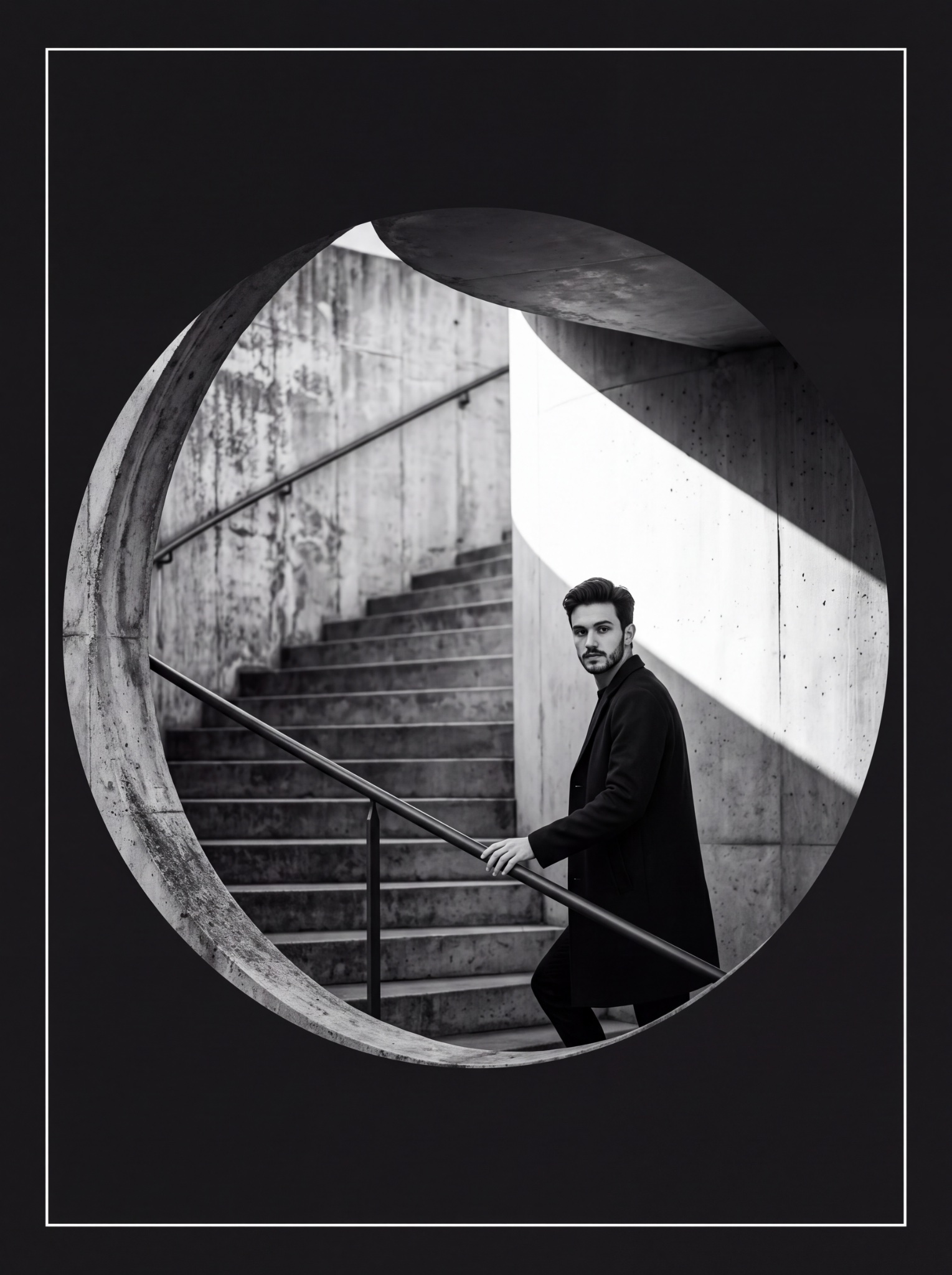
Brutalist Circular Porthole Stairwell Portrait
 Nano BananaGoogleimage
Black and white fine-art architectural portrait photography, vertical 4:5 portrait format. A perfectly circular porthole-shaped cutout reveals a brutalist concrete stairwell, while everything outside the circle is flat, solid near-black charcoal (#161616), with a thin crisp white rectangular border line inset a few millimeters from the frame edge. The circle sits slightly above center, with the thick, weathered concrete ring edge visible on the left side. Inside the circle: wide concrete steps rising diagonally from left to right, a slim dark metal handrail running parallel along the diagonal, a large curved concrete wall on the right catching a hard shaft of direct sunlight that creates a bright white diagonal shape, a dark curved ceiling overhang at the top right, and rough concrete texture on the left wall. Extremely high contrast, deep crushed blacks, bright highlights, strong geometric lines and curves. A lone man is walking up the stairs in the lower right of the circle, caught mid-step, one hand lightly sliding along the metal handrail. His body is angled up the staircase, but his head is turned and he looks directly into the camera lens, making strong eye contact with the viewer. He is clearly visible, not a silhouette: bareheaded with short dark hair, no hat, no cap, wearing a dark long coat, face lit by the sunbeam on one side, with a calm, serious expression. His face is the sharpest point in the image, with crisp eyes, skin texture, and defined jawline, in razor-sharp focus. Shot on an 85mm f/1.4 portrait lens, shallow depth of field, the stairs, handrail, and concrete walls behind and in front of him fall into a soft, creamy blur, with gentle compression of the stairwell geometry. Moody, minimalist, cinematic, fine film grain, no color, no text.
Details
- Type
- AI Image Prompts
- Aspect Ratio
- 1529:2048
- Updated
- Oct 8, 2026
How to use this prompt
- 1Copy the full prompt with the copy button above.
- 2Open Nano Banana by Google, or any image generator with a similar style range.
- 3Paste the prompt, then swap the subject and style keywords to match your idea.
- 4Match the example's settings (1529:2048 · Architecture · Black & White · Minimalist), then iterate — small wording changes shift the output a lot.
Frequently asked questions
Which AI model generated this image?
This image was generated with Nano Banana by Google. The prompt on this page is the exact text used to create it.
What settings does this prompt use?
The example was generated with Nano Banana using: 1529:2048 · Architecture · Black & White · Minimalist. Reusing these settings gives the closest match.
How do I get similar results?
Copy the prompt as-is first, then replace only the subject while keeping the style, lighting, and composition keywords. Generate a few variations — outputs differ between runs.
Can I modify this prompt?
Yes. Prompts work best as starting points — adjust descriptors, aspect ratio, or style tags to make the output your own.