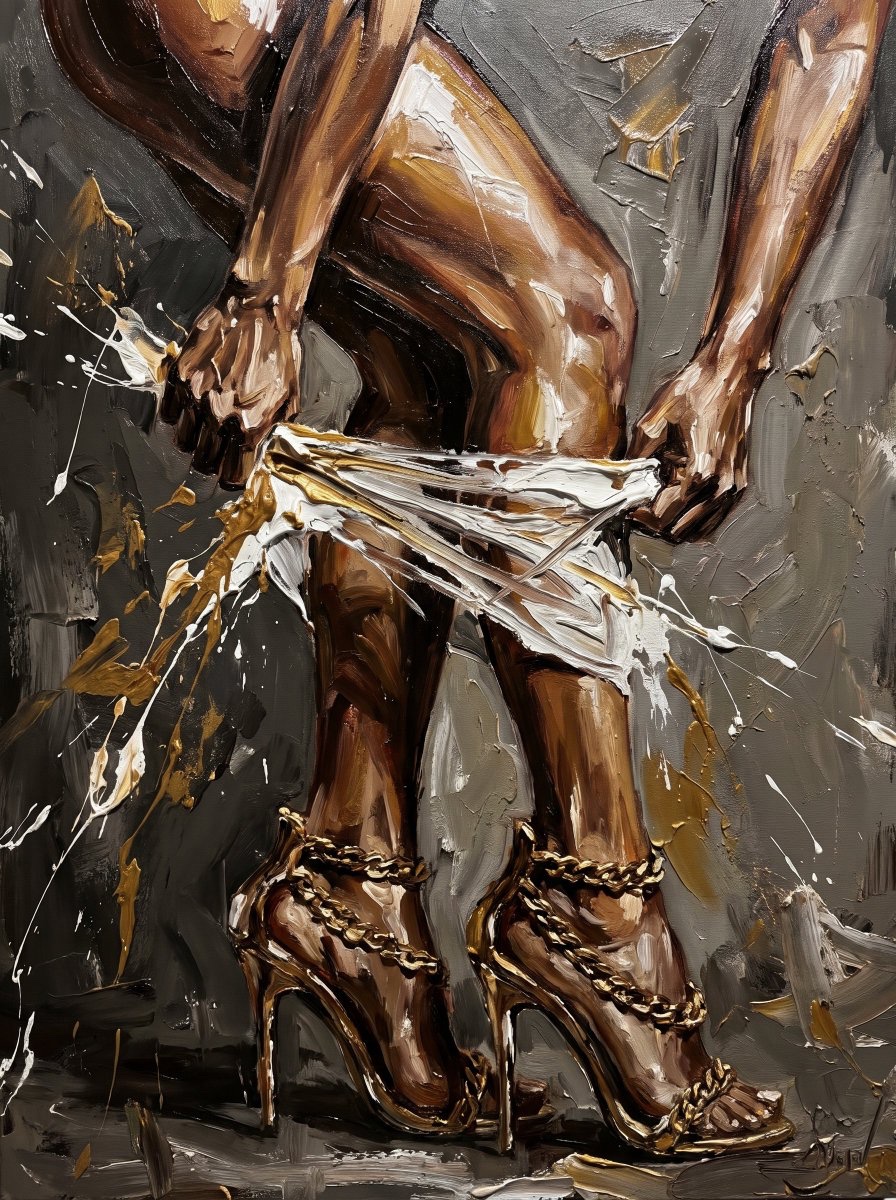
Abstract Expressionist Impasto Leg Study

Theme: Abstract Expressionist Figure Study Subject: Fragmented lower body of an athletic female figure from the waist down, featuring powerful, bronze-toned legs. The figure is captured in a forward-leaning, wide-set stance with hands positioned at the mid-calf. Person · Expression: The skin is rendered through thick, glistening layers of oil paint and visceral impasto ridges that suggest muscular tension. The hands are formed by bold, gestural strokes, with fingers hooked into fabric straps in a pulling motion. The feet and ankles show raw canvas texture and dark linear pigment streaks. Clothing · Pose: Bright white fabric straps are pulled taut around the upper calves, rendered as sharp, linear strokes against the skin tones. The footwear consists of nude-toned stiletto forms integrated with heavy, gold curb-link chain ankle bracelets, built from dense metallic pigments and raised ridges. Background · Light: A neutral dark grey and taupe studio field of raw canvas and broad gestural washes. The scene is illuminated by dramatic side lighting (chiaroscuro), creating bright specular highlights on the raised paint peaks and deep, carved shadows within the texture. Composition · Camera: Vertical 3:4 orientation. A low-angle close-up focusing on the gestural marks of the legs and feet. The composition uses upward-sweeping brush arcs to create a sense of scale and force, with the edges of the frame dissolving into loose splatters. Texture · Style: Authentic human-made oil painting on heavy canvas. The style features aggressive impasto, violent paint splatters, and chaotic drips. There is a high tactile contrast between the fluid white paint of the fabric, the metallic texture of the gold chains, and the matte ground of the raw canvas.
Details
- Type
- AI Image Prompts
- Aspect Ratio
- 56:75
- Updated
- Oct 25, 2026
Category
How to use this prompt
- 1Copy the full prompt with the copy button above.
- 2Open Nano Banana Pro by Google, or any image generator with a similar style range.
- 3Paste the prompt, then swap the subject and style keywords to match your idea.
- 4Match the example's settings (56:75 · Oil Painting · Abstract · Dramatic), then iterate — small wording changes shift the output a lot.
Frequently asked questions
Which AI model generated this image?
This image was generated with Nano Banana Pro by Google. The prompt on this page is the exact text used to create it.
What settings does this prompt use?
The example was generated with Nano Banana Pro using: 56:75 · Oil Painting · Abstract · Dramatic. Reusing these settings gives the closest match.
How do I get similar results?
Copy the prompt as-is first, then replace only the subject while keeping the style, lighting, and composition keywords. Generate a few variations — outputs differ between runs.
Can I modify this prompt?
Yes. Prompts work best as starting points — adjust descriptors, aspect ratio, or style tags to make the output your own.