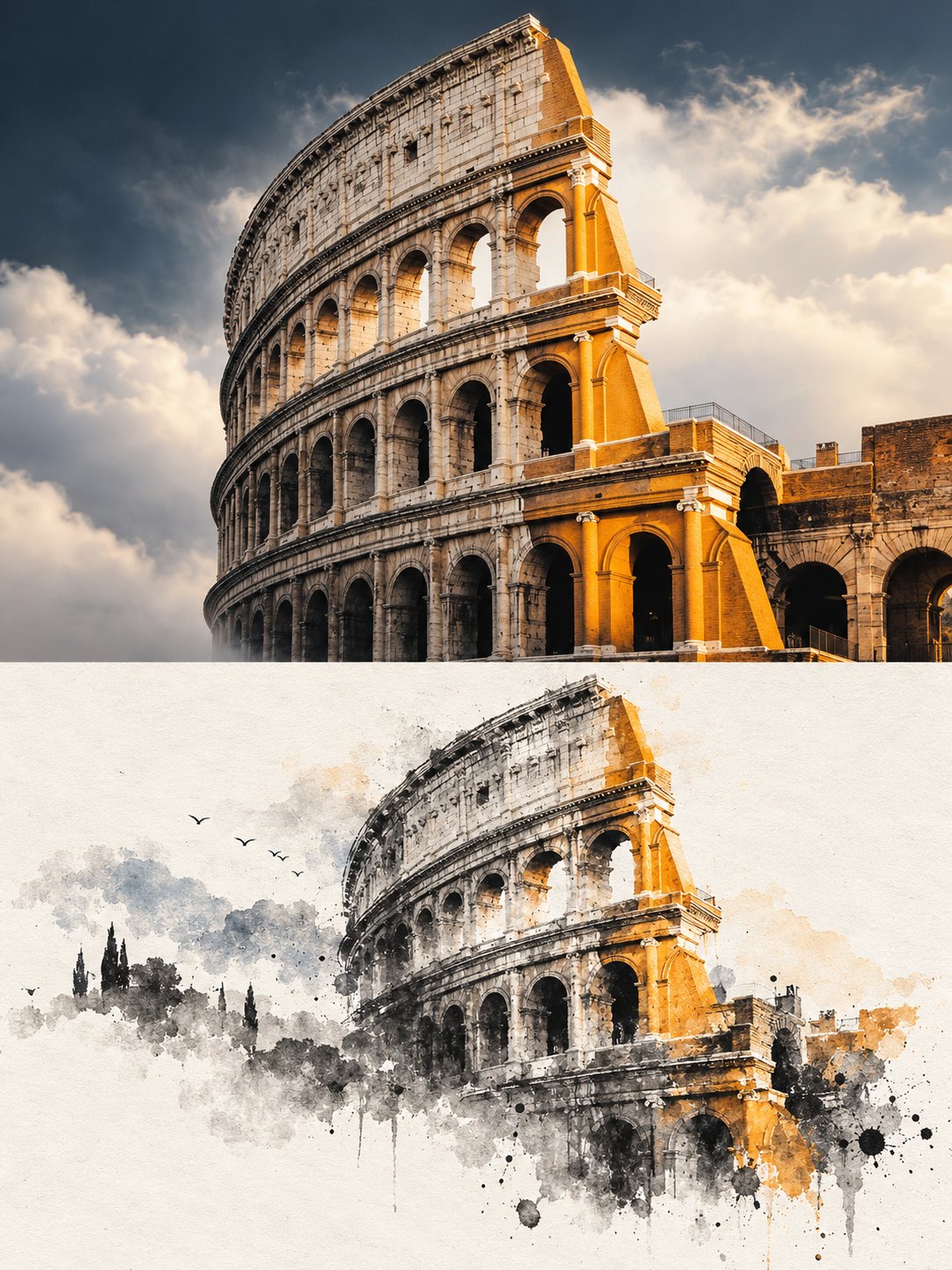
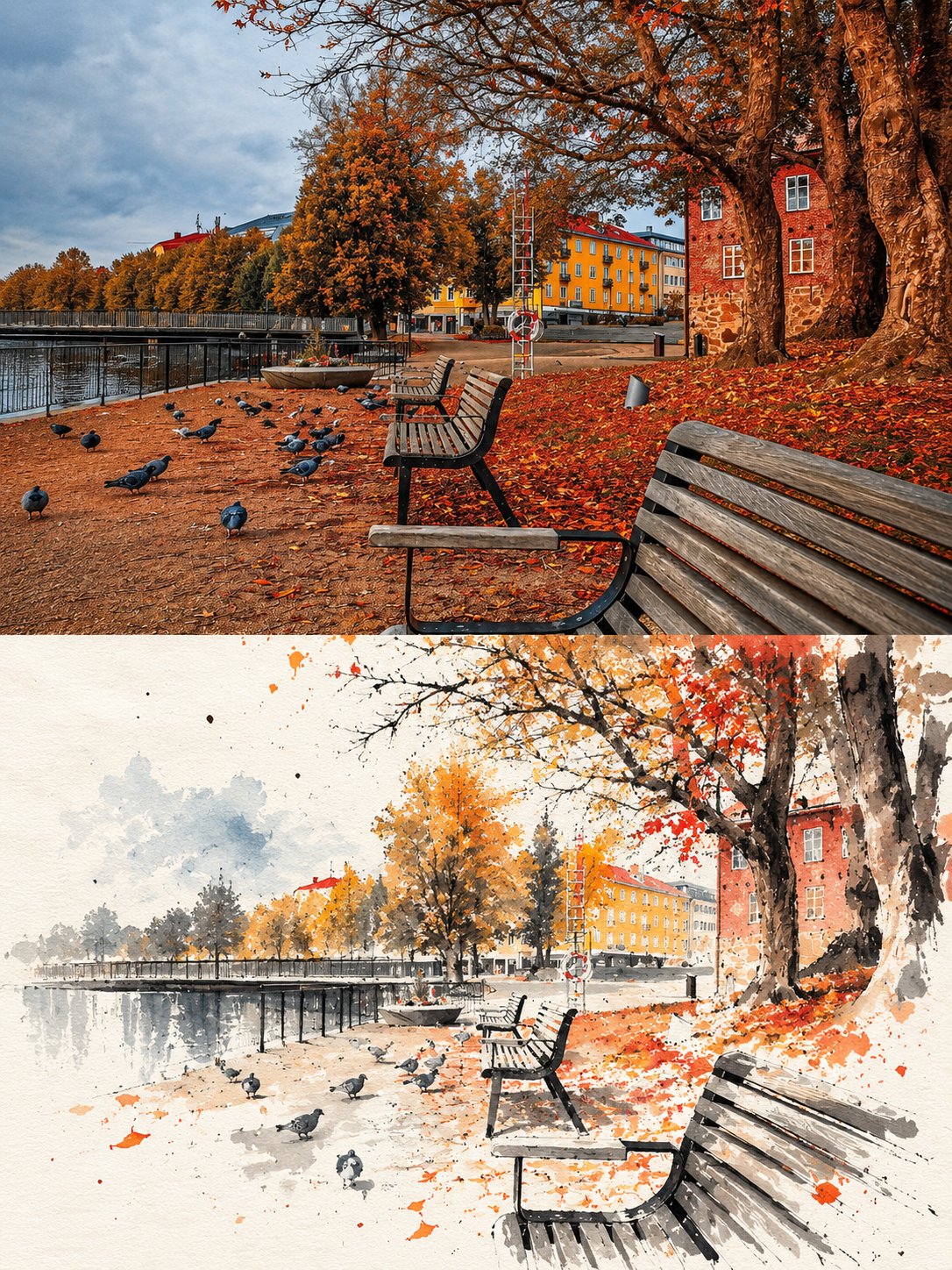
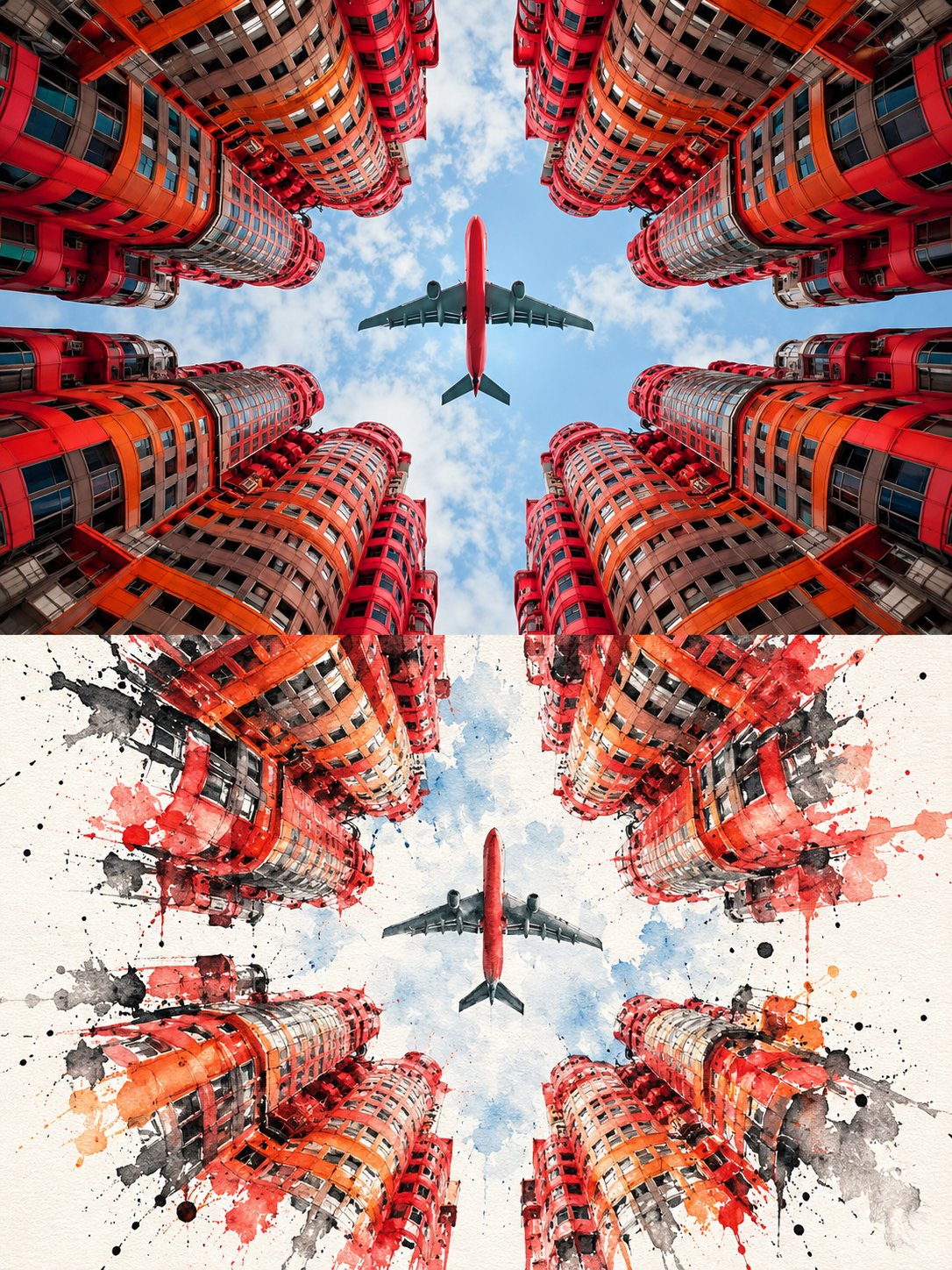
Split Editorial Ink Wash Poster
 GPT Image 2.5OpenAIimage
Create a premium 3:4 vertical editorial poster using the uploaded photo as the sole reference. OVERALL FORMAT The image must use a strict 3:4 vertical composition divided horizontally into two equal regions with an exact 1:1 height ratio. Each region occupies exactly 50% of the total image height. UPPER REGION: ORIGINAL PHOTO Use the original uploaded photo directly as the upper 50% of the composition. Preserve the subject's exact identity, facial features, body structure, proportions, posture, perspective, clothing, materials, lighting, and original color atmosphere. Do not regenerate, reshape, distort, stretch, beautify, or alter the subject. Only apply subtle high-end color grading, image purification, refined tonal balance, and gentle detail enhancement, giving the image the refined texture of an art magazine or exhibition photograph. The background may be moderately expanded to fit the 3:4 composition, but the subject must remain completely unchanged in structure, posture, proportions, and core composition. LOWER REGION: MINIMALIST INK WASH RECONSTRUCTION Reconstruct the same subject and scene as a minimalist contemporary ink wash artwork. First identify and preserve the most recognizable elements of the original image, including silhouette, outline, structure, perspective, movement, visual rhythm, spatial relationship, and overall atmosphere. Do not directly copy photographic details. Do not create a realistic reproduction. Instead, translate the original scene into an artistic ink wash interpretation that preserves its recognizable essence and visual relationship with the upper photograph. Use a milky white, warm white, or natural paper-white base with delicate paper fibers and subtle organic texture. Build the artwork using expressive ink wash techniques including dry and wet brushwork, flying white, ink seepage, ink accumulation, soft diffusion, broken edges, layered washes, and intentional white space. Remove secondary details. Keep only the most distinctive contours, structural transitions, spatial layers, movement, and atmosphere. The lower artwork should feel summarized, refined, poetic, and intentionally incomplete rather than realistically detailed. INK AND COLOR Use black, charcoal gray, soft gray, and diluted ink tones as the dominant palette. Create clear tonal layering with varied ink density, pressure, rhythm, and transparency. Extract only a few emotionally important colors from the original image and reinterpret them as small areas of artistic staining or pigment. Colors may transform naturally into blue-gray, distant blue, soft gold, warm yellow, vermilion red, light cyan, or similar restrained tones. Do not mechanically reproduce the original color values. Ink and negative space must remain dominant. Avoid muddy brown, dull vintage tones, heavy coloring, excessive decoration, or vulgar color combinations. COMPOSITION AND NEGATIVE SPACE The main reconstructed subject should occupy approximately 30% to 45% of the lower half. Reserve the remaining area for generous negative space. The artwork may be asymmetrically positioned, partially framed, suspended, slightly cropped, or offset. Maintain strong asymmetrical balance and a sophisticated editorial composition. The edges of the ink artwork should gradually loosen, fragment, fade, scatter, and disappear into the paper, creating a natural sense of breathing space. Negative space must function as an intentional visual element, not as empty unused space. Reduce information rather than filling the entire lower region. The final lower section should resemble a refined ink seal, contemporary Eastern material study, or museum-quality oriental artwork displayed on a clean editorial page. TEXT Use very little text. Do not add preset titles, numbers, labels, or template typography. If appropriate, extract only a few meaningful words or a very short phrase related to the subject, location, time, action, emotion, or metaphor. Place the text quietly within the negative space or near the edge of the artwork. Typography must remain subtle, sparse, elegant, and secondary to the visual composition. OVERALL AESTHETIC Contemporary Eastern aesthetics. Minimalist ink wash reconstruction. Premium art magazine presentation. Exhibition photography quality. Large-scale intentional negative space. Subtle editorial typography. Small-scale seal-like visual focus. Quiet, restrained, poetic atmosphere. Elegant asymmetrical composition. Refined paper texture. Museum-quality visual finish. Avoid complex backgrounds, excessive photographic details, realistic duplication, decorative clutter, excessive text, rigid template layouts, filled compositions, heavy colors, old-fashioned brown tones, and unnecessary visual elements.
Details
- Type
- AI Image Prompts
- Aspect Ratio
- 3:4
- Updated
- Oct 7, 2026
How to use this prompt
- 1Copy the full prompt with the copy button above.
- 2Open GPT Image 2.5 by OpenAI, or any image generator with a similar style range.
- 3Paste the prompt, then swap the subject and style keywords to match your idea.
- 4Match the example's settings (3:4 · Poster · Fashion), then iterate — small wording changes shift the output a lot.
Frequently asked questions
Which AI model generated this image?
This image was generated with GPT Image 2.5 by OpenAI. The prompt on this page is the exact text used to create it.
What settings does this prompt use?
The example was generated with GPT Image 2.5 using: 3:4 · Poster · Fashion. Reusing these settings gives the closest match.
How do I get similar results?
Copy the prompt as-is first, then replace only the subject while keeping the style, lighting, and composition keywords. Generate a few variations — outputs differ between runs.
Can I modify this prompt?
Yes. Prompts work best as starting points — adjust descriptors, aspect ratio, or style tags to make the output your own.
![Create a premium vertical 4:5 editorial travel poster for [COUNTRY], where the outline of the countr — AI image prompt — GPT Image 2.5](https://cdn.ahaprompt.app/harvest-media/import-1789369064970-j9jipe.jpg)
![Create a sophisticated, dreamy editorial magazine cover titled “[COUNTRY NAME] — A COUNTRY IN ONE DR — AI image prompt — GPT Image 2.5](https://cdn.ahaprompt.app/harvest-media/import-1789368946131-xefjx1.jpg)
![Create a premium educational travel poster featuring [STRUCTURE NAME], one of the world’s most famou — AI image prompt — GPT Image 2.5](https://cdn.ahaprompt.app/harvest-media/import-1789369131185-x1iuzs.jpg)
![Create a premium cinematic luxury tourism poster for [COUNTRY / DESTINATION] in a STRICT 4:5 vertica — AI image prompt — GPT Image 2.5](https://cdn.ahaprompt.app/harvest-media/import-1789369001673-dctuvc.jpg)
![Create a premium contemporary editorial art poster for [LOCATION] in a playful Japanese design-ZINE — AI image prompt — GPT Image 2.5](https://cdn.ahaprompt.app/harvest-media/import-1789139846025-v6z310.jpg)