LogoAhaPrompt
  • Prompts
  • Featured
  • Models
  • Submit
  • Blog
AhaPromptAhaPrompt

AI Prompts for Images, Video & Audio — Every Model, One Library

Built withLogoNEXTY.DEV
Explore
  • All Prompts
  • Featured Prompts
  • Image Prompts
  • Video Prompts
  • Audio Prompts
  • AI Models
  • Submit a Prompt
  • Blog
Languages
  • English
  • 中文
  • 日本語
  • 한국어

Copyright © 2026 AhaPrompt All rights reserved.

Privacy PolicyTerms of Service
HomeAI Prompt LibraryAI Image PromptsLiterary Artifact Hybrid Diorama Grid
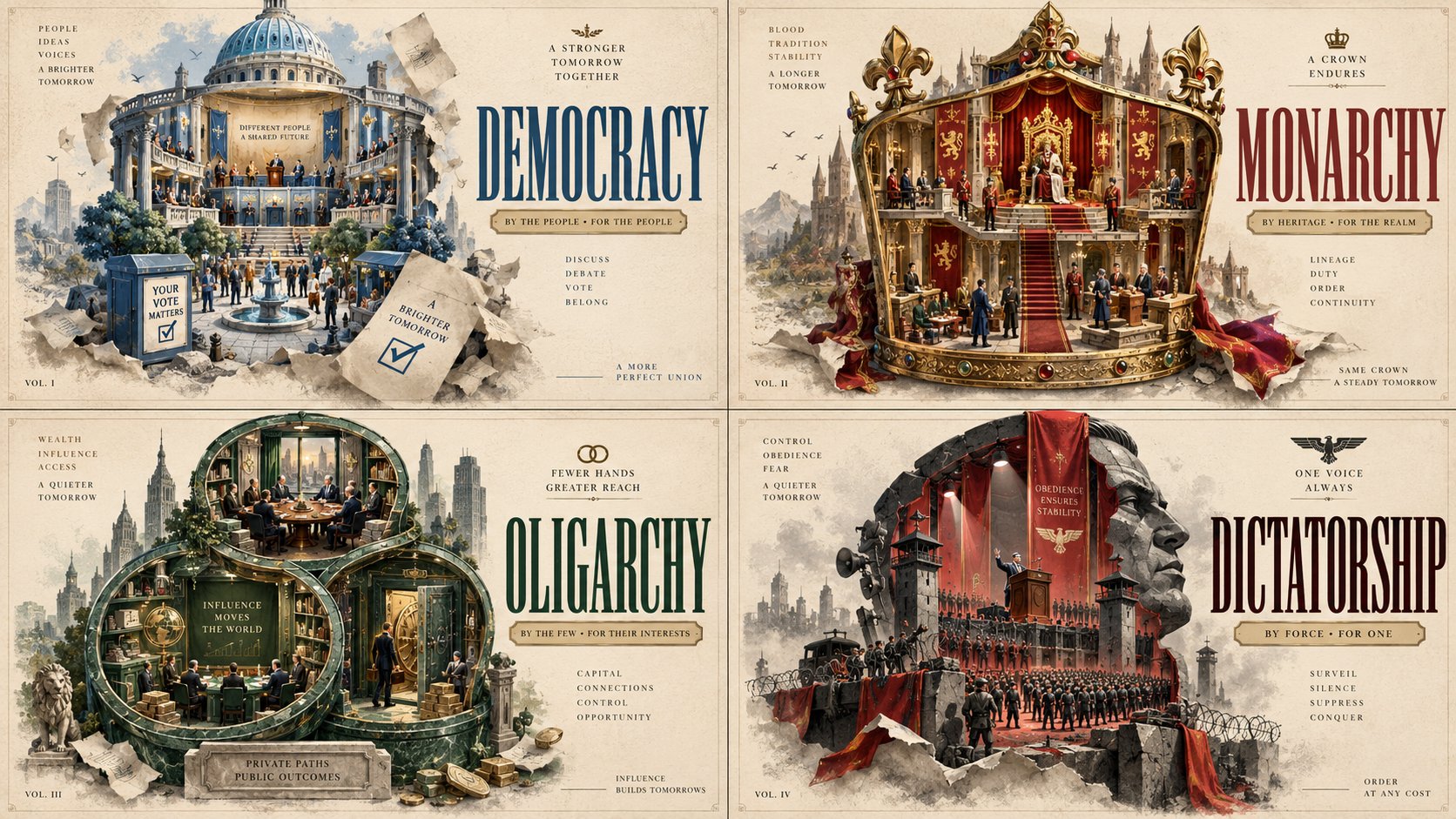
Literary Artifact Hybrid Diorama Grid — AI image prompt — GPT Image 2.5 — Poster, 3D Render, Vintage

Literary Artifact Hybrid Diorama Grid

OpenAIGPT Image 2.5OpenAIimage

2x2 grid, 16:9, do this for 4 systems of government: 2x2 grid, 16:9, do this for famous manga: CONCEPT ANCHOR 1: "Pastel storybook cutaway collectible diorama — spherical or capsule-like cross-sections, miniature rooms and habitats, matte toy materials, tiny props, plaque presentation, warm editorial lighting" :: CONCEPT ANCHOR 2: "Vintage literary screenprint cover — cream paper field, limited duotone palette, tall condensed typography, silhouette profiles, embedded skylines and iconography, elegant poster frontality" :: CONCEPT ANCHOR 3: "Graphite fantasy plate interrupted by dimensional page-burst drama — whisper-soft pencil rendering, atmospheric negative space, drifting dust and paper fragments, selective sculptural emergence from flat image space" INSTRUCTION: Find the exact visual center of these three concepts. Ignore the literal books, monsters, spaceships, authors, and riders. Capture only the style essence. Render {$SUBJECT} as a deluxe literary-artifact hybrid image where the subject exists simultaneously as: 1. a finely crafted cutaway miniature world, 2. a classic screenprinted book-cover silhouette, 3. a soft graphite illustration with vast breathing room, 4. and a partially ruptured page-space where select elements burst forward into dimensional reality. STYLE RULES: - Main composition should feel like a collector’s edition book-cover poster for {$SUBJECT}. - The outer silhouette or framing device should be iconic and poster-readable from far away. - Inside that silhouette, AI should infer a tiny layered micro-world built from handcrafted miniature diorama logic. - The micro-world should include inferred props, architecture, creatures, tools, furniture, terrain, machinery, ornaments, or symbolic story fragments drawn from {$SUBJECT}. - Most of the composition should retain elegant restraint: cream paper, negative space, clean typography zones, and selective pencil softness. - One or two focal elements should rupture the flat printed world and emerge forward with suspended debris, torn paper fibers, dust motes, broken margins, and dimensional energy. - Use tactile material contrast: matte miniature surfaces, flat ink print fields, graphite softness, and sharp burst-depth accents. - Typography should be inferred from {$SUBJECT}: title, subtitle, author-like credit, edition badge, or series plaque. - Layout should feel premium, collectible, literary, and gallery-worthy. COLOR RULES: - Base field: warm cream, parchment, pale ivory. - Main print palette: infer one restrained duotone family from {$SUBJECT}. - Diorama interior: softened pastel variants of the same palette, with subtle toy-like warmth. - Graphite zones: smoky grays, silver pencil values, soft edge falloff. - Burst zones: one higher-contrast accent family inferred from the emotional charge of {$SUBJECT}. OUTPUT: A premium hybrid literary key art for {$SUBJECT} that feels like a vintage cover, a handcrafted miniature museum piece, a graphite illustration, and a book-page eruption frozen in one elegant image.

Details
Type
AI Image Prompts
Aspect Ratio
1672:941
Updated
Sep 11, 2026
Category
Poster3D RenderVintage
Source

How to use this prompt

  1. 1Copy the full prompt with the copy button above.
  2. 2Open GPT Image 2.5 by OpenAI, or any image generator with a similar style range.
  3. 3Paste the prompt, then swap the subject and style keywords to match your idea.
  4. 4Match the example's settings (1672:941 · Poster · 3D Render · Vintage), then iterate — small wording changes shift the output a lot.

Frequently asked questions

Which AI model generated this image?

This image was generated with GPT Image 2.5 by OpenAI. The prompt on this page is the exact text used to create it.

What settings does this prompt use?

The example was generated with GPT Image 2.5 using: 1672:941 · Poster · 3D Render · Vintage. Reusing these settings gives the closest match.

How do I get similar results?

Copy the prompt as-is first, then replace only the subject while keeping the style, lighting, and composition keywords. Generate a few variations — outputs differ between runs.

Can I modify this prompt?

Yes. Prompts work best as starting points — adjust descriptors, aspect ratio, or style tags to make the output your own.
More GPT Image 2.5 prompts

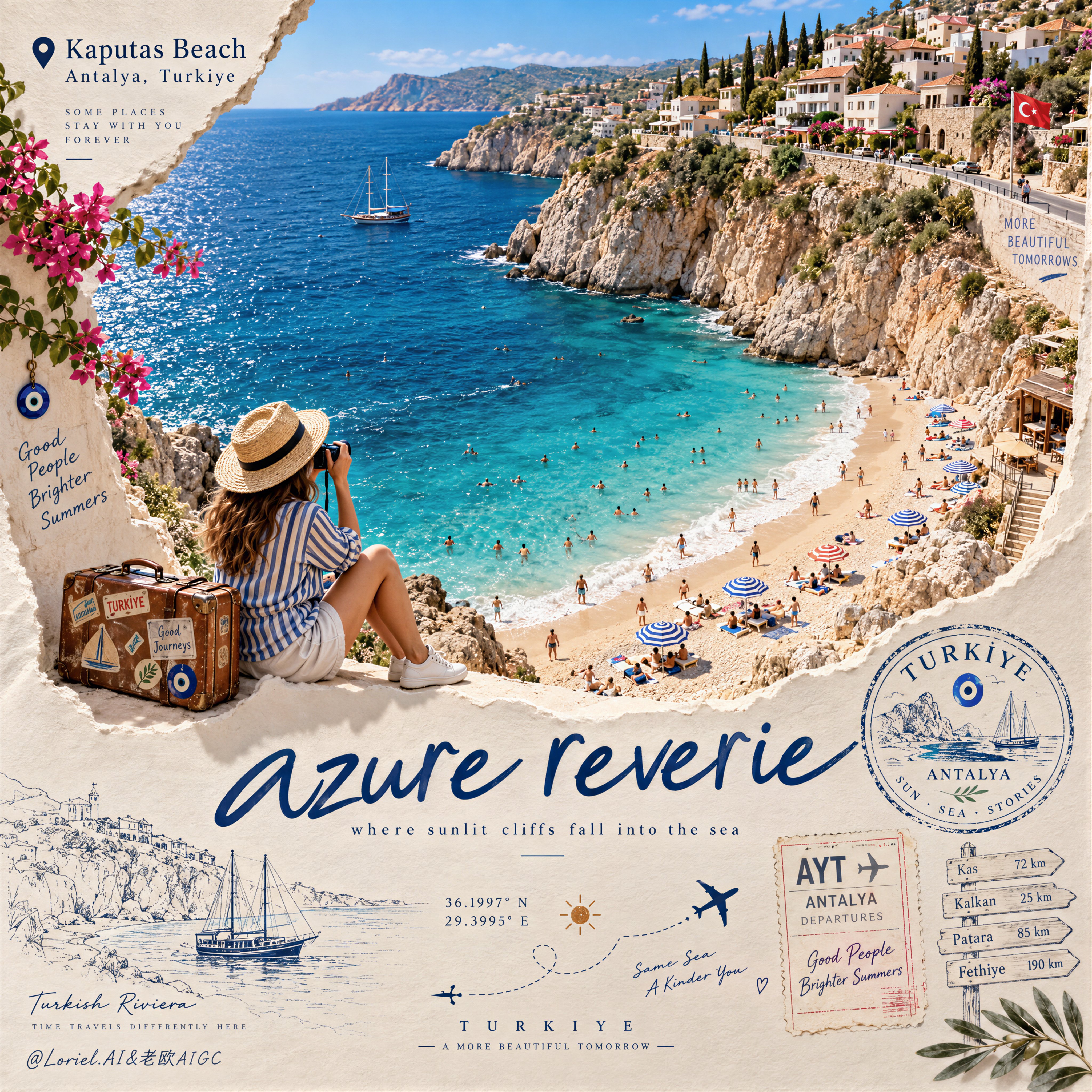
Create a Cannes-level travel destination advertising poster for TURKIYE, preserving the exact struct — AI image prompt — GPT Image 2.5
OpenAIGPT Image 2.5
Create a Cannes-level travel destination advertising poster for TURKIYE, preserving the exact structural logic of a premium paper-sculpture tourism print while merging emotional summer atmosphere with forensic material realism. The composition is vertical and built around one large curved torn-paper window that reveals a luminous handcrafted miniature view of KAPUTAS BEACH, ANTALYA, TURKIYE, while the lower foreground remains a refined cream paper field carrying elegant destination typography, travel stamps, route sketches, coordinates, and curated tourism graphics. The final image must feel like a collector-grade Mediterranean travel memory object: tactile, sun-warmed, cinematic, and exquisitely constructed. Hero destination scene: inside the curved paper opening, reveal a radiant turquoise cove embraced by pale limestone cliffs and a gently arcing golden beach. Show layered Mediterranean water bands shifting from pale aqua near the shore to saturated teal and deep azure farther out, with delicate repeating wave lines and bright foam edges rolling onto the sand. Populate the beach with tiny yet believable sunbathers, swimmers, striped parasols, towels, and scattered leisure details, all proportionally correct and integrated into the scene. Along the upper horizon, build a densely stepped hillside of whitewashed and pastel coastal houses, terracotta roofs, boutique balconies, cypress trees, and warm stone terraces, arranged like a refined miniature Mediterranean village. The entire destination window must feel like a luxury handcrafted 3D diorama enhanced with highly realistic micro-surface detail. Narrative foreground: on the lower edge of the cutout, place one seated miniature traveler figure as an emotional invitation into the destination. The traveler wears elegant striped resort clothing, a straw hat, white sneakers, and holds a camera, beside a small vintage suitcase covered in tasteful travel stickers. The anatomy, hands, posture, and clothing folds must be natural and correct. This figure should feel quietly alive, as if pausing at the threshold of memory, adding warmth and human scale without competing with the destination itself. Typography and editorial layout: preserve the same poster rhythm as the reference. At the upper left, place a small map-pin icon followed by “Kaputas Beach” and beneath it “Antalya, Turkiye” in refined editorial type. On the lower paper field, place one large flowing handwritten English title in deep Mediterranean blue, such as “azure reverie”, followed by a small subtitle like “where sunlit cliffs fall into the sea”. Distribute a few highly curated travel graphics across the lower area: one circular passport-style destination stamp, one boarding-pass or visa-stamp element, one dotted flight-path doodle with tiny airplane icons, precise latitude-longitude coordinates, a small sun glyph, a fine-line coastal sketch, and one discreet signpost marking nearby destinations. All typography must feel elegant, airy, and graphically integrated, never generic, heavy, or cluttered. Turkey-specific accents: add subtle premium local cues with restraint. Integrate a tiny evil-eye motif into one stamp or baggage sticker, a delicate line illustration of a gulet sailboat or coastal architectural silhouette in the lower graphics, and visual cues that suggest refined Turkish Riviera identity without becoming folkloric or overloaded. Everything should feel international, luxurious, and compositionally clean. Atmosphere: the poster should carry the sensation of late-morning Mediterranean light, salt in the air, and the emotional softness of an unforgettable summer coast remembered through beautifully crafted paper. The sea must feel alive and breezy, the sky fresh and expansive, and the destination window should radiate optimism, escape, and warmth. The image should feel like a tactile travel keepsake elevated into a world-class advertising object. Material realism: emphasize thick layered paper edges, crisp cut contours, matte card texture, embossed shadow transitions, tiny architectural facade details, miniature umbrellas, foam ridges, cliff stratification, printed stamp ink, luggage leather grain, sticker gloss, clothing fabric weave, and precise micro-scale beach props. The sea should have dimensional depth without losing the handcrafted paper language. The paper opening must cast believable soft shadows onto the lower field, and every surface should read as physically buildable, premium, and photographically convincing. Lighting: use bright Mediterranean daylight from the upper left with soft clean shadows that enhance the paper relief and miniature depth. The waves, parasols, rooftops, cliffs, and traveler should receive warm, luminous highlights. The lower paper field remains softly lit with subtle shadowing from the cut edge, stamps, and seated figure, producing a polished museum-quality commercial finish. Avoid harsh contrast, dull flatness, or dirty shadow masses. Color hierarchy: 60% luminous turquoise, aqua, pale sand, sun-bleached ivory, and clear coastal sky blue; 30% terracotta roof tones, limestone beige, sage-green foliage, and soft neutral ink tones; 10% deep navy typography, warm suitcase browns, and small accent colors from parasols and travel graphics. The palette must feel fresh, upscale, joyful, and unmistakably Mediterranean. Design intent: the final image must preserve the reference’s exact logic of a
Details
Create a premium vertical 4:5 editorial travel poster for [COUNTRY], where the outline of the countr — AI image prompt — GPT Image 2.5
OpenAIGPT Image 2.5
Create a premium vertical 4:5 editorial travel poster for [COUNTRY], where the outline of the country is formed organically from its landscapes, architecture, culture, and nature rather than using a normal map. Inside the country silhouette, create a seamless cinematic journey: * Top: iconic architecture emerging from clouds * Middle: famous city skyline + traditional buildings * Lower middle: dramatic natural landscape * Bottom: wildlife, local crafts, food, flowers, or cultural details * Small birds, boats, trains, or people can subtly connect the different scenes. Instead of decorative borders, use one continuous architectural element—an ancient arch, carved doorway, stone wall, temple corridor, bridge, or traditional pattern—that visually holds the composition together. On the side, use elegant editorial typography: [COUNTRY NAME] WHERE [SHORT POETIC PHRASE] HISTORY • CULTURE • NATURE • CITIES • CUISINE Add small details: CAPITAL AREA FAMOUS FOR BEST TIME TO VISIT ICONIC PLACES Use a “window into the country” concept: the country silhouette looks like a giant architectural doorway/window, and instead of showing separate boxes, the entire interior becomes one continuous surreal landscape.
Details
Create a sophisticated, dreamy editorial magazine cover titled “[COUNTRY NAME] — A COUNTRY IN ONE DR — AI image prompt — GPT Image 2.5
OpenAIGPT Image 2.5
Create a sophisticated, dreamy editorial magazine cover titled “[COUNTRY NAME] — A COUNTRY IN ONE DREAM”. The entire composition should feel like a poetic visual journey rather than a conventional travel poster. Use a warm ivory paper background with subtle handmade paper texture, elegant high-fashion serif typography, and delicate architectural linework. Build the country’s identity through layered miniature scenes that seamlessly merge into one surreal landscape: dramatic mountains fading into mist, an ancient architectural landmark emerging from clouds, a winding river transforming into a silk ribbon, traditional houses nestled among trees, tiny local people walking along stone paths, native wildlife, iconic food, flowers, traditional crafts, and subtle cultural symbols. Instead of placing everything separately, make each element flow organically into the next, almost like an illustrated dream. Add translucent watercolor washes, fine ink outlines, soft faded edges, atmospheric fog, reflections in still water, tiny handwritten-style annotations, ornamental borders, and subtle geometric design elements. Color palette: muted sage, dusty blue, warm beige, pale peach, soft gray, touches of faded terracotta. Style: luxury travel magazine × Japanese watercolor × vintage cartography × contemporary editorial design × dreamscape illustration. Mood: peaceful, intelligent, nostalgic, cinematic, elegant, mysterious and deeply connected to the culture. At the bottom, add a small elegant line: “Places become memories. Cultures become stories.” Vertical 4:5 composition, highly detailed, refined negative space, premium print quality, delicate textures, sophisticated visual hierarchy, no photorealism, no clutter.
Details
2x2 grid, 9:16, 4 goat chess players who passed away [SUBJECT] :: single standalone vertical tribute — AI image prompt — GPT Image 2.5
OpenAIGPT Image 2.5
2x2 grid, 9:16, 4 goat chess players who passed away [SUBJECT] :: single standalone vertical tribute poster, not a grid Create a heroic illustrated legacy poster for [SUBJECT], showing them as a larger-than-life cultural icon. The poster should combine a giant emotional portrait, multiple smaller action poses, milestone trophies/medals, symbolic locations, fan signs, handwritten quotes, and inspirational typography into one dense but readable composition. CORE FORMULA :: GIANT_PORTRAIT([SUBJECT]) + ACTION_ECHOES([career moments]) + ACHIEVEMENT_OBJECTS([trophies / medals / records]) + HOME_SYMBOLS([city / country / team / arena]) + FAN_MEMORY([signs / banners / handwritten notes]) + LEGACY_TEXT([values / slogans / future impact]) = premium inspirational athlete collage poster AI-INFERENCE RULES :: - infer the sport, uniform, colors, trophies, signature pose, and visual symbols of [SUBJECT] - infer 4–8 smaller action poses showing iconic movements or career moments - infer the most meaningful achievement object: trophy, medal, championship, record, title, crown, ball, apparatus, etc. - infer background landmarks: home city, national flag colors, stadium, court, arena, skyline, mountains, track, field, or stage - infer 5–10 short text fragments: slogan, values, stats, fan signs, handwritten quote, legacy phrase - make the subject feel inspirational, mythic, beloved, and larger than the sport - keep the poster as ONE finished image, not a 2x2 sheet STYLE :: luxury sports tribute poster ::5 maximal illustrated collage ::5 watercolor + gouache + pencil texture ::4 premium magazine cover energy ::4 heroic portrait realism mixed with painterly poster art ::5 large elegant typography ::4 scrapbook/fan-art emotional layering ::4 soft atmospheric glow and paper grain ::4 national/team color palette inferred from subject ::3 dense but readable hierarchy ::5 COMPOSITION :: top = bold inspirational headline or name upper center = huge close-up portrait looking upward / determined / visionary middle = smaller action poses wrapping around the portrait lower center = trophy, medal, ball, apparatus, or iconic achievement object bottom = crowd, stadium, city, flag, court, field, or homeland scene edges = flowers, paint splashes, smoke, stars, signatures, banners, handwritten notes TEXT LOGIC :: Use large readable title text: [SUBJECT NAME] [LEGACY PHRASE] Add short inferred phrases like: “MORE THAN A CHAMPION” “REDEFINING WHAT’S POSSIBLE” “THE BEAUTIFUL GAME LIVES ON” “FLY HIGHER” “COURAGE LOOKS GOOD ON YOU” “DREAMS HAVE NO BORDERS” NEGATIVE :: no 2x2 grid, no plain portrait, no empty background, no corporate infographic, no photorealistic Photoshop collage, no flat vector, no random unrelated objects, no illegible text, no generic athlete, no watermark
Details
Create a premium educational travel poster featuring [STRUCTURE NAME], one of the world’s most famou — AI image prompt — GPT Image 2.5
OpenAIGPT Image 2.5
Create a premium educational travel poster featuring [STRUCTURE NAME], one of the world’s most famous architectural landmarks. Show a beautiful, highly detailed illustration or photorealistic miniature of the structure as the main focal point, surrounded by clean infographic-style information. Include these clearly arranged details: NAME: [Structure Name] RULER / LEADER OF THE TIME: [Ruler or leader] CONSTRUCTION DURATION: [Number of years / approximate duration] HISTORICAL COST: [Original construction cost, if known] CURRENT TICKET PRICE: [Current entry price] LOCATION: [City, Country] FAMOUS FOOD TO TRY: [1–3 famous local foods] Add small architectural sketches, construction details, a tiny location map, historical symbols, subtle decorative elements, and elegant infographic lines. Use a sophisticated museum archive + luxury travel magazine aesthetic with warm ivory paper, muted heritage colors, fine black typography, subtle vintage grain, and clean geometric layout. Make the structure large and dominant, with the information arranged neatly around it. Add a small “WORLD ARCHITECTURE ARCHIVE” label and a subtle historical catalog number. Style: elegant, educational, premium, collectible travel poster, highly detailed, clean composition, realistic textures, sophisticated typography. FORMAT: Vertical 4:5. Avoid: clutter, excessive text, unrelated landmarks, people, modern advertisements, and watermark.
Details
Create a premium cinematic luxury tourism poster for [COUNTRY / DESTINATION] in a STRICT 4:5 vertica — AI image prompt — GPT Image 2.5
OpenAIGPT Image 2.5
Create a premium cinematic luxury tourism poster for [COUNTRY / DESTINATION] in a STRICT 4:5 vertical format, designed like an official international tourism campaign. COMPOSITION Create a sophisticated editorial layout with a strong visual hierarchy. LEFT — INFORMATION PANEL A dark matte black/deep charcoal panel occupying approximately 30% of the width. [COUNTRY NAME] — large, elegant classical serif typography "[SHORT TAGLINE]" — refined secondary text Clean travel-information section using subtle icons and modern sans-serif typography: Capital: [CAPITAL] Area: [AREA] Famous for: [3–5 KEY CHARACTERISTICS] Best time to visit: [SEASON / MONTHS] Iconic places: [5–7 LOCATIONS] Use ivory, cream and muted gold typography with minimal geometric or authentic cultural motifs. Keep everything elegant, organized and highly readable. RIGHT — CINEMATIC DESTINATION SCENE Create a breathtaking ultra-realistic cinematic panoramic landscape that authentically represents [COUNTRY / DESTINATION]. Naturally integrate: Iconic city skyline and real, geographically appropriate landmarks Dramatic mountains, landscapes or natural formations River, lake, valley or coastline in the foreground Authentic local architecture and vegetation People in geographically and historically appropriate traditional clothing Appropriate native wildlife Traditional food, crafts and cultural objects A subtle national flag element Spectacular golden-hour sunset Frame the main landscape with a large ornate traditional arch or window, inspired specifically by the authentic architectural heritage of [COUNTRY]. Add tasteful foreground details such as carpets, crafts, instruments, food or architectural ornaments. Include one or two travelers/cultural figures, naturally posed in profile or from behind. LIGHTING & STYLE Golden-hour cinematic lighting, warm sunlight, volumetric rays, realistic shadows, atmospheric haze and strong depth. Combine ultra-realistic photography with premium cinematic concept art. Aim for a National Geographic-quality luxury travel campaign, high-end travel magazine aesthetic, epic scale, photorealistic textures, extremely detailed architecture and landscapes, natural colors and sophisticated warm cinematic grading. DESIGN Use a refined black, ivory, bronze and muted-gold palette. Maintain strong contrast between the dark information panel and luminous landscape. Keep the composition luxurious, balanced and uncluttered. Typography: classical serif for the destination name; clean modern sans-serif for information. Ensure all text is accurately spelled, legible and professionally arranged. AUTHENTICITY — CRITICAL Every cultural, architectural, environmental and historical element must be authentic to [COUNTRY / DESTINATION]. Do not mix cultures or landmarks from other countries. Do not invent recognizable landmarks. Maintain believable geography and natural relationships between all elements. Avoid distorted architecture, duplicated objects, malformed faces, extra limbs, unrealistic animals or artificial-looking environments. FINAL RESULT: A breathtaking, highly detailed 4:5 luxury tourism poster that seamlessly combines heritage, modernity, nature, architecture and national identity into one believable cinematic destination scene.
Details
Create a premium contemporary editorial art poster for [LOCATION] in a playful Japanese design-ZINE  — AI image prompt — GPT Image 2.5
OpenAIGPT Image 2.5
Create a premium contemporary editorial art poster for [LOCATION] in a playful Japanese design-ZINE style. FORMAT: Vertical 3:4 | High resolution | Modern editorial art Automatically choose the most iconic and visually interesting-elements of [LOCATION]-landmarks, architecture, streets, landscapes, food, nature, transportation, or cultural details—and build the artwork around the strongest subject. Use a bold full-frame collage composition, with the main subject occupying about 70–90% of the image. Combine dramatic crops, enlarged details, cutout elements, layered paper shapes, small image fragments, irregular edges, and overlapping graphics. Avoid large empty spaces, but keep everything clean and professionally art-directed. Automatically extract 2–4 signature colors from the character of [LOCATION] and use them for translucent shapes, circles, brush strokes, watercolor marks, lines, arrows, symbols, and small hand-drawn motifs. Add a strong combination of English + Japanese typography: A short, original English title inspired by the location A complementary Japanese title expressing its mood or story 2–4 small Japanese editorial captions Minimal English/Japanese details such as place, season, date, or atmosphere Use elegant serif or modern sans-serif English typography and refined Japanese Mincho or Gothic lettering. Allow some text to overlap the imagery or extend slightly beyond the frame for an editorial feel. Add one small handwritten Japanese message, naturally drawn with a thin black pen, inspired by the scene. Include 5–10 tiny black stick figures throughout the design. Give each a different playful action—climbing letters, pulling arrows, carrying shapes, observing the landmark, sitting on the image edge, holding a tiny flag, or interacting with the artwork. Keep them small and subtle, with only a few using accent-colored accessories. FINAL LOOK Make it feel like a lively little magazine created from [LOCATION]—a sophisticated combination of contemporary Japanese design, independent magazines, art books, fashion editorials, and gallery-shop ZINEs. Bright, fresh, artistic, playful, and highly polished. Not a traditional tourist poster, generic advertisement, vintage poster, or ordinary AI illustration. No reference image required. Generate the entire visual concept from [LOCATION] alone.
Details
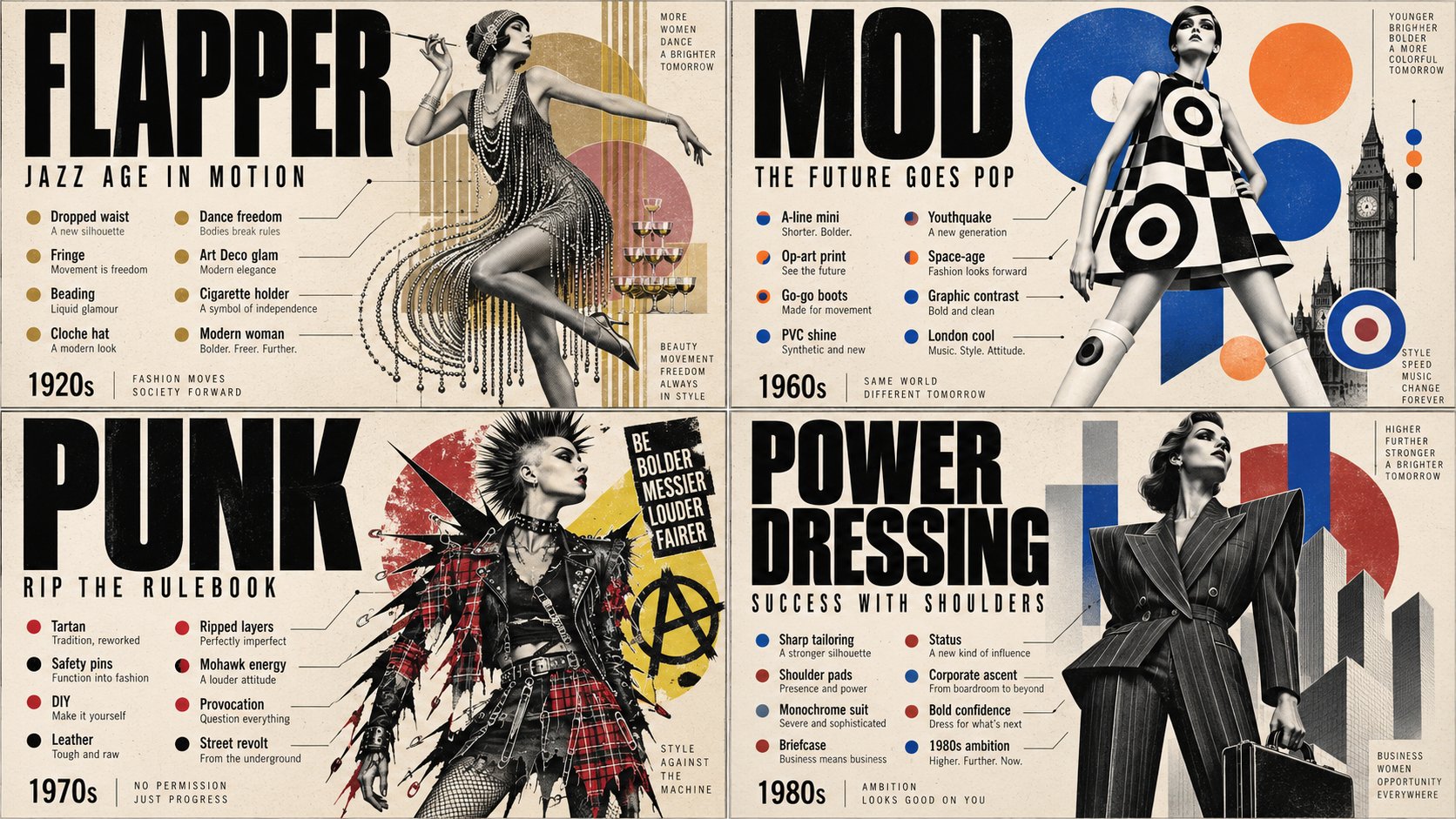
2x2 grird, do this for 4 fashion movement of various decades, 16:9 class EditorialPoster:     def __ — AI image prompt — GPT Image 2.5
OpenAIGPT Image 2.5
2x2 grird, do this for 4 fashion movement of various decades, 16:9 class EditorialPoster: def __init__(self, topic): self.topic = topic self.resolution = self.resolve_auto_fields(topic) def resolve_auto_fields(self, topic): # Module 2: Copy & Facts self.title = generate_title(topic, max_words=5) self.tagline = generate_tagline(topic, min_words=3, max_words=8) self.labels = extract_key_points(topic, count=6-12, relationship="components") # principles/stages/types # Module 3: The Surreal Character Engine self.mechanism = infer_verb(topic) # e.g., "filtering", "branching", "accumulating" self.base_form = select_organism(self.mechanism) # human, animal, or object # CRITICAL: Transformation must be structural, not just accessories self.transformation = invent_structural_alteration(self.base_form, self.mechanism) self.pose = select_pose(topic, attitude="intriguing_uncanny") # Module 5: Geometry & Palette self.geometry = select_geometric_family(topic) # rays, arcs, ribbons, grids self.palette = derive_accent_colors(topic, count=2-6, mood="flat_matte_weathered") def verify_character_logic(self): # The "Thumbnail & Concept" Check assert is_structural(self.transformation), "Module 3: Must be anatomy/proportion, not accessories." assert fits_sentence(self.transformation, self.mechanism), "Module 3: Logic check failed." assert visible_at_thumbnail(self.transformation), "Module 3: Must read at small scale." assert not is_generic_cute_scary(self.pose), "Module 3: Avoid default emotional tropes." def render(self): self.verify_character_logic() # Module 1 & 6: Style Kernel canvas = Canvas(aspect="1:1", bg="warm_ivory", texture="subtle_analog_grain") # Hero: Grayscale, sculptural shading, stippling/halftone hero = render_grayscale_sculptural(self.base_form, self.transformation, self.pose, shading="fine_stippling", texture="tactile_print") # Module 4: Adaptive Layout layout = adaptive_composition( hero=hero, title=self.title, # Oversized, black, condensed, uppercase labels=self.labels, # Compact, high contrast geometry=self.geometry, # Connects hero to info palette=self.palette # Flat, matte accents ) return canvas.compose(layout, typography="extreme_contrast_hierarchy") EditorialPoster($ TOPIC).render()
Details
Browse all GPT Image 2.5 promptsExplore AI Image Prompts