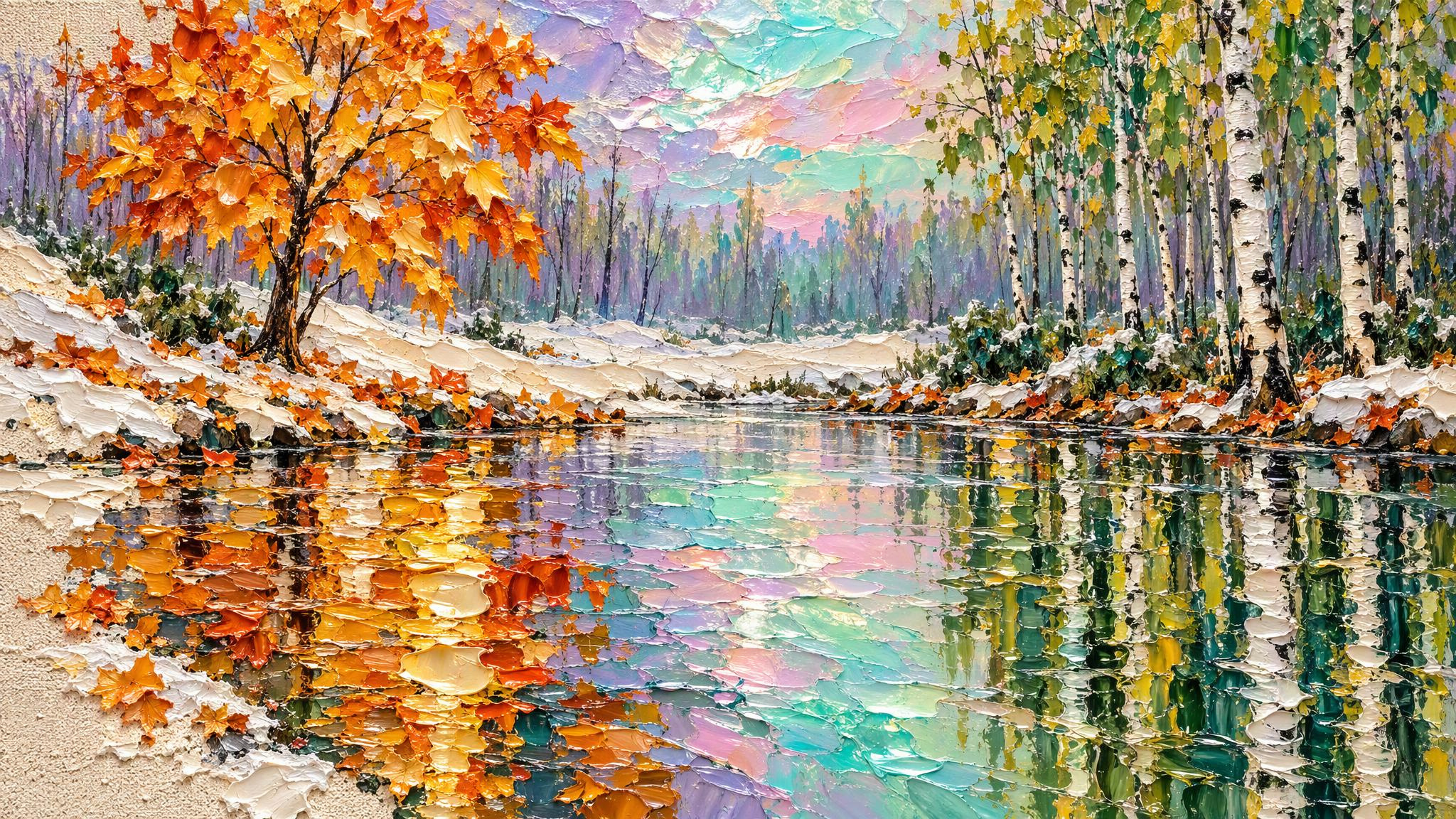
Impasto Autumn Lake Texture Painting
 GPT Image 2.5OpenAIimage
Extremely thick impasto oil painting on rough grainy ground, sculptural palette-knife paint standing up in real three-dimensional petals and slabs, wide 16:9 panoramic composition. Edge to edge, no frame, no border. SKY: a luminous iridescent sky fills the upper middle, washed in soft pastel lavender, mint green, pale turquoise, blush pink and peach, shimmering like mother-of-pearl and crinkled foil. Behind it, distant slender tree trunks fade into a pale violet and green haze. LEFT: the hero, one young maple tree in brilliant golden-orange, its leaves raised into thick knife-petals of amber, ochre, burnt orange and pale yellow, each leaf a sculpted curl catching light, thin dark branches rising from a narrow trunk. RIGHT: a stand of slender birches, white trunks marked with rough black dashes, crowned with small green and yellow leaves in crisp short dabs, rising to the top edge. MIDDLE: a pale bank of drifted snow and cream ground runs between the trees, cracked into heavy ridges, with low green shrubs and dry orange leaves lying along the waterline. WATER: the bottom half is a still flooded surface reflecting everything above in broken marbled bands — slabs of gold, amber and white for the maple, long vertical green and white streaks for the birches, and a wide band of iridescent mint, pink and turquoise at the centre. The reflections lie as separate thick paint slabs, each edged with a bright rim. GROUND: bare areas of unpainted canvas show as pale cream, coarse and grainy, scattering the lower corners and left edge with heavy texture. PALETTE: golden amber, burnt orange, ivory cream, pale mint, turquoise, blush pink, soft violet, deep green, black. Heavy tactile ridges, glossy thick paint, clean and unmarked.
Details
- Type
- AI Image Prompts
- Aspect Ratio
- 16:9
- Updated
- Oct 17, 2026
Category
How to use this prompt
- 1Copy the full prompt with the copy button above.
- 2Open GPT Image 2.5 by OpenAI, or any image generator with a similar style range.
- 3Paste the prompt, then swap the subject and style keywords to match your idea.
- 4Match the example's settings (16:9 · Oil Painting · Nature · Landscape), then iterate — small wording changes shift the output a lot.
Frequently asked questions
Which AI model generated this image?
This image was generated with GPT Image 2.5 by OpenAI. The prompt on this page is the exact text used to create it.
What settings does this prompt use?
The example was generated with GPT Image 2.5 using: 16:9 · Oil Painting · Nature · Landscape. Reusing these settings gives the closest match.
How do I get similar results?
Copy the prompt as-is first, then replace only the subject while keeping the style, lighting, and composition keywords. Generate a few variations — outputs differ between runs.
Can I modify this prompt?
Yes. Prompts work best as starting points — adjust descriptors, aspect ratio, or style tags to make the output your own.