Daocheng Yading Alpine Lake Landscape
 GPT Image 2.5OpenAIimage
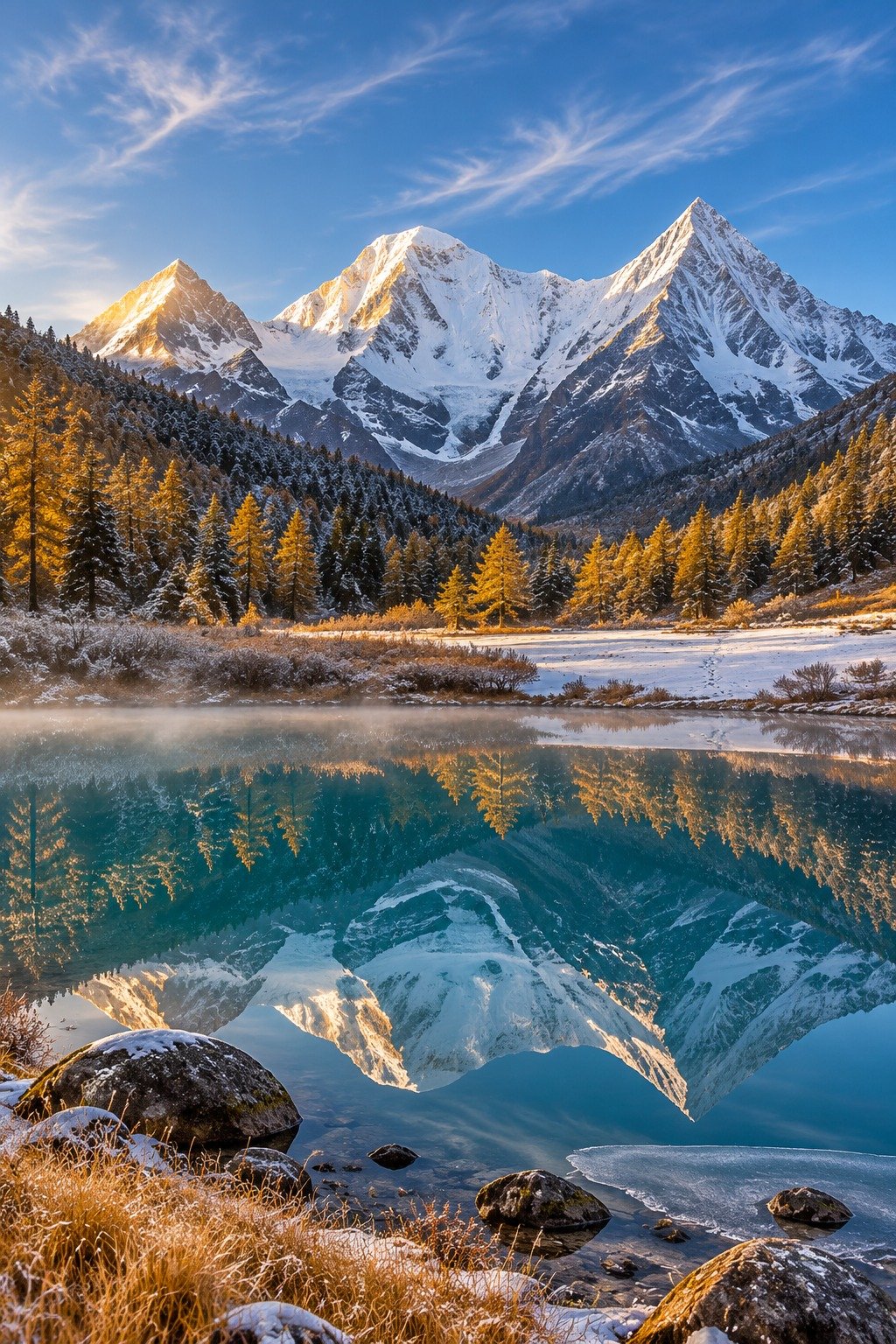
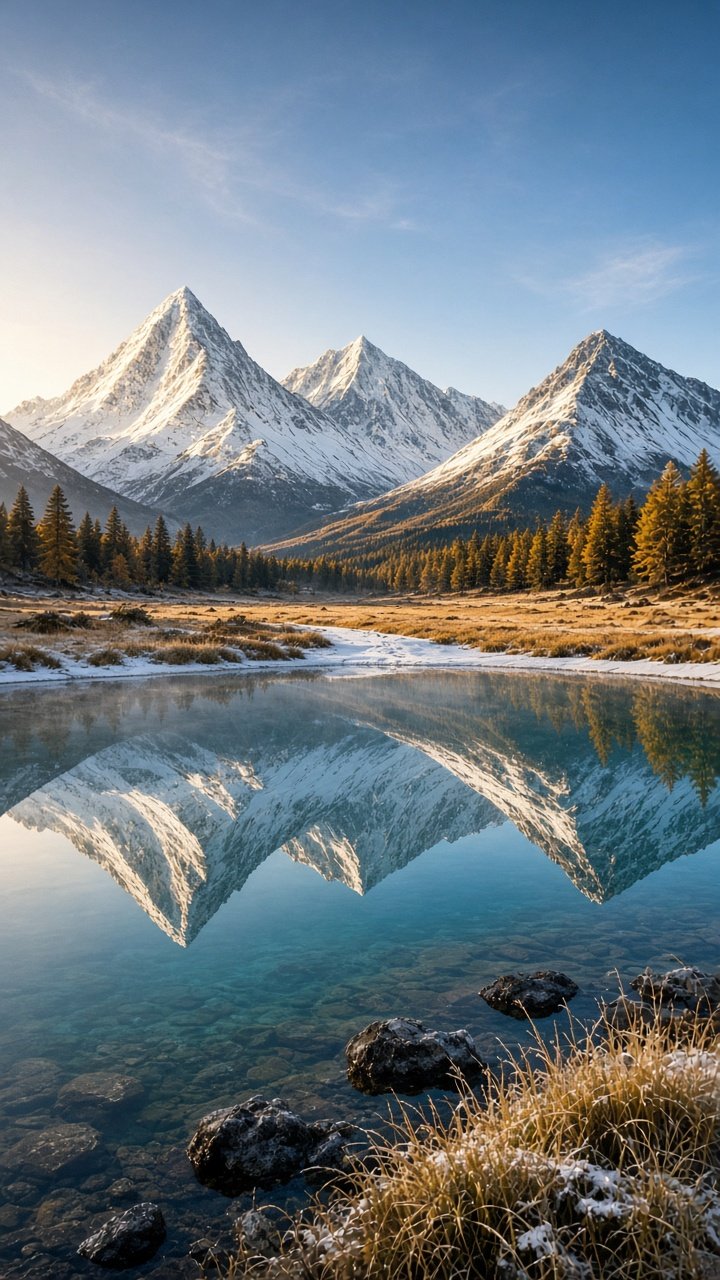
Breathtaking high-altitude landscape photograph of Daocheng Yading in early November, where late autumn meets the first snow on the eastern edge of the Tibetan Plateau in Sichuan. Environment: a still turquoise alpine lake at around 4,000 meters, ringed by golden autumn meadows and snow-dusted larch and pine, under a clear, thin high-altitude sky in the early morning. Subject details: the glassy lake fills the lower third and mirrors the snow-capped sacred peaks behind it with near-perfect symmetry; a scattering of dark wet boulders and a fringe of frost-touched golden grass anchor the near shore; a thin skin of ice edges the lake where shadow lingers, and a single trail of footprints crosses a small snow patch on the far bank. Atmosphere particles: faint mist drifting off the water, fine snow crystals glinting in the first sunlight, and thin high clouds streaking the blue sky. Light: low warm morning sun at 3800K striking the peaks from the left, casting long cool-blue shadows across the meadow, with warm gold and cold blue in direct contrast. Background layers: near shore and lake in the foreground, golden meadow and dark forest in the middle ground, three towering snow peaks and pale sky in the far distance. Camera: low viewpoint at the lakeshore, 24mm wide-angle lens, f/11, deep depth of field, vertical 9:16 composition on the rule of thirds, the reflection centered and undistorted. Color: Eastmancolor film look, restrained natural saturation, subtle film grain, crisp high-altitude clarity. Mood: silent, vast, and sacred. Photorealistic landscape photography, ultra-detailed, high resolution. No people, No buildings, No text, No watermark, No oil painting, No anime, No 3D render, No oversaturation, No deformed reflections.
Details
- Type
- AI Image Prompts
- Aspect Ratio
- 2:3
- Updated
- Nov 5, 2026
How to use this prompt
- 1Copy the full prompt with the copy button above.
- 2Open GPT Image 2.5 by OpenAI, or any image generator with a similar style range.
- 3Paste the prompt, then swap the subject and style keywords to match your idea.
- 4Match the example's settings (2:3 · Nature · Realistic · Landscape), then iterate — small wording changes shift the output a lot.
Frequently asked questions
Which AI model generated this image?
This image was generated with GPT Image 2.5 by OpenAI. The prompt on this page is the exact text used to create it.
What settings does this prompt use?
The example was generated with GPT Image 2.5 using: 2:3 · Nature · Realistic · Landscape. Reusing these settings gives the closest match.
How do I get similar results?
Copy the prompt as-is first, then replace only the subject while keeping the style, lighting, and composition keywords. Generate a few variations — outputs differ between runs.
Can I modify this prompt?
Yes. Prompts work best as starting points — adjust descriptors, aspect ratio, or style tags to make the output your own.