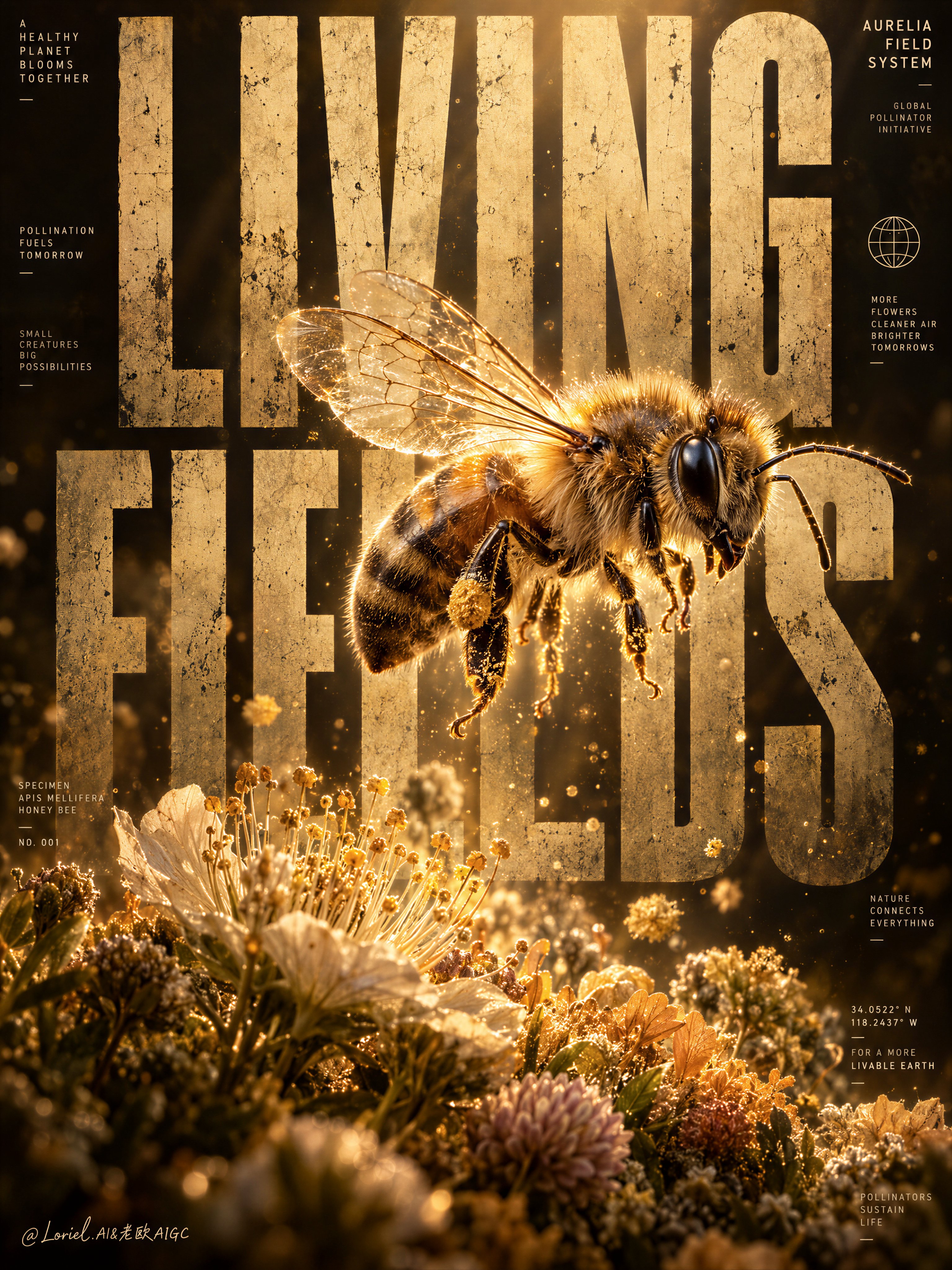
Monumental Bee Ecological Campaign Poster
 GPT Image 2.5OpenAIimage
Create the definitive Orbit + Transit + Port final poster for the fictional international ecological design campaign AURELIA FIELD SYSTEM. Preserve the exact editorial architecture of the reference, but refine it into a sharper, rarer, more collectible campaign key visual with stronger bee centrality, stricter typography hierarchy, cleaner scientific micro-system, and more sacred atmospheric depth. Keep the same essential structure: one monumental macro bee suspended mid-flight near the center-right, giant distressed block typography occupying most of the poster height behind and around the insect, a dense glowing flora mass in the lower field, floating pollen and particulate atmosphere throughout, and a restrained system of tiny scientific-editorial markers along the edges. The final result must feel like a museum-grade biodiversity manifesto and a premium environmental campaign where the bee is the unquestioned hero. The composition must be vertical, severe, and instantly readable from a distance. One massive oversized English word system in tall weathered condensed letters fills almost the entire poster surface, acting as architectural structure rather than simple title. The wording must be entirely newly invented in English only, built from one or two commanding concepts related to pollination, field intelligence, survival, or living systems, without copying the source text. The letters must feel mineral, worn, dusty, and deeply integrated into the atmosphere, with the bee and lower vegetation cutting across them to create strong spatial layering. The typography reads first as mass, second as language. The absolute hero is one extraordinary honeybee rendered in extreme macro photorealism, suspended in a believable mid-flight state at the center-right of the composition. It must dominate the emotional read through anatomical precision, luminous wing transparency, tactile thorax fur, and exact body structure. Treat the bee as a sacred protagonist, not an insect specimen. Show dense golden-brown body hair, striped abdomen, finely articulated legs, realistic antennae, translucent veined wings catching warm backlight, and a polished dark compound eye with sharp reflection. The flight pose should suggest hovering arrival above the plants, with the legs naturally suspended and the body slightly angled. The bee must feel biologically exact, reverent, and irreplaceable. The lower third of the frame must become a glowing ecological ground mass: dense pollen-rich blossoms, illuminated seed heads, textured moss-like clusters, wildflower structures, and botanical forms with strong tactile specificity. It should read like a micro-landscape of nourishment and ecological interdependence rather than a decorative meadow. The plants must be lit with warm ember-like light, with select pollen filaments and bloom textures catching glow so the lower field feels alive and precious. This flora mass supports the bee, but the bee remains dominant. The environment is a dark amber atmospheric stage rather than an open natural scene. Use deep black-brown, umber, and shadowed field darkness as the dominant background, cut by warm shafts of late light and filled with suspended pollen, microscopic dust, drifting particles, and subtle organic haze. The upper half must remain spacious enough for the giant typography wall and the bee silhouette to read clearly. The image should feel half natural history study, half prestige cinematic worship. Typography beyond the giant title must be extremely restrained and fully re-authored in English only. Add a minimal editorial field system along the edges: one or two micro specimen labels, a tiny numeric marker, one coordinate-style or archive-style notation, and a short conservation-minded line, all subtle and secondary. These details must feel like high-end field-journal design, never clutter. Keep the bee, title mass, and ecological glow as the dominant read. Lighting is the emotional engine and must be exceptionally controlled. Use powerful golden backlight and warm side-raking light so the bee’s wings glow translucent, thorax fur sparkles with microscopic detail, and the floating pollen ignites in the air. The lower flora mass should receive dense amber highlights while the upper background falls into expensive darkness. The contrast must be sharp but clean: no muddy blacks, no dirty haze, no blown highlights. The whole image should feel radiant, devotional, and mythic while remaining photoreal. Use a disciplined 60/30/10 palette hierarchy: 60% deep black, umber, and shadowed earth atmosphere, 30% golden amber, honey, and sunlit ochre across the bee and typography, 10% pale cream pollen glow and delicate botanical highlight accents. The palette must feel ecological, luxurious, and immediately iconic. Material semantics are critical. The bee must feel anatomically real and microscopically tactile. The wings must feel thin, glasslike, and structurally veined. The flora must feel pollen-heavy, living, and textural. The typography must feel printed, worn, and embedded into the poster surface. The atmosphere must feel dusty with living particles. Every element must reinforce that this is a premium environmental campaign about the silent intelligence, fragility, and planetary importance of pollinators. Orbit priority: maximize first-glance impact through the trinity of giant typography wall, luminous mid-air bee, and glowing particle atmosphere. Transit
Details
- Type
- AI Image Prompts
- Aspect Ratio
- 3071:4096
- Updated
- Sep 29, 2026
How to use this prompt
- 1Copy the full prompt with the copy button above.
- 2Open GPT Image 2.5 by OpenAI, or any image generator with a similar style range.
- 3Paste the prompt, then swap the subject and style keywords to match your idea.
- 4Match the example's settings (3071:4096 · Nature · Surreal · Poster), then iterate — small wording changes shift the output a lot.
Frequently asked questions
Which AI model generated this image?
This image was generated with GPT Image 2.5 by OpenAI. The prompt on this page is the exact text used to create it.
What settings does this prompt use?
The example was generated with GPT Image 2.5 using: 3071:4096 · Nature · Surreal · Poster. Reusing these settings gives the closest match.
How do I get similar results?
Copy the prompt as-is first, then replace only the subject while keeping the style, lighting, and composition keywords. Generate a few variations — outputs differ between runs.
Can I modify this prompt?
Yes. Prompts work best as starting points — adjust descriptors, aspect ratio, or style tags to make the output your own.
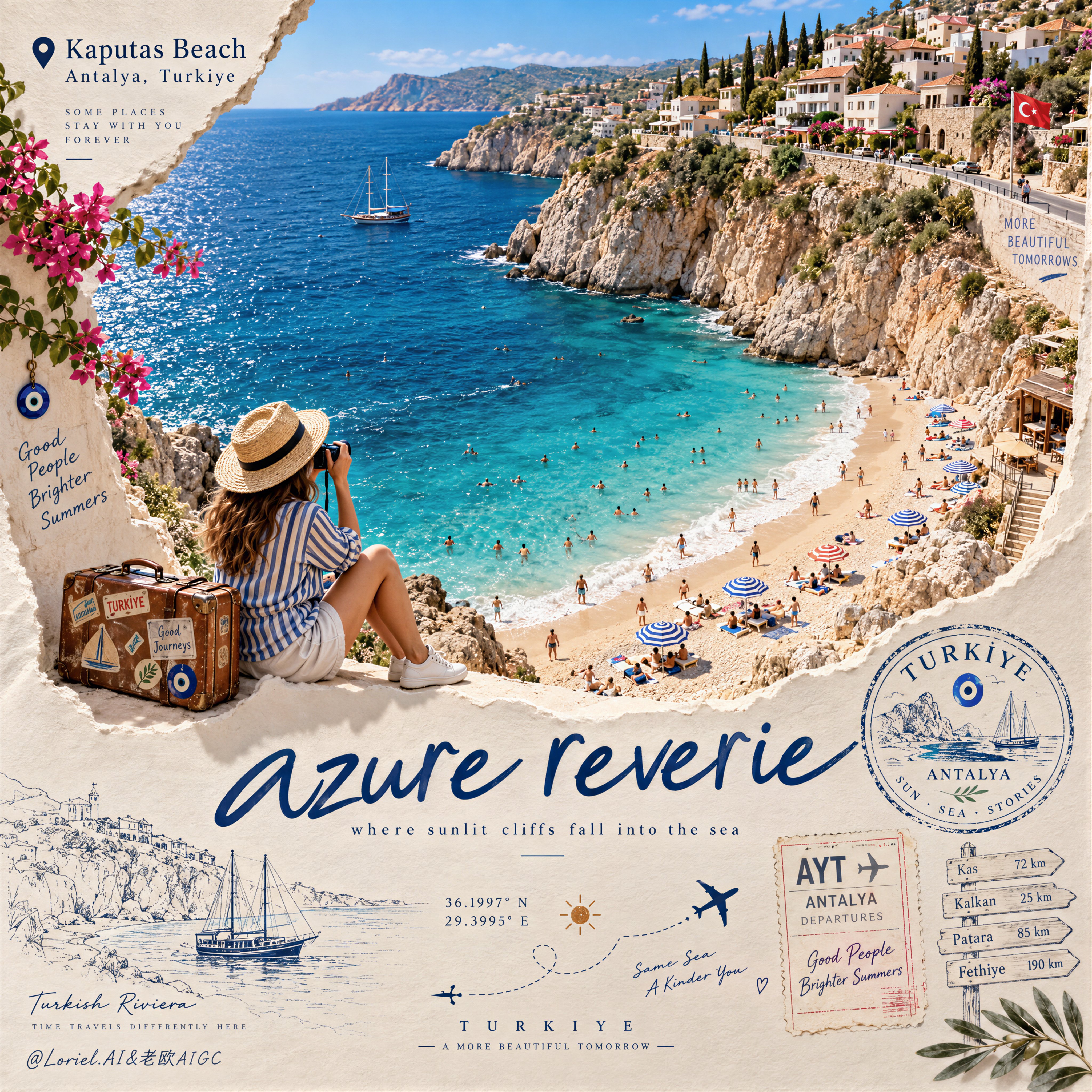
![Create a premium vertical 4:5 editorial travel poster for [COUNTRY], where the outline of the countr — AI image prompt — GPT Image 2.5](https://cdn.ahaprompt.app/harvest-media/import-1789369064970-j9jipe.jpg)
![Create a sophisticated, dreamy editorial magazine cover titled “[COUNTRY NAME] — A COUNTRY IN ONE DR — AI image prompt — GPT Image 2.5](https://cdn.ahaprompt.app/harvest-media/import-1789368946131-xefjx1.jpg)
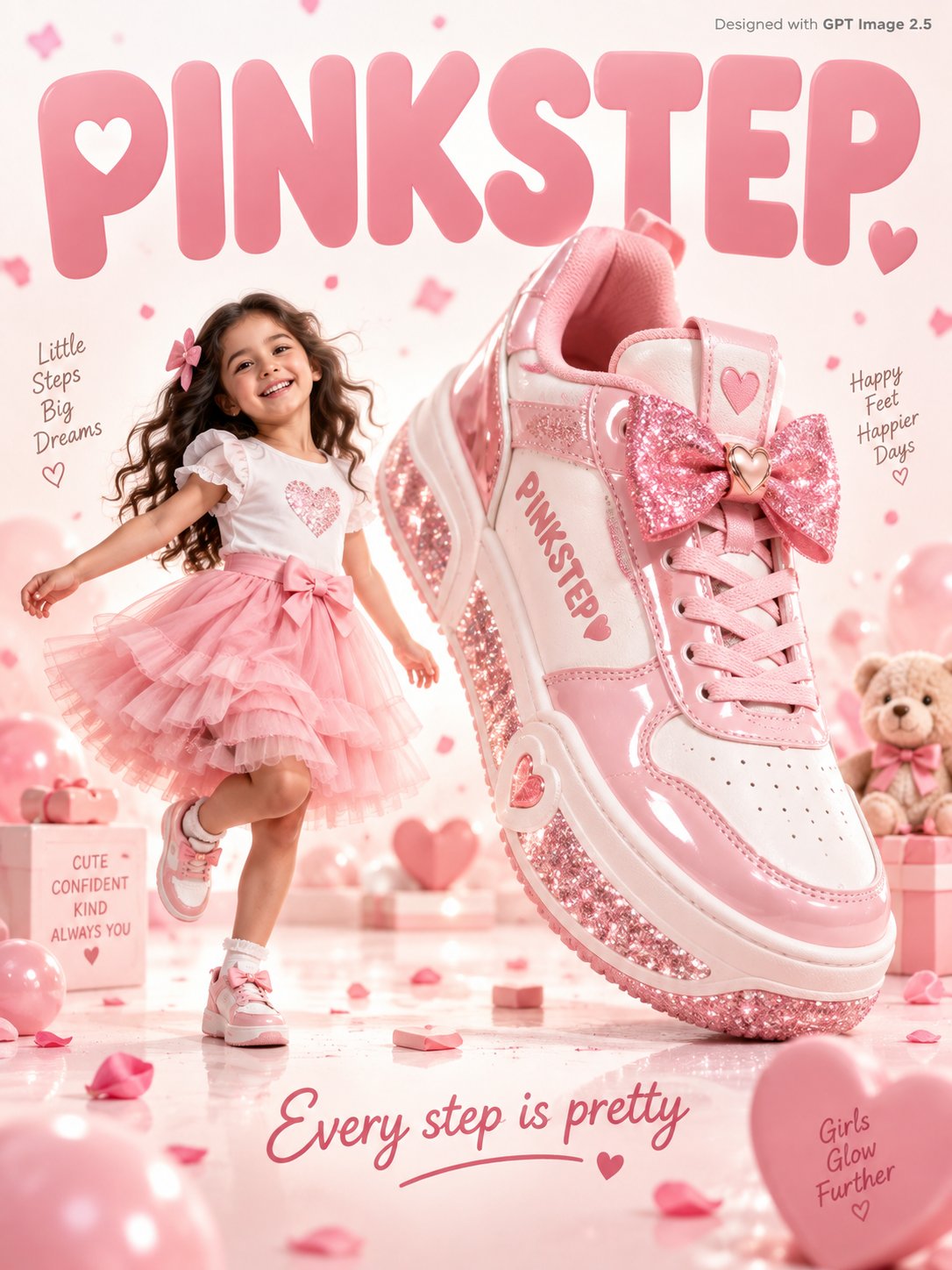
![Create a premium educational travel poster featuring [STRUCTURE NAME], one of the world’s most famou — AI image prompt — GPT Image 2.5](https://cdn.ahaprompt.app/harvest-media/import-1789369131185-x1iuzs.jpg)
![Create a premium cinematic luxury tourism poster for [COUNTRY / DESTINATION] in a STRICT 4:5 vertica — AI image prompt — GPT Image 2.5](https://cdn.ahaprompt.app/harvest-media/import-1789369001673-dctuvc.jpg)
![Create a premium contemporary editorial art poster for [LOCATION] in a playful Japanese design-ZINE — AI image prompt — GPT Image 2.5](https://cdn.ahaprompt.app/harvest-media/import-1789139846025-v6z310.jpg)
![2x2 grid, 9:16, 4 goat chess players who passed away [SUBJECT] :: single standalone vertical tribute — AI image prompt — GPT Image 2.5](https://cdn.ahaprompt.app/harvest-media/import-1789139801507-ah2jvt.jpg)